Exploration Licences Grant Access to Prospective Gold Area in Western Australia
The Western Australian Department of Mines has granted three exploration licences covering a total area of 201 square kilometres, offering new opportunities for gold exploration in the Gascoyne region. These licences, E09/2986, E09/2987, and E09/2988, are part of Western Yilgarn’s (ASX:WYX) Gascoyne gold projects. The company has identified seven priority target zones, each with varying sizes, within the newly acquired tenements.
The Gascoyne gold projects represent an early-stage exploration opportunity with significant potential for district-scale discoveries. This is due to the geological similarities between the newly licensed areas and the nearby Glenburgh gold district, which is operated by Benz Mining Corp (ASX:BNZ). The geophysical signatures used to define these targets closely resemble those that have successfully identified gold mineralisation at Glenburgh, which currently holds a resource of 510,000 ounces of gold.
Geology and Strategic Location
The licences are situated near the Glenburgh project, which is known for its extensive gold system that stretches over 50 km in strike length. The tenements granted to Western Yilgarn share the same host lithologies as the Glenburgh project—specifically metamorphic rocks of the Dalgaringa Supersuite. These rock formations are highly prospective for gold mineralisation and have been shown to host significant deposits in the region.
Western Yilgarn’s non-executive director, Pedro Kastellorizos, expressed enthusiasm about the new licences, stating that they offer the potential to delineate gold resources comparable to those found at Glenburgh. He highlighted the proximity of the new tenements to the established gold system and the geological equivalence between the two areas.
Identification of Drill Targets
Core Geophysics was commissioned in August to review historical airborne magnetic, radiometric, and gravity data. This analysis aimed to identify any characteristic geophysical signatures that could be indicative of gold mineralisation. The results of this high-level interpretation have led to the identification of multiple new drill targets.
Importantly, extensive structural and magnetic trends have been outlined across the project area, all of which remain untested by drilling within the Dalgaringa Supersuite. These trends are considered highly promising, as they align with geological features observed at Glenburgh.
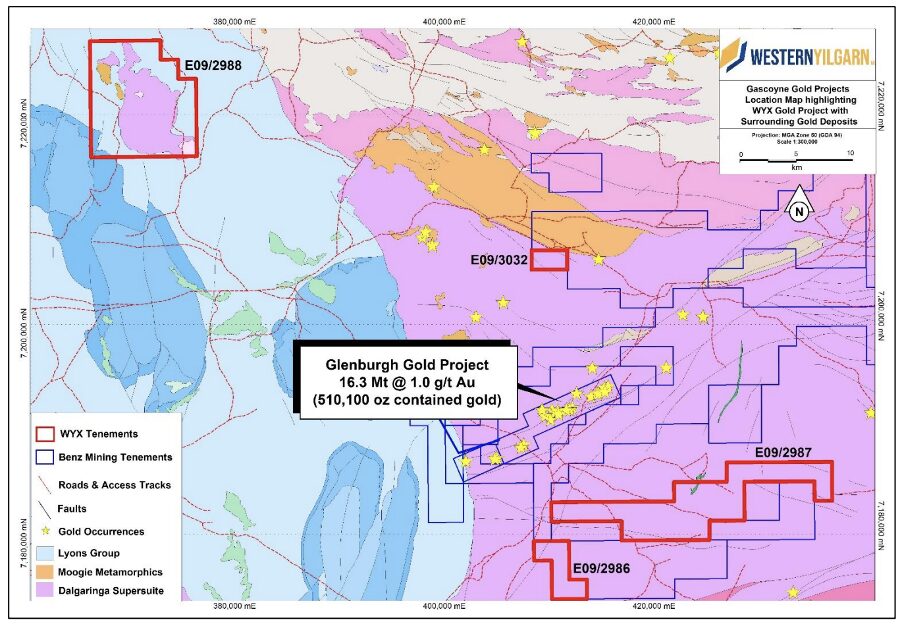
The E09/2986 and E09/2987 licences cover areas with abundant structural gold targets. These areas are part of the same rock-type package that hosts the 16.3Mt resource at Glenburgh, containing 1.0 g/t Au, equivalent to 510,000oz of gold.
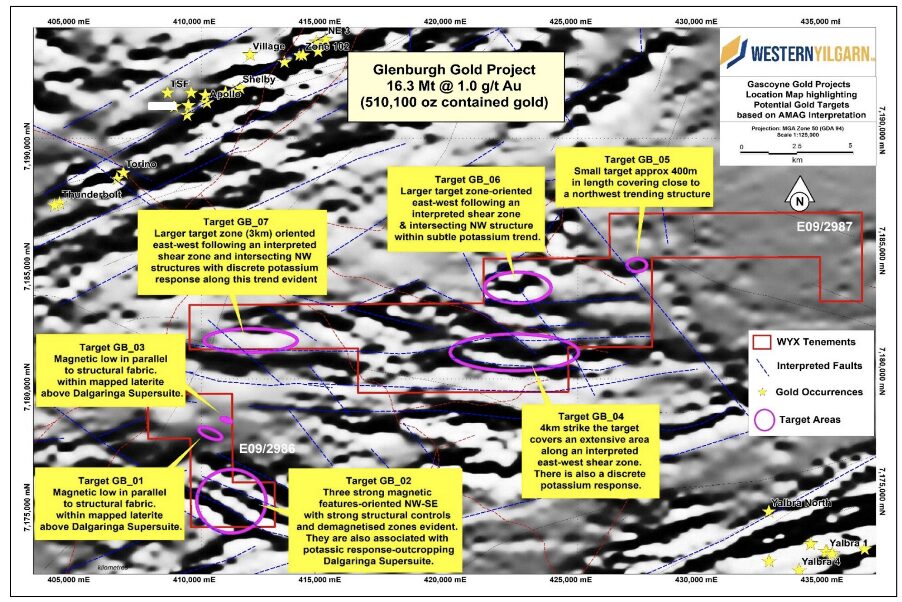
The zones of interest within the eastern tenements were selected based on proximity to interpreted shear structures or faults. These structures are located within magnetic lows associated with potassium responses, similar to those seen in Glenburgh deposits. Elevated geochemical values further support the potential for gold mineralisation in these areas.
Underexplored but Highly Prospective
Exploration in the Gascoyne region has been ongoing since the 1990s, with initial discoveries made by Helix Resources. Since then, various companies have conducted work in the area, contributing to the growing understanding of the region’s geological potential.
Recent exploration and drilling activities, particularly by Benz Mining Corp, have positioned Glenburgh as an emerging frontier gold district. This area is now being viewed as having multi-million-ounce potential, with both bulk tonnage and high-grade gold targets.
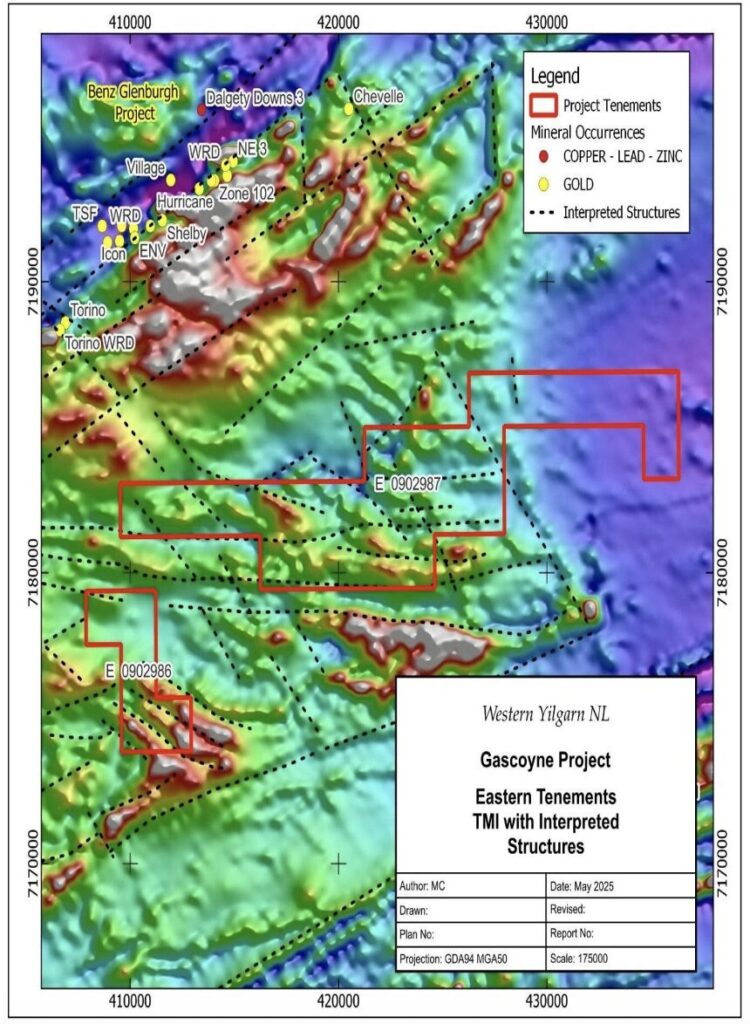
Western Yilgarn’s acquisition of these exploration licences marks a significant step forward in its strategy to explore and develop gold resources in one of Western Australia’s most promising regions. With the right exploration efforts, the company may uncover new gold deposits that could rival those already established in the Glenburgh district.
This article was developed in collaboration with Western Yilgarn, a advertiser at the time of publishing. This article does not constitute financial product advice. You should consider obtaining independent advice before making any financial decisions.