
Generational Divide Revealed in South Korean AI Perceptions
A recent study has illuminated a significant generational divide in how South Korean consumers perceive and anticipate the impact of artificial intelligence (AI). While younger demographics, particularly teenagers and those in their twenties, exhibit a relatively lower set of expectations regarding AI’s efficacy and benefits, older generations, specifically those in their forties through sixties, have demonstrated a more optimistic outlook on the integration of AI technologies.
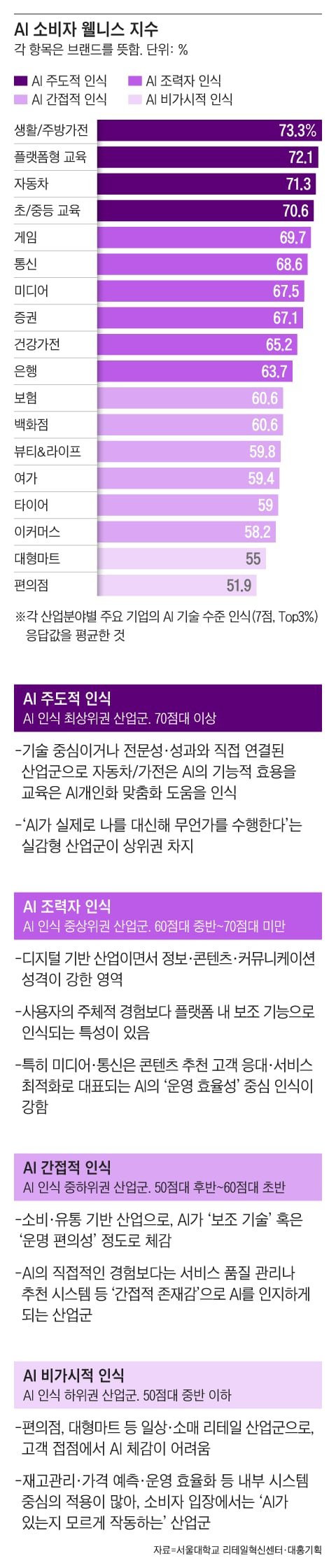
This nuanced understanding of consumer sentiment towards AI has been quantified through the development of the ‘AI Consumer Wellness Index (AIWI)’. This collaborative project, spearheaded by Daehong Planning in conjunction with the Retail Innovation Center affiliated with Seoul National University’s College of Human Ecology, aims to gauge the acceptance levels of AI technology among Korean consumers and their associated life satisfaction. The index is meticulously calculated by synthesizing four core components: positive emotions, negative emotions, self-actualization, and ethical awareness.
The initial findings from this comprehensive research indicate that the AI Consumer Wellness Index for South Koreans stands at 62.8 out of a possible 100 points. A representative from Daehong Planning emphasized the strategic importance of this benchmark, stating, “We plan to systematically track changes in Koreans’ AI acceptance levels periodically using this index as a benchmark.” This commitment suggests a long-term vision for understanding and responding to evolving consumer attitudes.
Widespread Interest, Divergent Preferences
The survey also delved into consumers’ general interest in AI and their perceived benefits derived from its adoption. Notably, a significant majority of respondents, precisely 60.4%, reported a high level of interest in AI, underscoring that more than half of the surveyed consumers are actively engaged with or curious about this transformative technology.
However, the generational differences in perception become starkly apparent when examining specific preferences. For instance, when asked about their inclination towards products or services offered by companies utilizing AI technology, only 43.2% of teenagers expressed a preference. This figure climbs substantially among older demographics, reaching 56.6% for those in their fifties and an even more impressive 61.5% for individuals in their sixties.
Understanding the Disconnect
This discernible trend is being interpreted by researchers as a reflection of younger generations’ deep immersion in the digital landscape. For them, AI may be perceived less as a groundbreaking innovation and more as a natural, albeit advanced, extension of existing technological frameworks. Consequently, they might not readily discern a unique or differentiated value proposition compared to the more established digital tools they are accustomed to.
In contrast, the middle-aged and older cohorts appear to exhibit a greater appreciation for AI’s distinct contributions. This appreciation extends to their engagement behaviors. The proportion of respondents who actively seek information about AI and express interest in its various services was notably higher among those in their fifties (61.9%) and sixties (62.3%) when compared to their younger counterparts, the teens (59.7%) and those in their twenties (55.8%).
Strategic Implications for Brand Communication
Daehong Planning has highlighted the critical implications of these generational perception gaps for companies developing AI-centric brand communication strategies. The organization suggests that for younger demographics, such as teenagers and individuals in their twenties, marketing efforts should focus on articulating the novel experiences that AI can unlock, its capacity for delivering personalized value, and its potential to foster emotional satisfaction.
Kim Deok-hee, a representative from Daehong Planning, underscored the imperative for brands to adapt their strategies in light of these findings. “In an era where all citizens encounter AI in their daily lives, brand strategies must be based on objective indicators reflecting consumers’ trust and acceptance of AI,” she stated. “Strategic marketing communication utilizing the AI Consumer Wellness Index will be an opportunity to leap forward as an innovative AI-leading enterprise.” This sentiment points towards a future where data-driven insights, like those provided by the AIWI, will be instrumental in shaping successful AI brand narratives and fostering genuine consumer trust.