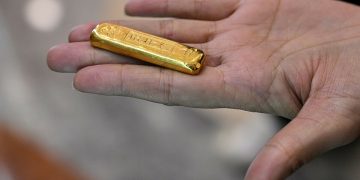


Gold Shatters Historic $5,000 Per Ounce Milestone Amid Global Uncertainty
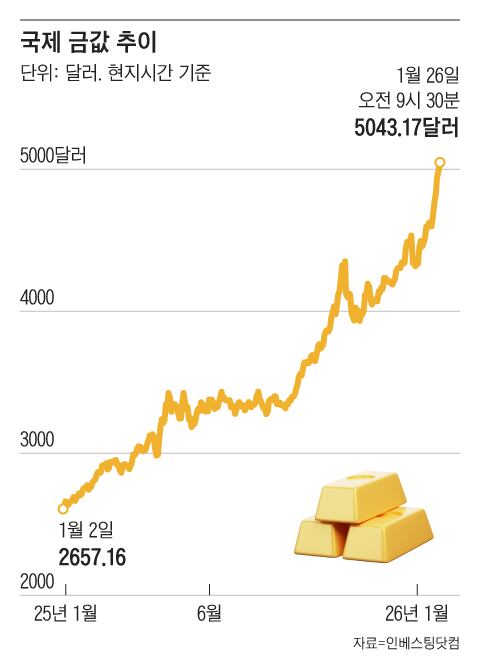
In a landmark moment for financial markets, international gold prices have surged past the $5,000 per ounce mark for the first time in history. This significant achievement underscores gold’s enduring status as a premier safe-haven asset. As reported from the New York Mercantile Exchange, the international spot gold price reached an unprecedented $5,019.85 per ounce on the 25th, marking a 0.75% increase from the preceding trading day and decisively breaching the $5,000 psychological barrier. This latest surge represents a remarkable $1,000 climb in just three months, following its ascent past the $4,000 threshold in October of the previous year.
The Price Tag of Global Uncertainty
Several interconnected factors are fueling this meteoric rise in gold’s valuation, solidifying its role as a barometer of global economic and political instability. Analysts widely attribute the current surge to a heightened sense of global uncertainty, largely driven by assertive actions from key global players. These actions have prompted a significant flow of capital into traditional safe-haven assets like gold.
For instance, recent geopolitical tensions, including threats of additional tariffs and interventions in financial policy, have been interpreted by global investors as potentially destabilizing to the dollar and U.S. Treasury bonds. This perception drives investors to seek refuge in gold, viewing it as a more secure alternative store of value.
Central Banks Pivot Towards Gold
Another pivotal driver of gold’s increasing appeal is the strategic shift observed among central banks worldwide. Over the past decade, as U.S. financial sanctions have become more prevalent, central banks have increasingly opted to purchase gold rather than dollars. Data from the World Gold Council indicates that global central banks have collectively acquired 368 tons of gold since the beginning of last year. Notably, countries that have experienced friction with the United States, such as Brazil (42 tons), China (26 tons), and Kazakhstan (49 tons), have been among the most substantial purchasers. This trend reflects a diversification of foreign reserves and a hedge against potential geopolitical risks associated with dollar dependency.
The Rise of Gold-Linked Financial Products
The proliferation of innovative gold-related financial instruments has also played a crucial role in amplifying demand. The emergence and growing popularity of gold exchange-traded funds (ETFs) and gold-backed stablecoins have created new avenues for investment in the precious metal. The value of these products is intrinsically linked to the price of physical gold. As expectations for further price appreciation mount, the scale and accessibility of these investment vehicles have expanded significantly.
A prime example is ‘Tether Gold,’ a prominent gold-backed stablecoin. According to CoinMarketCap, its market capitalization has seen a substantial increase, growing by 22% from $1.8 billion at the close of last year to $2.2 billion by the 26th. Furthermore, the World Gold Council reports that asset management firms managing gold ETFs held approximately 4,000 tons of gold, with a net purchase of around 800 tons in the past year alone. The momentum has continued into the current year, with an additional 56 tons net purchased in less than a month, including a significant 36 tons acquired in the most recent week.
South Korea Joins the Gold Rush
The global trend of increasing gold investment is also profoundly impacting South Korea, where the price of gold has now surpassed the 1 million Korean won mark per don (equivalent to 3.75 grams). This has led to a noticeable shift in capital allocation, with significant funds flowing into gold accounts, often referred to as gold banking, and gold ETFs.
Data from the banking sector reveals that as of the 23rd of this month, the combined balance of gold banking across major institutions like KB Kookmin, Shinhan, and Woori Bank has reached a substantial 2.1728 trillion Korean won. This figure represents a remarkable increase of over 1.3 trillion Korean won from the 813.7 billion Korean won recorded on January 23 of the previous year. This surge is largely attributed to increased volatility in stock and virtual asset markets, prompting investors to seek the stability offered by gold accounts.
The securities market has also witnessed substantial inflows into gold ETFs, with trillions of won being invested. Over the past year, approximately 400 billion Korean won has been net invested in the eight gold ETFs listed domestically. According to ETF Check, as of the 26th, the ‘ACE KTX Gold Spot’ ETF ranked seventh among all ETFs for the highest fund inflows over the preceding three months, having attracted 1.2304 trillion Korean won during that period.
The demand for physical gold has also seen a dramatic uptick. Last year, sales of gold bars by the five major commercial banks in South Korea amounted to 1.0354 trillion Korean won, a staggering 3.2-fold increase compared to the 321.7 billion Korean won recorded in the previous year.
Evolving Perceptions of Gold Investment
The rapid escalation in gold prices has also begun to reshape social customs and gifting practices. Traditional gifts of a one-don gold ring are increasingly being supplemented or replaced by smaller, more accessible items such as ultra-thin mini bars weighing just 1 gram and miniature gold spoons. This shift indicates a broader trend where gold is transitioning from primarily a decorative asset to one that is being purchased incrementally and as a tangible form of savings.
Future Outlook for Gold Prices
Market analysts and financial institutions are largely optimistic about the continued upward trajectory of gold prices. Goldman Sachs, a prominent investment bank, recently revised its gold price forecast upwards for the end of 2026, projecting it to reach $5,400 per ounce. This revised target represents an approximate 10% increase from their previous projection of $4,900. This adjustment reflects a strong conviction that robust demand for gold from both central banks and private sector investors is poised to persist, further bolstering the precious metal’s appeal in the coming years.