Orange Juice: Re-evaluating a Breakfast Staple
For years, orange juice has been a fixture on breakfast tables across Australia, a seemingly healthy way to kick-start the day. However, recent pronouncements have cast a shadow over this beloved beverage, with some experts likening its sugar content to that of a soft drink. This has led many to question whether we’re sacrificing significant health benefits by giving OJ the boot.
New research, published in the esteemed journal Molecular Nutrition & Food Research, suggests that orange juice might not be the villain it’s been made out to be. The study indicates that compounds within orange juice can actually suppress gene activity linked to inflammation. This has the potential to positively impact blood pressure and cholesterol levels, offering a compelling argument for its inclusion in a balanced diet, albeit with caveats.
The Case for Moderation: What Experts Advise
Before you rush to the fridge for a full glass, health professionals are urging a measured approach. Dietitian Maeve Hanan, founder of Dietetically Speaking, points out that participants in the aforementioned study consumed a substantial 500ml of juice daily – significantly more than the recommended 150ml serving.
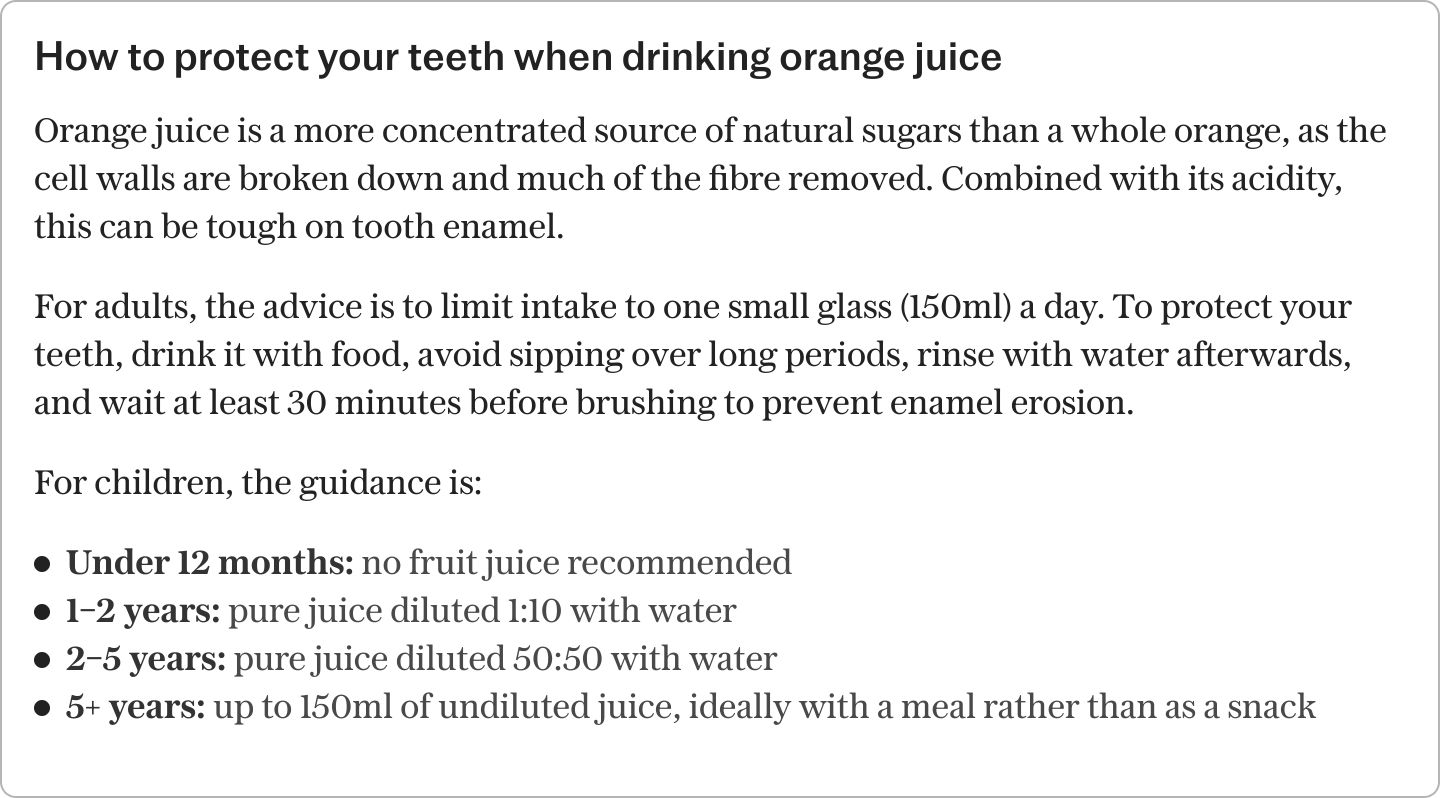
Hanan clarifies that “a small glass can absolutely be a nutritious addition to the diet.” However, she strongly discourages consuming half a litre a day, citing concerns about dental health and the cumulative effect of such a high sugar intake.
The Undeniable Benefits of a Small Serving
So, what exactly are the advantages of that modest 150ml glass? Hanan confirms that orange juice is an excellent source of hydration and is packed with vital nutrients like folate and potassium. Crucially, it counts towards your daily “five-a-day” fruit and vegetable intake.
But the headline health benefit remains its impressive vitamin C content. A mere 150ml of freshly squeezed juice can provide your entire recommended daily intake of this essential vitamin. Vitamin C is a powerful antioxidant that not only bolsters your immune system but also plays a crucial role in enhancing the absorption of nutrients from other foods. For instance, pairing orange juice with plant-based iron sources like beans and leafy greens can significantly boost your body’s ability to absorb iron.
Deciphering the Different Types of Orange Juice
The question then arises: does the type of orange juice you choose make a difference? Is the standard boxed variety sufficient, should you invest in freshly squeezed, or is it best to juice your own at home? Let’s break down the options.
Freshly Squeezed at Home
Juicing your own oranges, whether with a manual press or an electric machine, offers the freshest flavour. However, even this seemingly ideal option requires a degree of caution. While it might appear to be the healthiest choice, the juicing process liberates the fruit’s natural sugars from their cellular structure.
These sugars are classified as “free sugars,” meaning they are rapidly absorbed into the bloodstream, leading to blood sugar spikes. Over time, frequent and significant spikes can contribute to insulin resistance.
Despite this, freshly squeezed orange juice is naturally rich in the flavonoid hesperidin and other potent plant compounds that act as powerful antioxidants. These compounds help combat oxidative stress, a process where unstable molecules called free radicals can damage cells and tissues.
Furthermore, a recent study in the journal Advances in Nutrition found that consuming 100% orange juice demonstrably improves markers of inflammation and oxidative stress in adults.
The timing of consumption is also important. While freshly squeezed juice boasts the highest initial levels of vitamin C, this nutrient is susceptible to degradation when exposed to room temperature. Even when refrigerated, vitamin C levels can begin to decline significantly within 24 to 48 hours, potentially making it nutritionally similar to some store-bought options.
Supermarket Chiller Cabinet Juice (Not From Concentrate)
The “not from concentrate” (NFC) juices found in supermarket chiller cabinets offer a convenient and often more affordable alternative. The primary distinction from freshly squeezed juice is that NFC varieties undergo brief pasteurisation to ensure safety and extend shelf life. Despite this process, they generally retain most of their nutritional value, including vitamin C.
A perennial debate centres around fibre content: with pulp or smooth? While pulp does contain slightly more fibre, Hanan stresses that the difference is minimal. The amount of fibre in a small glass of orange juice, regardless of pulp, is “very low and far lower than eating an actual orange.” Ultimately, the choice between pulpy and smooth often comes down to personal preference.
Long-Life Carton Juice (From Concentrate)
The most budget-friendly option is typically the long-life carton juice, often labelled “from concentrate” (FC). These are produced by removing water from fresh juice to concentrate it for easier transport, with water being added back later. While this involves more processing, the nutritional profile of FC juice is often very similar to NFC options.
Importantly, any vitamins potentially lost during the initial concentration process are usually replenished when water is added back. Hanan acknowledges that FC juice can still be a nutritious choice, “especially when it’s a 100 per cent juice with no added sugar, even if the processing slightly lowers levels of certain nutrients such as vitamin C.” In essence, the more economical carton can offer comparable nutritional benefits to its pricier counterparts.
Orange-Flavoured Drinks: A Different Proposition
It’s crucial to distinguish genuine orange juice from “orange-flavoured drinks.” The latter, often packaged attractively and marketed towards children, may contain high levels of artificial sweeteners and flavourings with very little actual fruit juice.

Australian labelling regulations are strict. A “100% Juice” label guarantees purity and the absence of added sweeteners. Products labelled as “drink” or “nectar” are typically diluted and sweetened. Consumers are urged to scrutinise labels carefully, remembering that even pure juice is naturally high in sugars, hence the recommended 150ml daily limit. Many orange drinks boast of having no added sugar but may contain other additives to enhance palatability.
Speciality Juices: Exploring the Niche Market
Beyond the standard offerings, a growing array of speciality orange juices are available, often promoted for specific health advantages.
Cold-Pressed Juice: While fashionable and often commanding a higher price, cold-pressed juices are simply made without heat. Research indicates that both flash-pasteurised and cold-pressed juices retain over 90% of their original vitamin C and antioxidant content. The primary appeal of cold-pressed juice often lies in its flavour, as the extraction process can infuse more aromatic oils from the orange peel, resulting in a more intense taste rather than a significant nutritional superiority.
Blood Orange Juice: Beyond its striking colour, blood orange juice may offer a modest health boost. These varieties contain anthocyanins, red-pigmented antioxidants not found in standard oranges. However, sugar levels and vitamin C content are generally comparable to regular orange juice.
The Final Verdict on Orange Juice
While eating a whole orange remains the superior choice due to its significantly higher fibre content (around 3g compared to less than 0.5g in juice), both options can provide your daily recommended vitamin C intake.
If opting for juice, 100% orange juice can be a nutritious addition to your diet, provided consumption is kept within the recommended limits. Your healthiest bet is to juice your own oranges at home, ideally with the pulp included for that extra fibre. If time is a constraint, select a pure, unsweetened, not-from-concentrate version from the supermarket.
Ultimately, when faced with a choice between 100% orange juice and a sugary soft drink like cola, orange juice is the clear winner.