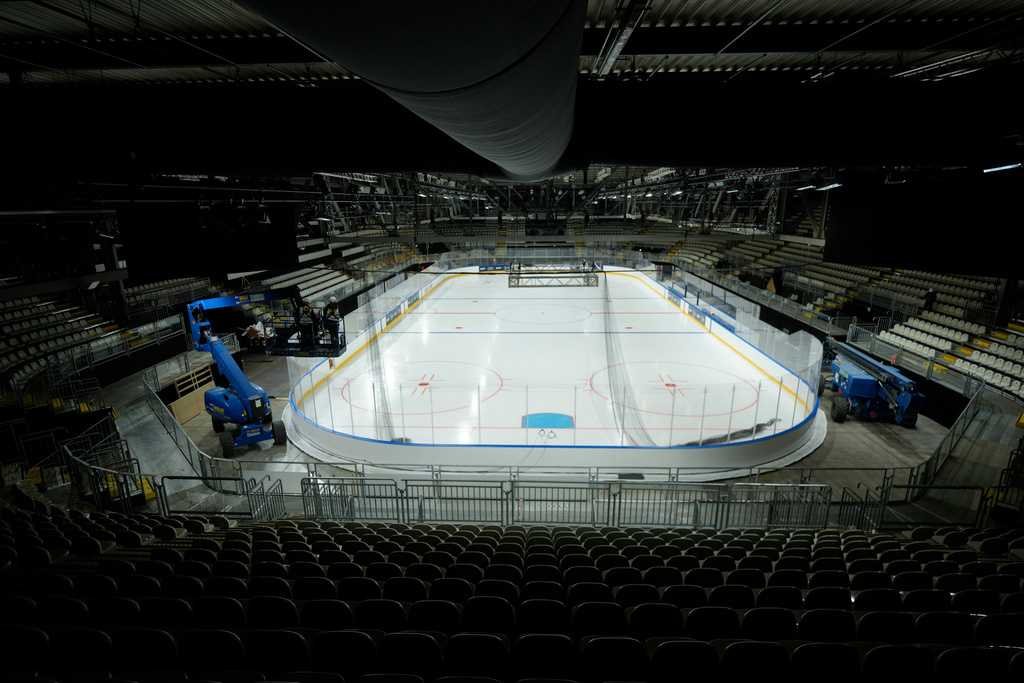
The 2026 Winter Olympics in Milan will feature hockey games played on ice surfaces that deviate slightly from the standard NHL dimensions, a detail that has sparked discussion among players, coaches, and hockey officials. This marks the return of NHL players to the Winter Olympics for the first time since 2014.
The Olympic Ice Dimensions
The men’s and women’s hockey competitions will be held in two arenas with rinks measuring 60 meters long by 26 meters wide (approximately 196.85 feet by 85.3 feet). While the width is marginally greater, the length is shorter than the standard NHL rink size of 200 feet by 85 feet (60.96 meters by 25.908 meters).
This isn’t unprecedented. The International Ice Hockey Federation (IIHF) has sanctioned rinks of this size, and they were even utilized for a pair of games between the Pittsburgh Penguins and Nashville Predators in Stockholm during November.
IIHF’s Stance
The IIHF has previously adopted NHL dimensions for Olympic hockey, starting in 2018 and continuing in 2022. The decision to use the slightly smaller ice surface in Milan has raised eyebrows, but the IIHF maintains that the difference is negligible.
In a statement, the federation asserted that the dimensions are consistent with IIHF regulations and align with the rink size used at the Beijing 2022 Olympic Winter Games. Furthermore, these dimensions meet the NHL’s requirements for its Global Series games. The IIHF, the Organizing Committee, NHL, NHLPA, IOC, and venue authorities are all in agreement that the variations in rink specifications are insignificant and won’t compromise player safety or the quality of play.
Historical Context
Olympic hockey has a history of using varying ice dimensions. In 1998, 2006, and 2014, games were played on international ice measuring 60 meters by 30 meters (196.85 feet by 98.4 feet), with a minor alteration in Salt Lake City in 2002. The Vancouver 2010 Olympics utilized NHL-sized ice due to the existing arena infrastructure.
Reactions from Hockey Personnel
While the IIHF downplays the significance of the size difference, some hockey figures have expressed their thoughts on the matter.
Jere Lehtinen (General Manager, Finland Men’s Hockey): “It’s the same for every team, and I think that’s the bottom line. Our coaches, maybe it’s more interesting and something you need to pay attention more.”
Doug Armstrong (General Manager, Canada): Armstrong initially raised the issue of the ice being slightly off from NHL regulation size in a podcast.
Peter DeBoer (Assistant Coach, Canada): DeBoer questioned why NHL-sized ice wasn’t being used on a radio show.
Arena Construction Concerns
The primary arena, the Santagiulia Ice Hockey Arena, a new 16,000-seat venue located on the outskirts of Milan, is facing construction delays. Organizers have acknowledged that there is “no plan B.” A test event was relocated to the Rho Ice Hockey Arena, and additional test events at the main venue are scheduled just weeks before the start of the Olympic tournament.
- Bruce Cassidy (Assistant Coach, Canada Men’s): “We’re aware that they’re behind schedule a little bit, but we’re all assuming that that’ll all be taken care of.”
Logistical Challenges
NHL Commissioner Gary Bettman has repeatedly voiced concerns regarding logistical challenges. During the league’s annual fall Board of Governors meeting, he stated that the league is constrained in what it can request or demand. He added that the IOC and IIHF have consistently assured the league that everything will be in order.
Olympic Hockey Schedule
The men’s Olympic hockey tournament is scheduled to take place from February 11-22, while the women’s tournament will be held from February 5-19.