Spanish Police Officer Under Fire After Brutal Shove of Protester
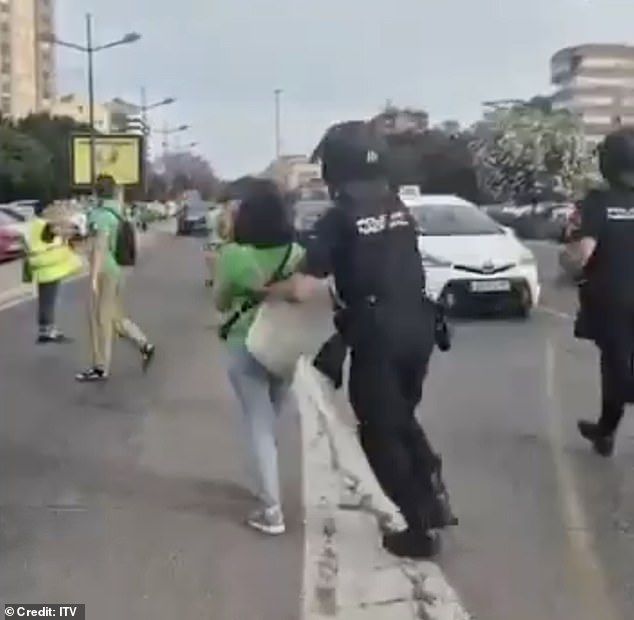
A shocking incident during a teachers’ protest in Valencia, Spain, has ignited widespread outrage after footage emerged showing a riot police officer forcefully shoving a 68-year-old former teacher to the ground from behind. The former educator sustained a broken nose and a cut to her chin as a result of the alleged unprovoked assault, prompting an immediate investigation by Valencian authorities.
The incident unfolded on Sunday as hundreds of teachers gathered outside the Ministry of Education in Valencia, participating in an ongoing indefinite strike that commenced on May 11. Their demands centre on improved working conditions, a movement described as the most significant education sector protest in the region since the 1980s.
Video footage captured the retired teacher, clad in a green t-shirt, walking peacefully amidst the demonstration. Without any apparent provocation, a riot police officer, identifiable by their helmet and dark uniform, is seen violently barging into the woman, sending her to the pavement.



Pilar Bernabe, the Valencian government delegate and secretary for equality for the left-wing PSOE party, unequivocally condemned the act, labelling it “unacceptable.” She assured the public that a “thorough investigation” would be conducted to “establish where responsibility lies.” Bernabe stressed the paramount importance of safeguarding the “right to protest safely,” adding that the incident “completely tarnishes the work carried out by the police over the past three weeks of demonstrations, which have been coordinated with the organising trade unions.”
Reports indicate that the injured former teacher has since filed a lawsuit against the officer involved. She received medical attention for her injuries at a local health centre on Sunday and was subsequently discharged.
This isolated event is not the sole point of tension during the ongoing protests. Earlier in the demonstrations, clashes escalated when police intervened to disperse a group of protesters who had threatened to block a major city thoroughfare, Avenida Pio XII. Later that evening, further unrest erupted as officers forcibly removed protesters from the Ministry’s steps while they attempted to stage a sit-in.
Widespread Disruption and Demands for Reform
The teachers’ strike has significantly disrupted educational institutions across Spain’s Valencia region. Unions claim that up to 90 per cent of public school classes were affected during a strike last month, though the regional Ministry of Education offered a lower figure of 47 per cent participation. Demonstrations have not been confined to Valencia; large crowds have also rallied in cities such as Alicante, Castellon, and Elche.
The core grievances expressed by teachers revolve around what they perceive as deteriorating working conditions and years of chronic underinvestment in the education sector. Union leaders are pushing for a comprehensive set of reforms, including:
- Reduced Administrative Workloads: Teachers are calling for a significant decrease in the bureaucratic tasks that detract from their teaching responsibilities.
- Smaller Class Sizes: A persistent issue highlighted is the overcrowding of classrooms, with many classes reportedly exceeding 30 pupils.
- Increased Support for Special Educational Needs: There is a demand for greater resources and personnel to assist students with additional learning requirements.
The Bitter Row Over Pay
A particularly contentious issue fuelling the industrial action is the matter of remuneration. Education officials have put forward a proposal for a phased salary increase, which, over three years, would see teachers receive an additional €75 per month.
However, this offer has been met with outright rejection by the unions. They argue that the proposed increase is woefully inadequate, failing to compensate for what they describe as two decades of declining real wages and a sustained erosion of teachers’ purchasing power. The ongoing dispute underscores a deep-seated dissatisfaction within the teaching profession regarding their compensation and the overall state of public education.