White Cliff Minerals Gears Up for Major Copper Drilling Campaign in Nunavut
White Cliff Minerals is on the cusp of launching an ambitious drilling program at its Rae Copper Project in Nunavut, Canada. The upcoming campaign is set to meticulously explore the significant potential of high-grade, surface-exposed copper mineralisation at the well-regarded Danvers prospect. This strategic initiative aims to comprehensively assess the sheer scale of the mineralisation, a crucial step in unlocking the project’s full value.
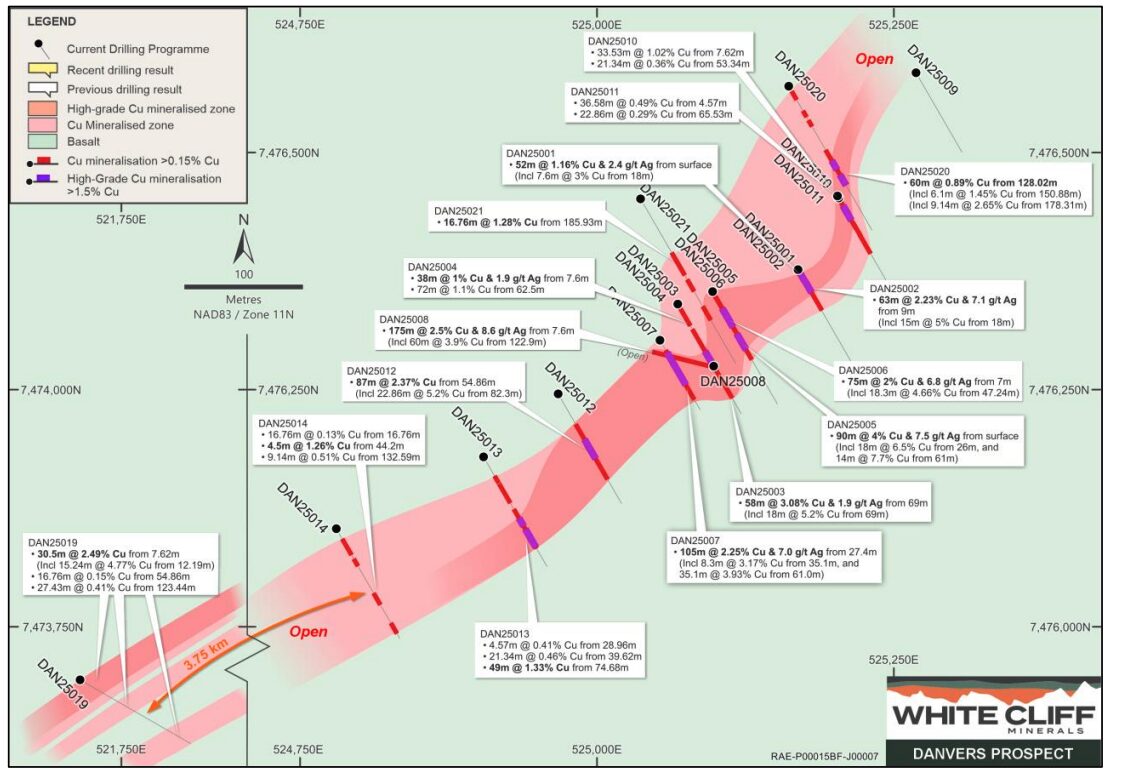
The initial phase of the drill program will focus on testing priority geological and geophysical targets, extending across an impressive strike length of over 8 kilometres. This extensive testing is designed to thoroughly investigate the mineralisation potential along the Teshierpi Fault Zone, a key geological feature. A critical objective will be to confirm and extend previously identified mineralisation, including the promising intersection of 15 metres grading 4.8% copper in drill hole DAN25019.
Following this initial phase, White Cliff Minerals will transition to diamond drilling. This phase will be specifically geared towards discovering a substantial sediment-hosted copper system within the Stark-Hulk sub-basin. This targeted approach underscores the company’s commitment to identifying large-scale, economically viable deposits.
The planning and execution of this extensive drill program have been meticulously refined over several months. The company has leveraged a wealth of data, including historical records, findings from the 2024 field season, and insights gained from the 2025 drilling activities. Furthermore, updated geological and geophysical information has played a pivotal role in defining the most promising targets and optimising the drilling strategy.
Strategic Advantages and Operational Readiness
Troy Whittaker, Managing Director of White Cliff Minerals, highlighted the significant advancements made in 2025. “The 2025 campaign was definitive, not only in terms of the results we achieved but also because it enabled us to bring our airstrip online. This greatly facilitated the mobilisation of resources and the establishment of our camp at Rae, which in turn has substantially reduced mobilisation costs for this year’s operations,” Whittaker stated.
“With the diamond rig already on-site and the RC rig scheduled for deployment from Yellowknife, we are fully prepared to recommence exploration activities at Rae,” he added. “Our primary focus this year is to unequivocally demonstrate the scale of mineralisation at Danvers. This represents a significant step-change from last year, as our exploration efforts will now extend across more than 8 kilometres of strike length along the proven copper conduit, the Teshierpi Fault Zone. We will also be venturing into the Eastern Sedimentary Basin at Stark and Hulk, which lies adjacent to the Herb Dixon Fault.”
Danvers Prospect: A History of High-Grade Results
The Danvers prospect boasts a historical, non-JORC compliant resource estimate of 4.16 million tonnes grading 2.96% copper. This historical grade is considered exceptionally high by today’s industry standards, signalling the prospect’s considerable economic potential.
Detailed Drill Program Outline
The upcoming drilling campaign will involve stepping out from the currently delineated 950-metre strike extent at the Danvers deposit. Previous drilling at Danvers has yielded exceptional results, including:
- 175.2 metres grading 2.5% copper from a depth of 7.62 metres (DAN25008)
- 90 metres grading 4% copper from surface (DAN25005)
- 58 metres grading 3.08% copper from a depth of 69 metres (DAN25003)
Exploring Regional Potential Along the Teshierpi Fault Zone
Approximately 4 kilometres southwest of Danvers, along the Teshierpi Fault Zone, a single, strategically placed regional exploratory drillhole delivered remarkable results. This hole intersected 15.24 metres grading 4.8% copper and 20 grams per tonne of silver from a depth of 12 metres. This significant intersection serves as compelling evidence of the fault’s fertility and the broader regional exploration potential it holds.
Targeting Larger Systems with Advanced Technology
Leveraging the geophysical signatures observed at Danvers, the company has identified targets with potentially larger footprints. These new targets are now slated for drill testing. A reverse circulation (RC) rig, capable of reaching depths exceeding 250 metres, will be mobilised from Yellowknife to undertake this work. This rig will be operated by the same experienced drill crew that worked at Rae in 2025. Their familiarity with the local ground conditions and proven track record of high productivity and professionalism are expected to contribute significantly to the program’s success.
The diamond rig, already on-site, is scheduled to commence operations approximately six weeks after the RC drilling begins. Its focus will be on following up on the 1.7-kilometre-long sediment-hosted copper mineralisation that was identified in 2025, further defining and potentially expanding this significant discovery.