

Cape Cod Bay a Potential Resting Place for Exploding Meteorite
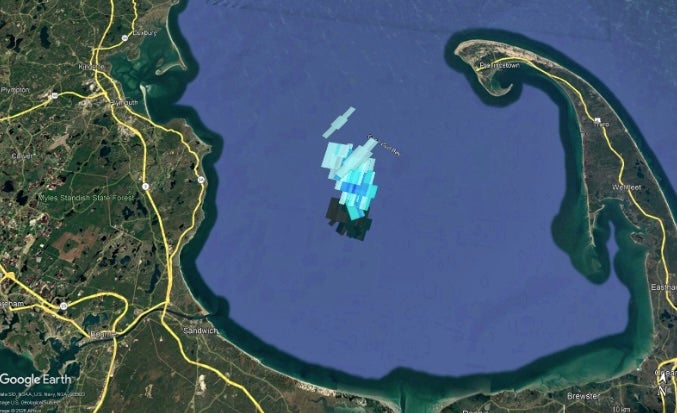
A recent celestial event has captured the attention of scientists and the public alike, with a meteor that lit up the skies and caused a significant sonic boom over New England potentially coming to rest in the waters of Cape Cod Bay. NASA has indicated that the space rock, which fragmented at an altitude of approximately 40 miles above northeastern Massachusetts and southeastern New Hampshire, likely made its final descent into the bay.
The dramatic fragmentation of the meteor released an estimated energy equivalent to 300 tons of TNT, a force powerful enough to account for the loud, thunderous booms reported by residents across the region. This significant energy release is what transforms a meteor into a meteorite upon impact with Earth.
NASA has playfully dubbed the potential recovery scenario a “fishy squisher,” given the meteorite’s suspected location in about 100 feet of water. The agency also highlighted a crucial detail for any aspiring space rock hunters: most meteorites possess magnetic properties. This characteristic means that such a find could be within reach using a magnet dangled from a boat on a rope approximately 100 feet long.
The impact of this event was felt far beyond the immediate vicinity. Numerous residents in New England shared striking video footage of the intense booms that reverberated through their homes. One individual from Newton, Massachusetts, described the unsettling experience of his entire house shaking. “It literally felt like someone was slamming all our doors in the house at once,” Manny Kharasch recounted to ABC News’ Good Morning America. “Whatever that shock wave was, was enough to literally move things.”
The reach of the meteorite’s sonic boom extended considerably. According to Robert Lunsford of the American Meteor Society, the organisation received a multitude of reports detailing booms, ground tremors, or sightings of fireballs in the sky. These accounts spanned from Delaware all the way up to Montreal, indicating a widespread atmospheric event. NASA has confirmed that the object was a natural space rock, ruling out the possibility of it being man-made satellite debris.
What is a Meteorite?
Understanding the terminology surrounding space rocks is key to appreciating events like this.
- Meteoroid: This is a small rocky or metallic body travelling through outer space. They are significantly smaller than asteroids and range in size from dust grains to small boulders.
- Meteor: When a meteoroid enters Earth’s atmosphere, it heats up due to friction and begins to glow, creating a streak of light visible in the sky. This phenomenon is commonly referred to as a “shooting star” or “falling star.” The meteoroid is the object, and the meteor is the visible streak of light.
- Meteorite: If a meteoroid survives its fiery passage through the atmosphere and impacts the Earth’s surface, it is then classified as a meteorite. The event described over Cape Cod involved a meteoroid that became a meteor and, upon reaching the surface, is now considered a meteorite.
The Science Behind the Boom
The substantial sonic boom associated with this event is a direct result of the meteor’s fragmentation. As the meteoroid plummets through the atmosphere at incredible speeds, it encounters immense atmospheric pressure and friction.
- Atmospheric Entry: The meteoroid enters the atmosphere at hypersonic speeds, typically tens of thousands of kilometres per hour.
- Friction and Compression: The rapid movement through air molecules causes intense friction and compresses the air in front of the object.
- Heating and Ablation: This friction and compression lead to extreme heating, causing the outer layers of the meteoroid to vaporise and ablate (wear away). This process creates the bright light we see as a meteor.
- Fragmentation: If the meteoroid is large or composed of less robust material, the immense pressure and stress can cause it to break apart into smaller pieces. This fragmentation event is often accompanied by a significant release of energy.
- Shockwaves: The rapid deceleration and fragmentation generate powerful shockwaves that propagate through the atmosphere. When these shockwaves reach the ground, they are perceived as a loud boom or thunderous noise. The energy released, as estimated by NASA at 300 tons of TNT, underscores the magnitude of this explosive event.
The potential recovery of this meteorite offers a unique opportunity for scientific study, providing valuable insights into the composition and origin of objects from our solar system.

