
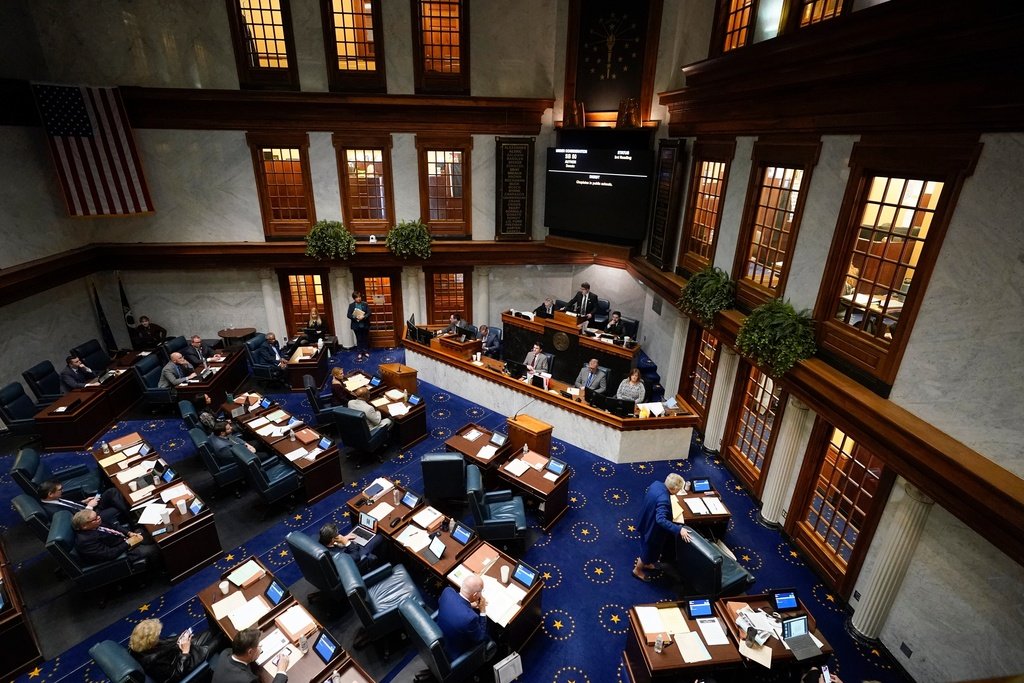
The Indiana Senate Committee on Elections recently passed a controversial redistricting bill, moving it forward for a full Senate vote. The proposed legislation aims to redraw the state’s congressional districts, potentially solidifying a Republican advantage. The committee vote was 6-3 in favor of the bill, setting the stage for a crucial vote in the full Senate.
Opposition and Ethical Concerns
Before the vote, Republican state Senator Greg Walker voiced his opposition, citing the state Senate rule book regarding ethics. He also addressed threats made against lawmakers, including himself, who opposed the mid-decade redistricting effort. “I refuse to be intimidated,” Walker declared, emphasizing his commitment to his principles.
Public Testimony and Concerns
Nearly 130 Indiana residents registered to testify regarding the redistricting proposal. Opponents argue the bill is designed to virtually guarantee an entirely Republican congressional delegation. The Senate elections committee hearing, lasting six hours, followed the bill’s passage through the state House.
Arguments For and Against the New Map
Mike Morris, representing Citizens in Action, a Lafayette tea party organization, claimed the new map was a response to past Democratic gerrymandering. He warned that if Democrats gained control of the House, they might attempt to impeach President Donald Trump for a third time. Morris urged the senators to “be in power, and use that power to save our federal republic.”
Lasima Packett, a resident of Hamilton County, implored senators to demonstrate integrity and resist pressure from President Trump. She argued that “House Bill 1032, by its own author’s admission, was drafted purely for political performance,” suggesting this admission alone should raise concerns.
The Goal: A Republican Sweep
The redrawn map aims to achieve a 9-0 Republican congressional delegation in the upcoming midterm elections. Currently, the GOP holds a 7-2 advantage in the state.
National Implications and Trump’s Influence
Pressure to alter the map and increase the Republican presence in the House stemmed from Trump and his allies. With Democrats needing only three seats to gain control of the House, the prospect of a Democratic-controlled House blocking Trump’s agenda and launching investigations during his final two years in office has fueled these efforts. This has led to Trump exerting influence on several GOP-controlled states.
A Coast-to-Coast Redistricting Battle
The redistricting fight has extended beyond Indiana. Trump initially called on Texas to redraw its map to create five additional Republican seats for the 2026 midterm elections. California responded by passing a ballot measure that could favor Democrats in five Republican-held districts. Florida, Ohio, and Missouri have also followed Texas’s lead by passing maps favoring the GOP.
Governor Braun’s Support
Indiana Governor Mike Braun has been a vocal advocate for mid-decade redistricting. In October, he announced a special session to redraw the map after facing weeks of pressure from the former president.
Senate Resistance
Unlike the swift passage in the state House, HB 1032 faced greater challenges in the state Senate. Republican Indiana Senate President Pro Tempore Rodric Bray had previously indicated a lack of sufficient votes for passage. While he seemed to slightly soften his stance, Bray cautioned that partisan gerrymandering was not the proper method to achieve a 9-0 map, suggesting it could ultimately harm Republicans.
Impact on Democratic Districts
The redrawn map, introduced just days prior to the vote, weakens the Democratic strongholds in Indianapolis, represented by Representatives Frank Mrvan and Andre Carson. The new map divides Indianapolis into four different districts (the 4th, 6th, 7th, and 9th), which extend into predominantly Republican rural areas.
Concerns About Representation
Attorney Karla Lopez-Owens warned that “If passed, HB 1032 would effectively erase Indiana’s two Democratic congressional districts, both of which represent the state’s most diverse communities, Marion and Lake County.” She added, “These two counties have the highest concentration of black, Latino, and Hispanic voters. By voting yes on HB 1032, you will be robbing so many of us of meaningful representation.” All four Democratic-introduced amendments to the bill were rejected.
External Pressure on Senators
House Speaker Mike Johnson reportedly contacted Indiana senators who were undecided about supporting the redistricting plan.
Over the weekend, Trump invited Governor Braun to a White House Christmas party and publicly pressured him about the redistricting’s success in Indiana. Braun reportedly responded affirmatively.
Republican Senators Face Pushback
Indiana’s Republican senators have resisted mid-decade redistricting, drawing criticism from Trump, Vice President JD Vance, and their allies.
Trump Targets Dissenting Senators
Trump publicly identified nine Indiana senators who “need encouragement.” He posted their names on Truth Social, urging supporters to contact them and advocate for their support of the redistricting bill. He specifically mentioned that some of these senators were up for re-election in 2026 or 2028.
Trump has consistently criticized Bray and other state senators on social media, threatening to endorse primary challengers against any lawmaker who opposed redistricting.
Threats and Intimidation
In the weeks leading up to the vote, numerous state lawmakers experienced threats and “swatting” incidents.
External Groups Weigh In
Brett Galaszewski, from Turning Point Action, stated that the Senate’s passage of the redistricting bill would be “the final exclamation point that we needed to send.” He also warned that if the bill failed, Turning Point Action was prepared to invest heavily in primary races against dissenting Republican senators, potentially surpassing the financial resources available to leadership political action committees.
Governor Braun, who headlined an event targeting reluctant senators, suggested that failure in the Senate would require “cleaning house to get real conservatives in.”


