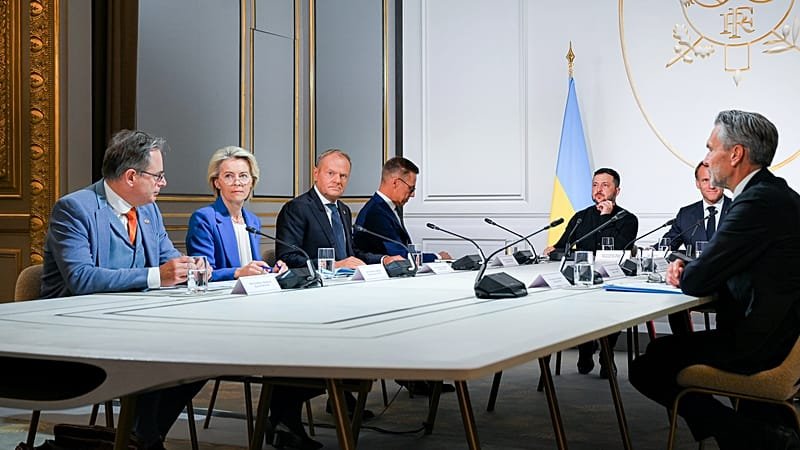
The European Union’s ambitious plan to leverage frozen Russian assets into a substantial reparations loan for Ukraine is facing mounting uncertainty, encountering significant hurdles and opposition on multiple fronts. The urgency of the situation is underscored by the approaching deadline of December 18th, when the 27 EU leaders are scheduled to convene and make a crucial decision on financing Ukraine’s budgetary and military requirements for the next two years, with a target of raising at least €90 billion in contributions.
One of the primary obstacles to the reparations loan is the staunch opposition from Belgium, the country holding the largest portion of the frozen Russian assets. Belgium remains steadfast in its reservations, citing potential negative consequences for its economy and financial stability. Despite considerable efforts to address these concerns, Belgium has not altered its original stance.
If the reparations loan, considered Plan A, fails to materialize, the EU may have to resort to issuing joint debt. However, this alternative requires unanimous approval from all member states, a prospect complicated by Hungary’s stated unwillingness to consent. Furthermore, common borrowing would immediately impact national treasuries, a scenario most EU capitals are keen to avoid due to concerns about potential backlash from taxpayers.
Meanwhile, the United States is reportedly pushing for a swift peace agreement between Ukraine and Russia. This development has fueled concerns among European leaders that Washington and Moscow might seek to release the frozen assets to pursue their own economic interests.
Despite these challenges, a coalition of leaders from Estonia, Finland, Ireland, Latvia, Lithuania, Poland, and Sweden has united to advocate for the rapid approval of the reparations loan. In a joint letter released recently, they argued that the loan is not only the most financially viable and politically realistic solution but also addresses the fundamental principle of Ukraine’s right to compensation for damages caused by the ongoing conflict.
“Time is of the essence,” they emphasized in their letter. “By reaching a decision on the reparations loan at the European Council in December, we have the opportunity of putting Ukraine in a stronger position to defend itself and a better position to negotiate a just and lasting peace.”
Several other influential EU member states, including Germany, France, the Netherlands, and Denmark, also support the reparations loan, which has been under consideration since September and was formally presented recently.
The proposed scheme involves the European Commission channeling the frozen assets of the Russian Central Bank into a zero-interest line of credit for Ukraine. Under the terms of the agreement, Kyiv would only be required to repay the loan once Moscow agrees to compensate for the damages resulting from the war, which has now entered its fourth year.
The majority of the assets, approximately €185 billion, are held at Euroclear, a central securities depository located in Brussels. An additional €25 billion is held in various other locations across the EU. This concentration of assets in Belgium has positioned the country as the primary opponent of the reparations loan.
Belgium’s Concerns and Resistance
Belgian Prime Minister Bart De Wever has been vocal in his opposition to the reparations loan, arguing that it is fundamentally flawed and carries significant risks that could lead to substantial financial losses for Belgium. He has emphasized that Belgium is bound to Russia through a bilateral investment treaty, adding another layer of complexity to the situation.
De Wever’s resistance has garnered support from across the political spectrum in the Belgian parliament, a rare occurrence in the often-divided legislative body.
“We loyally support Ukraine,” De Wever stated recently, “and we are prepared to make sacrifices for that. But this country should not be asked to do the impossible.”
The European Commission has attempted to alleviate De Wever’s concerns by offering guarantees to cover the value of the Russian assets and establishing legal safeguards to minimize the risk of retaliation from Moscow. However, these efforts have so far failed to sway the Belgian Prime Minister.
Diplomatic Efforts and Euroclear’s Warnings
German Chancellor Friedrich Merz recently cancelled a planned trip to Norway in order to travel to Brussels for a meeting with De Wever and European Commission President Ursula von der Leyen. The private dinner, however, did not yield any apparent breakthrough.
“What we decide now will determine Europe’s future,” Merz said after the meeting. “Belgium’s particular vulnerability in the issue of utilising the frozen Russian assets is indisputable and must be addressed in such a way that all European states bear the same risk.”
Coinciding with the meeting between De Wever, Merz, and von der Leyen, Euroclear issued a fresh warning about the reparations loan, cautioning that its experimental nature could deter investors, destabilize financial markets, and increase borrowing costs for member states.
A Euroclear spokesperson stated, “The proposal, as it stands, seems to have a great deal of legal innovation. Such innovation raises a lot of questions. We have the impression that the construction is currently very fragile.”
In response to Euroclear’s comments, a Commission spokesperson said, “We now have a clear proposal on the table and discussions continue.”
The situation remains fluid and complex, with the future of the reparations loan for Ukraine hanging in the balance. The outcome of the upcoming European Council meeting on December 18th will be crucial in determining the EU’s strategy for supporting Ukraine and addressing the challenges posed by the frozen Russian assets.