

In the heart of Kyiv, amidst a biting -18°C winter chill, a makeshift haven offers respite. Inside a warmly lit tent, children are engrossed in drawing, their laughter a stark contrast to the frozen world outside. Parents sip tea, their phones plugged in and charging, finding a moment of normalcy in a city grappling with an unprecedented energy crisis. This “resilience point,” nestled in the Troieshchina district on the left bank of the Dnipro River, is a testament to the spirit of a nation under siege.
Natalya Pavlovna, watching her two-year-old son Danylo play with Lego, voiced the sentiment of many. “Russia is trying to break us,” she stated, her voice firm despite the circumstances. “It’s deliberate genocide against the Ukrainian people. Putin wants us to capitulate so we give up the Donbas region.” The once vibrant capital, she explained, now carries the palpable tension of a frontline city. “People are dying of cold in their homes in the 21st century. The idea is to make us leave and to create a new refugee crisis for Europe.”
Natalya and Danylo’s apartment is one of the 2,600 buildings in Kyiv currently without power or heating. For nearly four years, since the full-scale invasion began, Russia has systematically targeted Ukraine’s energy infrastructure. Substations, thermal power plants, and the brave rescue workers striving to maintain the electricity network have been relentlessly attacked. In recent weeks, Russia’s aerial assaults have overwhelmed Kyiv’s air defences, inflicting further damage during one of the coldest winters in decades. The Darnytska combined heat and power plant, a vital energy source for the left bank, was flattened by ballistic missiles, leading to frequent city-wide blackouts that often restrict electricity to just three to four hours a day.
Two-year-old Danylo drawing at the resilience point
Natalya drew a chilling parallel between the current situation and the Holodomor, the man-made famine of 1932-33 engineered by Stalin, which claimed millions of Ukrainian lives. The linguistic echoes are profound: “holodomor” (extermination by starvation) and “kholodomor” (death by cold) now carry a terrifying resonance. “Putin wants to do to Kyiv what he did to Mariupol,” she asserted, noting that many shivering in the capital had already fled conflict zones elsewhere.
The impact on families and children is immense. Toby Fricker, a spokesperson for Unicef, which donated the warming tent, highlighted the severe disruption to education. “In Kyiv, 45% of schools are closed because of a lack of central heating. Education has been disrupted. Kids and teenagers experience social isolation. They are missing out on normal life,” he explained.
The struggle for warmth and comfort has led to a variety of coping mechanisms. Some mothers have shared tips in online chat groups for affordable accommodation abroad in countries like Bulgaria, Egypt, and Greece. Others, however, have chosen to remain. Yuliia, a mother of six-year-old twins, expressed the complex dilemma: “I see reasons to leave and to remain. At the moment we are together with my parents. If I left I would lose them.” She added, with a sigh, “We don’t know how long this situation will last. It’s cold. We sleep in our hats.”
Ingenuity in the Face of Adversity
Residents have resorted to ingenious hacks to bring a semblance of warmth into their homes. Power banks, camping gear, gas cylinders, and generators have become essential purchases, their rumbling presence a common sound on Kyiv’s icy streets. Some individuals have resorted to heating bricks and rocks over gas stoves, while others have set up tents within their living rooms. Cafes have transformed into popular refuges, and Ukraine’s state emergency service has established shelters complete with beds.
A Seventh-Floor Struggle
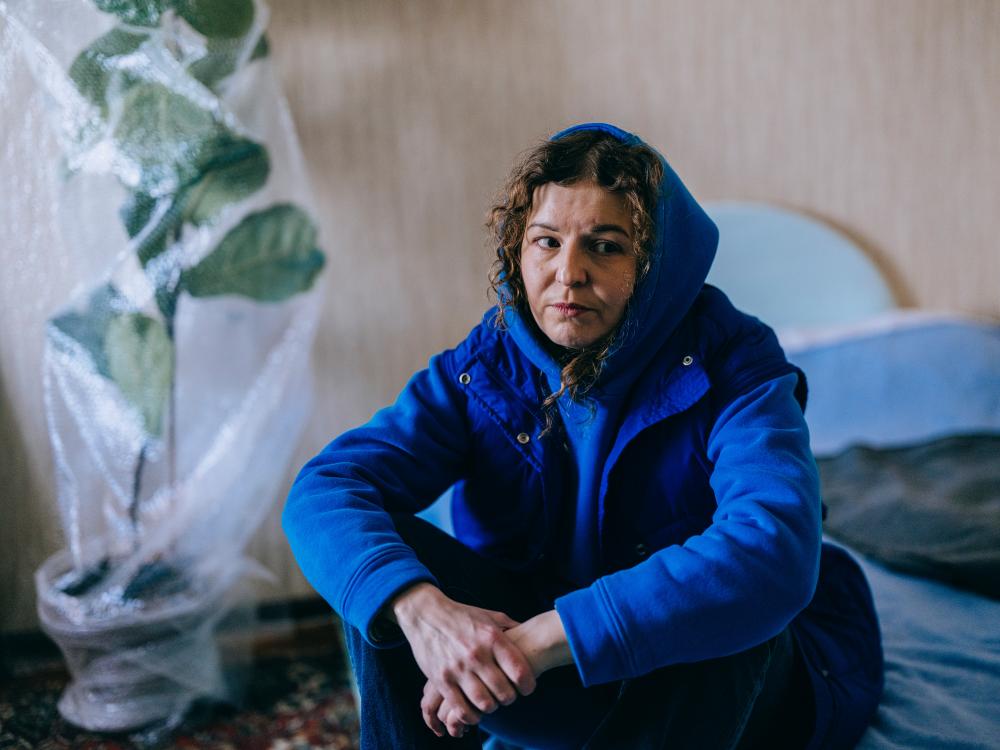
Julia Po, an artist, offered a stark glimpse into her seventh-floor apartment in Kyiv’s Dniprovskyi neighbourhood. The journey to her home involved navigating a dark staircase, as the lack of electricity rendered the lights and lift inoperable. Two weeks prior, frozen water pipes had burst, causing a flood, and a chill wind whipped through the slatted panels of her building, a relic from the 1970s Soviet era, poorly designed and ill-equipped for the current crisis.
Julia Po with her cat, Thom Yorke
Po has employed bubble wrap to insulate her front door and protect her plants, a practical measure against the pervasive cold. The kitchen, she reported, was a chilly 9°C. She sleeps under two blankets, clad in thermal underwear and a hoodie. “Underneath, from the ground, it’s just cold. When you wake up in the morning you can feel your kidneys,” she recounted. Her electric kettle had cracked from the cold, and she hadn’t washed her hair for two weeks. Her cat, Thom Yorke, named after the Radiohead singer, finds warmth nestled under a blanket in a cupboard. Po, originally from Russian-occupied Crimea, expressed a profound sense of displacement, likening her experience to having her home stolen. “There is the same vibe as 2022,” she observed, detailing her journey through stages of “depression-aggression to acceptance and a degree of irony.” “It’s not pleasant, but what can you do? There is a war in our country, unfortunately. This is our reality.”
Po showing the gas burner she uses during blackouts
The artist acknowledged that her situation, with a gas stove and boiler, was more comfortable than that of many of her neighbours. Pensioners, often struggling financially, are particularly vulnerable, unable to afford extra heating equipment and sometimes trapped in their flats. Tragically, at least 10 people have died from hypothermia, with 1,469 hospitalised. The relentless Russian attacks on power facilities continue, with further strikes reported in Kyiv and the southern city of Odesa.
Maxim Timchenko, the head of the energy provider DTEK, revealed the devastating scale of the damage. Moscow, he stated, had wiped out 80% of his company’s power generation capacity. “We are not talking about an energy crisis. It’s a humanitarian and national crisis. As a country we are in survival mode,” he emphasised. Only one out of five DTEK power plants remained connected to the grid, with repairs severely hampered by the freezing conditions.
Timchenko stressed Ukraine’s urgent need for international assistance, including additional air defence systems, ammunition, and an “energy ceasefire” – a concept Moscow had briefly entertained at Donald Trump’s request before resuming its attacks. “Kyiv has become the main target. We have lost all sources of power generation in the city. We are doing everything we can to keep the economy alive,” he stated.
The Frontlines of Repair
Oleh Yaruta, a DTEK engineer, described the overwhelming strain on the capital’s power grid, which has suffered burnouts due to residents’ reliance on electric heaters and boilers. While repairing an underground power cable, he emerged from a hole, holding an iPad displaying an extensive list of pending repair jobs across the city. His view of the aggressors was unequivocal: “They are devils and orcs. They are bombing because they can’t conquer us.”
A Glimmer of Hope Amidst the Darkness
Earlier this week, some buildings on the left bank saw electricity return, with lights flickering back on for a few hours. Natasha Naboka recounted sharing a bed in January with her 10-year-old daughter, Sofiia, and their Yorkshire terrier, Bonya, all huddled under one blanket, Bonya sporting a jacket. “I woke up and my nose was frozen. It was 4-5°C inside the flat,” she recalled. For Sofiia, whose school was closed, the ordeal was an “adventure.”
Naboka in her kitchen during a blackout
Naboka and her daughter, Sofiia, in the kitchen
With no functioning fridge, Naboka resorted to storing food on her fifth-floor balcony. She washed clothes by hand and transported them in a rucksack to dry at her workplace, a beauty parlour in central Kyiv, where the power situation was more stable. During air raids, she and Sofiia would retreat to the corridor, seeking refuge between two walls. Her husband, a soldier, is stationed in the Kharkiv region, another area severely affected by power disruptions.
While some Kyiv residents have voiced criticism of city authorities for failing to protect infrastructure, with President Volodymyr Zelenskyy pointing the finger at Mayor Vitali Klitschko, Naboka placed the blame squarely on Russia. “They thought they could seize Ukraine very quickly. They failed. So instead Putin is trying to destroy us,” she asserted, concluding, “This is all about the jealousy and unhealthy ambition of one man.”