
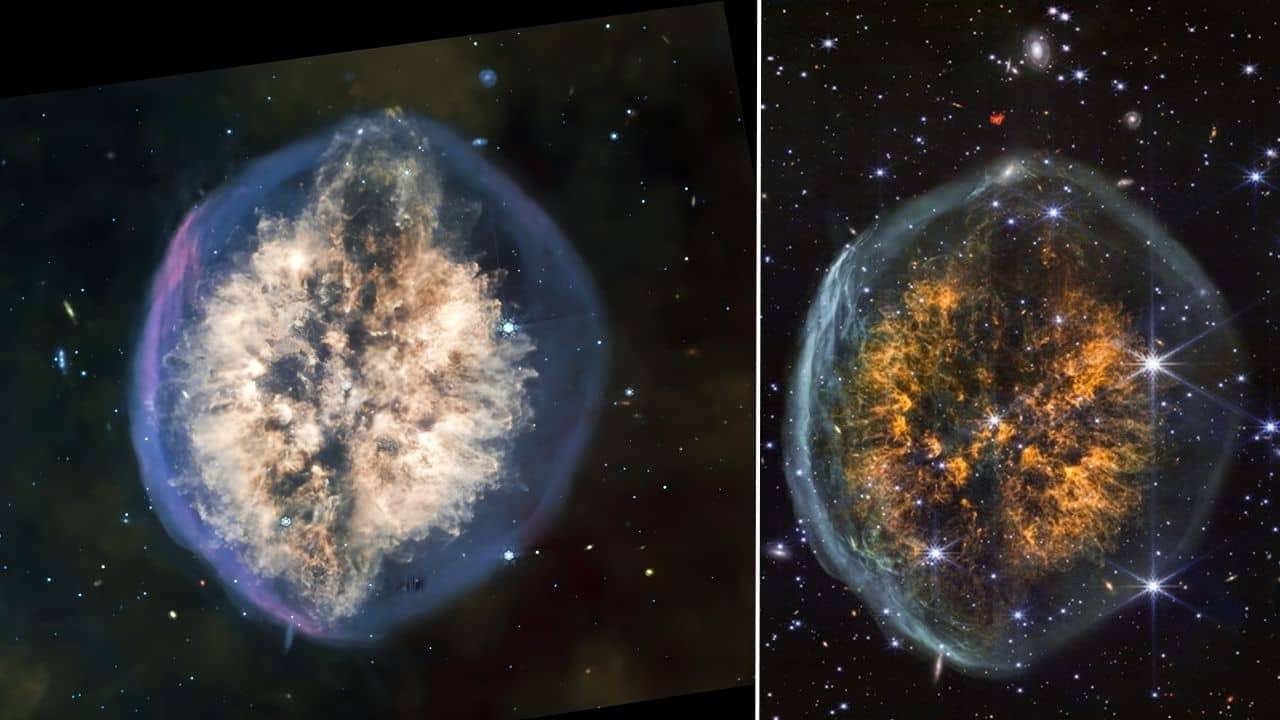
The James Webb Space Telescope (JWST) has unveiled an astonishing new infrared vista, capturing a celestial object that bears an uncanny resemblance to a human cranium and brain. Officially designated PMR 1, this nebula has earned the evocative nickname “Exposed Cranium” from astronomers due to its strikingly eerie shape. This latest imagery represents one of the most detailed views ever obtained of a star in its final throes of existence.
Nebula PMR 1: A Stellar Swan Song
The formation of Nebula PMR 1 is a direct consequence of an ageing central star actively shedding its outer layers into the surrounding expanse of space. Webb’s advanced infrared capabilities have allowed scientists to discern both the intensely hot and the more temperate gas clouds residing within this cosmic structure.
The innermost regions of the nebula are a rich tapestry of mingled gases and interstellar dust. In contrast, the nebula’s outer shell is predominantly composed of hydrogen, which glows brilliantly under the penetrating gaze of the Webb telescope. Images such as these serve as potent reminders of the universe’s boundless enigmas, underscoring the perpetual cycle of stellar birth and death that unfolds across cosmic eons.
Webb’s Infrared Instruments: Peering into the Cosmic Depths
NASA’s Webb telescope, with its sophisticated infrared instruments, has been instrumental in capturing these breathtaking images. The Near-Infrared Camera (NIRCam) has provided unparalleled detail of star-forming structures within the nebula, revealing intricate patterns invisible to previous instruments.
Complementing NIRCam’s observations, the Mid-Infrared Instrument (MIRI) has delved deeper, exposing cooler, more obscured layers of the nebula. The synergistic data from these two powerful instruments has enabled astronomers to construct a remarkably detailed, almost three-dimensional, portrait of a star’s demise. The study of nebulae like PMR 1 is crucial for scientists seeking to comprehend the intricate processes that govern the end stages of stellar life.
The Enigmatic Dark Lane: A Cosmic Question Mark
A particularly arresting feature of the “Exposed Cranium” nebula is a prominent dark lane that bisects its core vertically. It is this striking feature that lends the nebula its macabre, brain-like appearance, contributing significantly to its notoriety. The “Exposed Cranium” serves as a vivid, if somewhat unsettling, illustration of astronomical evolution.
Current scientific hypotheses suggest that this dark lane may be the result of powerful jets or outflows of material emanating from the central star. Alternatively, it could be an indication of exceptionally dense dust clouds that are effectively obscuring some of the star’s emitted light. Unravelling the mystery of this dark lane holds the potential to unlock new secrets regarding the fundamental processes of stellar evolution.
Why the Fascination with this Dying Star?
Planetary nebulae, like PMR 1, are considered invaluable cosmic laboratories. They offer scientists a unique opportunity to study the life cycles of stars, including those similar to our own Sun. These nebulae are the by-product of stars expelling vital elements into the interstellar medium, a process that ultimately enriches the galaxy and provides the raw material for the formation of future generations of stars.
The detailed observations from NASA’s Webb telescope have allowed for an unprecedented examination of the nebula’s chemical composition and temperature variations. Each meticulously captured image contributes to the development of more accurate models that predict the future behaviour of dying stars, enhancing our understanding of cosmic recycling.
The Unique Allure of the “Exposed Cranium Nebula”
The “Exposed Cranium Nebula” offers a rare and profound glimpse into the final moments of a star’s existence. Its spectral, almost ghostly, form captivates not only the scientific community but also amateur astronomy enthusiasts worldwide. The unparalleled vision of the Webb telescope continues to unveil cosmic wonders that have remained hidden from human observation until now.
Astronomers anticipate that further, more in-depth observations will undoubtedly reveal previously unseen structures and delicate dust filaments within the nebula. The “Exposed Cranium” stands as a testament to the profound beauty inherent in the universe, even in the spectacular and dramatic final stages of a star’s life.


