The Rise and Reckoning of Freebirthing in Australia
For some Australian women, the journey to motherhood is taking an increasingly unconventional path, one that bypasses traditional medical support entirely. Freebirthing, the practice of giving birth without the presence of any registered healthcare professional, is a growing movement that is sparking both fervent support and serious concern among health experts.
Phoebe Snow, a 37-year-old DJ from Adelaide, exemplifies this trend. When she went into labour with her third child, after four days of contractions, her home was filled with her husband and a close girlfriend, not a midwife or doctor. This deliberate choice stemmed from a traumatic first birth experience in hospital, which left her with post-traumatic stress disorder and a deep-seated distrust of the medical system. Her second homebirth, attended by a former midwife, had been “a dream,” but for her third, she wanted something even more radical.
“This time we would freebirth – outside the system,” Snow explained. She discovered the term “freebirth” on a parenting podcast and was drawn to the philosophy, which she found echoed in online communities. These groups often describe birth as an instinctual, spiritual, and sovereign act, emphasising trusting one’s body and rejecting fear. “It was exactly what I knew I wanted,” she says. “I trusted my body and wanted full responsibility to birth our baby on our terms – and no-one else’s.”
For Snow and her husband, the goal was an “undisturbed birth” – minimal intervention and interference. They opted out of all ultrasounds during her pregnancy, though they did attend some hospital-based prenatal appointments. Even when they discovered their baby was breech, they maintained their freebirth plan. After her waters broke on a Sunday evening, Snow laboured at home for five days. On Thursday night, as contractions intensified, they moved into the lounge room, where an inflatable birthing pool was set up under fairy lights and candles. Her husband monitored their son Billy’s heart rate by placing his ear to her belly, and her girlfriend provided hip squeezes during contractions. Billy was born at 2:06 am, and after a brief concern about his initial breathing, her father, a former paramedic, reassured them he was fine.
Billy is now a healthy eight-month-old, and Snow has no regrets. Her decision to share her experience on Instagram unexpectedly positioned her as an advocate for freebirthing. While her friends were largely supportive, she calmly addressed concerns about risk by stating she was “in full control.” Her experience has even inspired others; she recently acted as a “doula-from-afar” for her girlfriend, who freebirthed her first baby in country Victoria, offering support via FaceTime.
Snow believes she is part of a growing community of Australian women choosing to birth without medical intervention, a movement gaining significant momentum and, consequently, considerable controversy. Health professionals are increasingly alarmed by this trend.
Alarming Trends and Tragic Outcomes
Both the Royal Australian and New Zealand College of Obstetricians and Gynaecologists (RANZCOG) and the Australian College of Midwives (ACM) have called for policy and regulatory reforms following a series of freebirth-related deaths across the country.
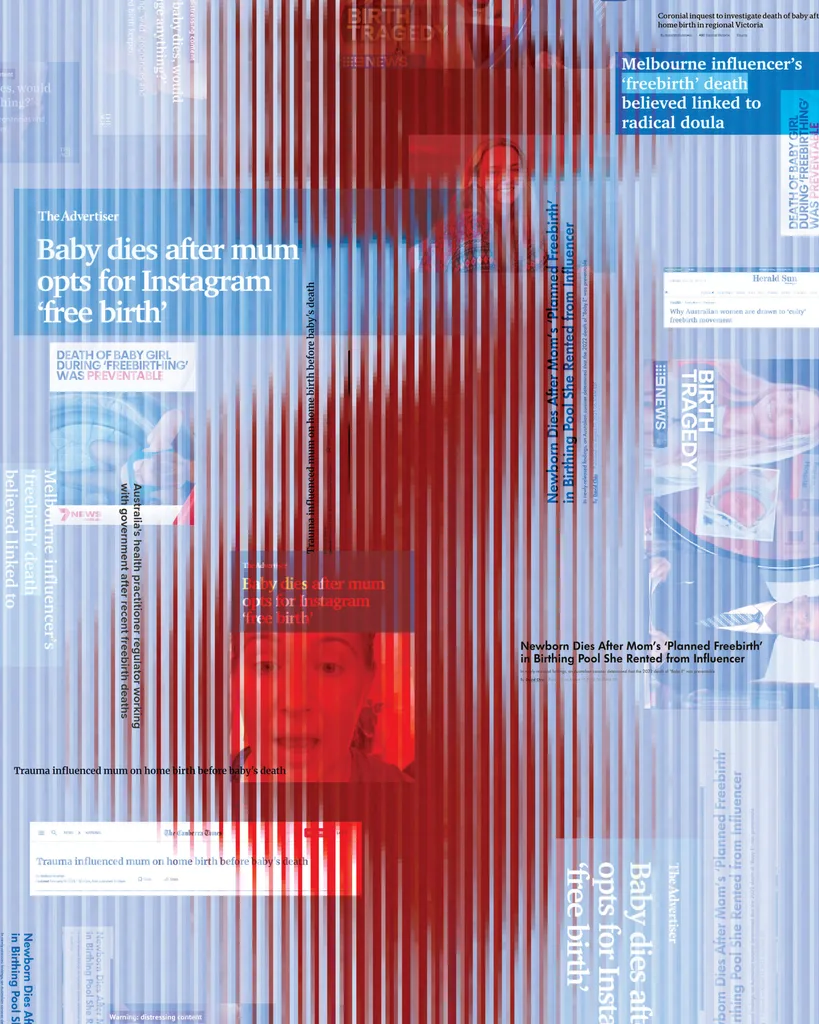
In October 2025, Melbourne health influencer Stacey Hatfield tragically died from a postpartum haemorrhage following a freebirth. Hatfield, who identified as a “low-tox nutritionist and food content creator,” had previously shared her journey from dealing with endometriosis and infertility to natural conception and freebirth, which later inspired her to become a “birthkeeper.” She argued that the presence of a medical provider doesn’t guarantee safety, stating, “As hard as it is to have these discussions, sometimes babies do die – and they die in the hospital as well.”
The coroner was involved in a case in June concerning a baby’s death during a medically unsupervised home birth in south-east Queensland. This followed an inquest that began in July into the death of a baby, referred to as “Baby R,” during a 2022 freebirth in Victoria. The baby’s mother, a former midwife, had refused prenatal care. Freebirthers often point to maternal and infant mortality rates within the hospital system as evidence that medical intervention doesn’t guarantee safety. According to the Australian Institute of Health and Welfare, the maternal mortality ratio (MMR) in Australia in 2023 was 8.2 deaths per 100,000 women giving birth. However, medical professionals argue that these risks are significantly heightened in freebirthing scenarios. RANZCOG explicitly warns on its website that “The absence of appropriate clinical support during freebirth has led to preventable harm and loss of life.”
Key concerns raised by RANZCOG include the involvement of untrained birth support workers, often called “birthkeepers” within freebirth communities, and a general lack of transparency and accountability. In October, the Victorian Health Complaints Commissioner launched an investigation into Emily Lal, known online as “The Authentic Birthkeeper.” Lal was present during Hatfield’s birth and reportedly at the time she was rushed to hospital. The investigation was prompted by allegations that Lal was facilitating or participating in homebirths that could endanger mothers and babies. The commissioner subsequently banned Lal from offering health advice for at least three months and advised the public to avoid engaging with her for health matters. Lal’s social media pages have since been deactivated.
Lal gained a significant following within the freebirthing community. In a 2021 interview, she detailed her personal journey from endometriosis and infertility to natural conception and freebirth, which motivated her to become a birthkeeper.
The Influence of Online Communities and Misinformation
The US-based Free Birth Society is a prominent platform within the movement, boasting nearly 70,000 YouTube subscribers. Videos like “First-time mom’s primal freebirth” have garnered over 25 million views collectively. Their four-month online course, “The Radical Birth Keeper School,” is marketed as a “complete re-education designed for women to refuse to participate in the medical industrial model.”
Dr. Vinay Rane, an obstetrician and gynaecologist and founder of Melbourne Mothers, attributes the rise of freebirthing in Australia to a “perfect storm” of misinformation and distrust in the medical system. “Social media has given a small number of loud voices an enormous reach, and pregnancy is a time when people are understandably searching for reassurance and certainty,” he stated. “Add to that a lingering mistrust of institutions since Covid, and you end up with ideology being presented as wisdom, and confidence mistaken for expertise.”
Victorian midwife Amelia Lamont has experienced the intensity of this movement firsthand. After posting an Instagram video stating, “You will never convince me there is a good reason to free birth,” she received a barrage of messages, some respectful, others aggressive. “Honestly, I wasn’t surprised by the intensity of the feedback from freebirth supporters,” she admitted. “While I wouldn’t label it as a cult, the strong reactions from this community do raise some questions.” Lamont is particularly concerned about how freebirth influencers portray the experience online, often downplaying the risks. “The idea that you can simply birth in your garden can be misleading and potentially dangerous,” she warned. “My primary worry is for vulnerable people, especially those who have experienced birth trauma or are dissatisfied with their past birth experiences. They might be led to believe that freebirth is the ultimate solution for healing.”
Algorithmic Amplification and the Dangers of Unchecked Information
Maria Padisetti, founder of Sydney-based cybersecurity company Digital Armour, highlights the risks associated with women turning to AI chatbots and YouTube for health information, including birth plans. “If a chatbot is trained on large volumes of content that include extreme or conspiratorial views, this can include distrust of obstetric care, midwives or hospitals,” she explained. “The danger is that misinformation is often phrased confidently, emotionally and persuasively, which can make it feel credible, particularly to someone already questioning the medical system.”
Padisetti warns that the widespread visibility of alternative groups like the freebirthing movement online can be a sign of “algorithm or bot-driven amplification,” where platforms deliberately boost certain topics. “Platforms reward content that provokes strong emotional reactions such as fear, anger, empowerment or moral outrage,” she noted. “Freebirthing content often sits at the intersection of all four.”
Her advice is to be sceptical of content that presents complex medical decisions with simplistic answers and to be cautious of “recommended” content. “AI chatbots and algorithms are not inherently malicious, but they are amplifiers,” Padisetti cautioned. “If a pregnant person watches content from a group like the Free Birth Society on YouTube, the platform’s algorithm may infer that she is interested in medical scepticism. From there, it can progressively recommend more extreme content. Outrage, fear and certainty drive engagement.”
Much like the debate surrounding Covid-19 vaccines, freebirthing has become a deeply polarising issue. Supporters of freebirthing describe the online discourse as a “witch-hunt” and argue that the focus should be on issues like continuity of care, birth trauma within the hospital system, and the widespread gaps in maternity services, particularly in regional and rural Australia. For low-risk pregnancies, homebirths are considered a safe option, but there’s a critical shortage of homebirth midwives. The cost of a private homebirth, ranging from $5,000 to $8,000, also presents a barrier for many. Furthermore, the lack of equipped birthing suites in many hospitals, even for water births, leaves women feeling unsupported and can push them towards unconventional choices.
Finding a Balance: Autonomy and Safety
Clinical psychologist Frances Bilbao, founder of Mums Matter Psychology in Melbourne, believes the freebirthing debate offers valuable insights into women’s desires to do what’s best for their babies. “What’s striking is that women across the spectrum feel judged,” she observed. “Freebirthers feel hunted, hospital-birthing women feel inadequate, and many sit quietly in the middle, afraid of saying anything at all.”
For women who have experienced birth trauma, Bilbao stresses the importance of balancing autonomy with medical safeguards. “When trust has been broken, people often swing towards the opposite extreme to regain a sense of control. Avoiding all medical care can feel protective and empowering, particularly when previous experiences involved feeling dismissed or powerless,” she explained. “A safer and more healing approach is trauma-informed care, where women are supported by clinicians who listen, explain, collaborate and respect autonomy while still offering medical oversight,” Bilbao continued. “Healing doesn’t require rejecting all medical expertise.”