

China’s ‘Great Wall of Sand’ Expands: Dredgers Transform Disputed Islands into Military Outposts
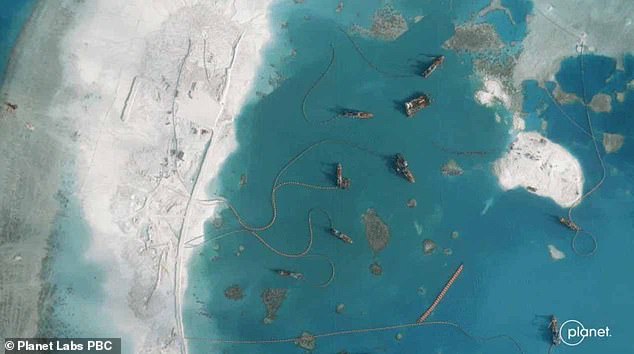
New satellite imagery reveals a significant escalation in China’s artificial island-building activities in the strategically vital South China Sea. Over twenty massive dredgers are reportedly at work, churning up seabed sand and mud to create foundations for extensive construction projects. This surge in activity, particularly around Antelope Reef within the Paracel Islands – a territory also claimed by Vietnam and Taiwan – appears to contradict a 2015 pledge made by Beijing to halt its expansionist efforts in the region.
What began with just two dredgers in December has now transformed into what one report describes as a “massive industrial campaign,” involving a fleet of 22 high-tech “dark dredgers.” These operations are a stark visual representation of China’s assertive stance in the South China Sea, a region where it claims virtually all of the waters, leading to ongoing territorial disputes with its Southeast Asian neighbours.
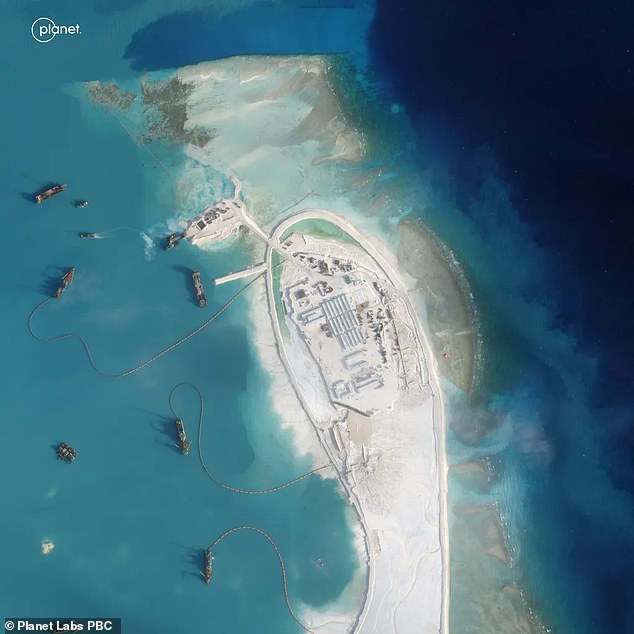
Since 2014, China has been systematically bolstering its claims by converting natural islands and reefs into formidable military bases. This strategic land reclamation has resulted in the construction of long runways on several key islands, including Fiery Cross Reef, Mischief Reef, and Subi Reef in the Spratly Islands chain, as well as Woody Island in the Paracels.
Fortifying the Front Lines: Advanced Military Capabilities
These newly established bases are not merely landing strips; they are equipped with sophisticated military infrastructure. Hangars capable of housing military aircraft and advanced radar systems are in place, granting China the ability to project air power across the entire South China Sea. Furthermore, these facilities have demonstrated the capacity to host anti-ship cruise missiles, surface-to-air missiles, and possess hardened shelters designed to store missile arsenals. Reports indicate that the airfields are fully operational and capable of receiving fighter jets, underscoring the serious military implications of these developments.
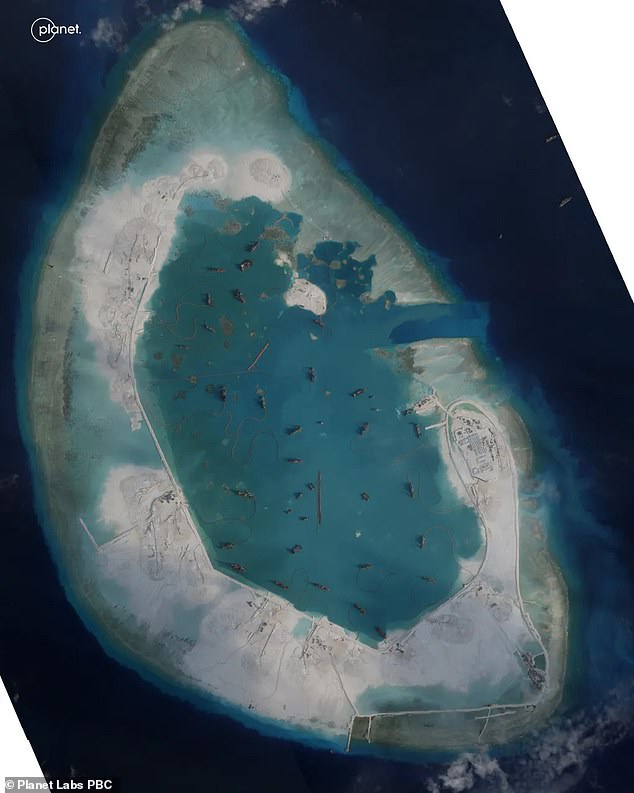
The resumption of these activities is particularly noteworthy given China’s 2015 statement promising to cease the militarisation of such bases. The current operations on Antelope Reef, for instance, are estimated to have already created several square kilometres of new land. Significant reclamation efforts are visible across more than 15 square kilometres of what was once a largely undeveloped reef.
A report from the London-based Open Source Centre highlighted the scale of this transformation, stating that “a modest start has since expanded into a massive industrial campaign… these developments suggest reclamation activity is intended to extend across the reef’s full length and will likely evolve into a multi-purpose outpost to enhance China’s military presence in the region.”
Historical Claims and Geopolitical Tensions
China’s assertion of sovereignty over the South China Sea has deep historical roots, with Beijing claiming ownership of nearly all of the 1.2 million square miles of this vital waterway. This expansive claim, often demarcated by the controversial “nine-dash line” drawn in the 1940s, has no basis under international law. This was definitively confirmed in 2016 when an international tribunal ruled overwhelmingly in favour of the Philippines, declaring China’s claims invalid.
The Paracel Islands, including Antelope Reef, were seized by China from South Vietnam in 1974. Antelope Reef’s strategic location serves as a crucial link between China’s Hainan Island and Woody Island, which already hosts fighter jets and surveillance aircraft.
Under President Xi Jinping, Beijing has pursued an aggressive expansion of its influence in the resource-rich and strategically important waters of the South China Sea. This expansion directly encroaches upon the territorial claims of several Southeast Asian nations, including the Philippines, Malaysia, Brunei, and Vietnam. All these countries assert sovereignty over various parts of the sea, including numerous small islands, shoals, and reefs.
The core of the dispute, particularly between China and the Philippines, revolves around features like the Spratly Islands and Scarborough Shoal. The Philippines bases its claims on geographical proximity and the United Nations Convention on the Law of the Sea (UNCLOS), which places many of these contested areas within its Exclusive Economic Zone (EEZ). China, however, insists on its historical rights, encompassing swathes of territory within the EEZs of its neighbours.
International Response and Regional Arms Race
In defiance of China’s claims, Western governments, including the United Kingdom, regularly conduct “freedom of navigation operations.” These missions, involving naval vessels sailing in close proximity to the disputed islands, serve as a symbolic challenge to Beijing’s assertions of control. Last September, the HMS Richmond and USS Higgins navigated the waters between Taiwan and mainland China, a move that provoked strong condemnation from Beijing. China accused the two allied nations of undermining regional peace and engaging in “harassment and provocation.” However, a spokesperson for the British and American alliance stated that the ships were operating in international waters.
It is important to note that China is not the sole actor engaging in island militarisation in the South China Sea. Taiwan operates a military base on Taiping Island, the Philippines maintains facilities on Thitu Island, and Malaysia has a presence on Swallow Reef. Vietnam, too, has a significant presence, with a 1,300-metre runway on Spratly Island and is actively developing new land and military facilities at a rapid pace, potentially aiming to rival China’s advancements.
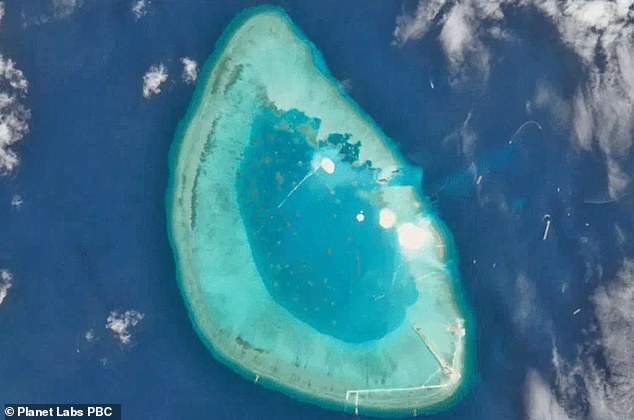
Images released last year by a United States think tank indicated that artificial land expansion has been employed to enlarge all 21 Vietnamese-occupied rocks and sandbanks within the Spratly Islands. Adding to the strategic build-up, earlier this week, local government bodies administering the South China Sea advertised for 11 “community worker” positions. These roles are intended for service on eight of its reefs and islands, including Woody Island, the administrative hub for these disputed territories. The job descriptions specify candidates aged between 18 and 35, holding a university degree, exhibiting dedication to island and community service, and possessing physical and psychological adaptability. This indicates a long-term commitment to developing and staffing these strategic outposts.


