
The AFL’s Stagnant Mark Rule: A Call for Evolution in the Modern Game
In the fast-paced world of professional sports, rule adjustments are often seen as essential for maintaining excitement and ensuring fair play. While other football codes are actively tweaking their regulations to enhance the spectacle, Australian Rules Football (AFL) appears to be lagging, particularly concerning the crucial element of the mark.
The National Rugby League (NRL) has recently implemented a series of rule changes designed to accelerate play and minimise stoppages. These include replacing penalty kicks with “six-again” calls, substituting scrums for play-the-balls in certain infringement scenarios, and shifting the “six-again” location from the 40-metre line to the 20-metre line. The underlying philosophy is clear: keep the ball in motion, maintain a high level of contest, and reduce interruptions.
In stark contrast, the AFL has not introduced any significant rule changes aimed at improving ball movement and contest intensity in a staggering 24 years. This lack of evolution is particularly striking for a competition that often prides itself on its adaptability, even when faced with calls for fewer rule alterations from its passionate fanbase.
While it’s true that more recent additions like the 6-6-6 rule and the “stand” rule were intended to combat congestion and encourage quicker play-on after marks, they haven’t addressed the fundamental issue of stoppages stemming from the mark itself. Tactical flooding has merely shifted, leading to different forms of stop-start play.
This brings us to the history of the mark distance. Back in 2002, the required mark distance was appropriately increased from 10 to 15 metres. This change was timely, as full-time professionalism, salary caps, and national drafts were in their early stages. The direction was clear: athletes were becoming better trained, leading to more frequent and easier marks. Increasing the difficulty was a logical response.
However, what is less logical is the subsequent two and a half decades of inaction, despite continuous advancements in player tactics and training.
The history of the mark’s distance isn’t one of static tradition. The rule has been adjusted numerous times throughout the sport’s evolution:
* 1859: Initially a verbal call.
* 1866: A five-yard protected area was established.
* 1887: This was reduced to two yards.
* 1897: The 10-yard mark was introduced.
* 1970s: The rule was metricated.
* 2002: The distance was increased to 15 metres.
The game has never treated its rules as immutable or fixed. The 2002 adjustment was consistent with this historical pattern of adaptation; the subsequent 24 years of inertia are not.
Other football codes have readily recalibrated their rules as professionalism has advanced. The National Football League (NFL) narrowed its hash marks in 1976 to foster a more attacking passing game. Rugby Union, after professionalising in 1995, updated its amateur-era laws, later introducing the referee’s “use it” call to expedite ball release from the ruck. Even soccer has implemented rules to curb time-wasting, such as limitations on goalkeeper handling. The underlying principle remains consistent: when the standard of play evolves significantly, the rules should follow suit.
Even figures like Bill Fallowfield, the late RFL secretary known for his firm leadership, acknowledged the responsibility of leagues to implement necessary rule changes to preserve the style of play that spectators most enjoy – an open game with continuous contest.
For the AFL, the argument for revisiting the mark distance is based on a simple observation. The 15-metre standard was set for a generation of players still adapting to the rigours of full-time professionalism.
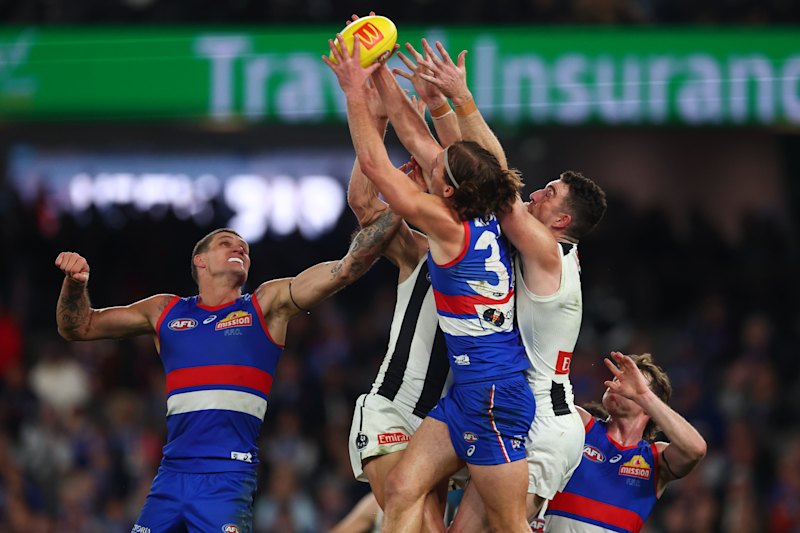
Today’s elite AFL players have been immersed in this professional environment their entire careers. Their physical conditioning, kicking accuracy, and aerial marking abilities are on an entirely different level. The 15-metre mark, once a genuine challenge, is now comfortably within the routine capabilities of these athletes.
The consequence is a game that, when compared to earlier eras, appears noticeably more stop-start, with an increased frequency of marks. The flowing, continuous contest that characterised past games is less prevalent. This is not a matter of misplaced nostalgia; it is a direct structural outcome of rules that have failed to keep pace with the remarkable athleticism and precision of the players performing under them.
While not a direct comparison, Gaelic Athletic Association (GAA) football offers an interesting perspective. Marks were introduced in 2017 but remain limited in their application, preserving a style built around continuous movement and contest. This demonstrates that similar football codes can be structured to prioritise flow over set-piece situations.
This is not to suggest that the AFL should unilaterally increase the mark distance. A sensible approach would involve trialling proposed changes at lower or developmental levels before implementing them in the elite competition. World Rugby, for instance, trials law changes domestically before introducing them to southern hemisphere competitions and then the international game. Similarly, the NFL and NCAA operate with different hash mark positions, with high school levels featuring the widest. The NRL also applies varying rules across community, international, and domestic elite levels.
There is no compelling reason why the AFL cannot adopt a similar strategy, trialling an increased mark distance before making any definitive decisions for the elite competition. The precise distance – whether it be 20, 25 metres, or another figure – is a question that can only be answered through a rigorous trial process. Data collection is essential, and trials are the only way to gather that data.
However, these crucial trials cannot commence until the conversation itself begins. The AFL has a reputation for frequent rule changes, often drawing criticism from supporters. Yet, a meaningful adjustment to the mark rule in over two decades, during a period of such significant advancements in player athleticism and precision, is a remarkable oversight. Whether an increased mark distance ultimately proves to be the correct solution or not, the question itself is long overdue. Twenty-four years is an extensive period to leave such a fundamental rule unchallenged in a game that has evolved so dramatically around it.


