Antisemitic Incidents Remain Worryingly High in the Netherlands Despite a Dip from Post-October 7 Peak
Amsterdam, Netherlands – New data released by the Center for Information and Documentation Israel (CIDI) reveals a persistent and concerning level of antisemitic incidents in the Netherlands throughout 2025. While the number of recorded antisemitic incidents in 2025 saw a decrease from the dramatic surge experienced in the aftermath of October 7, 2024, the figures remain significantly elevated when compared to pre-conflict benchmarks.
A comprehensive 100-page report detailing the state of antisemitism in the Netherlands for 2025, compiled by CIDI, has brought these troubling trends to light.
A Quarter of Discrimination Offences Target a Tiny Minority
The gravity of the situation is underscored by the statistics from the Dutch Public Prosecution Service. In 2025, a total of 46 antisemitic criminal discrimination cases were recorded. This figure represents a stark 26% of all registered discrimination offences for the year. To put this into perspective, this means that more than one in every four discrimination offences was directed at a minority group that constitutes a mere 0.3% of the entire Dutch population.
The report highlights several instances of direct, real-life threats of violence that sent shockwaves through the Jewish community. On February 4, 2025, a Jewish school received a chilling email containing explicit threats of violence against three pupils, vowing to shoot them. Further illustrating the pervasive nature of this hatred, on April 17, a man was subjected to a vile verbal assault in a supermarket, with his assailant uttering, “You look like a cancerous Jew. I’m going to chop your head off.” Alarmingly, one Jewish institution reported receiving almost daily threatening emails from the same individual, painting a picture of relentless harassment.
Demonstrations Become a Breeding Ground for Hate
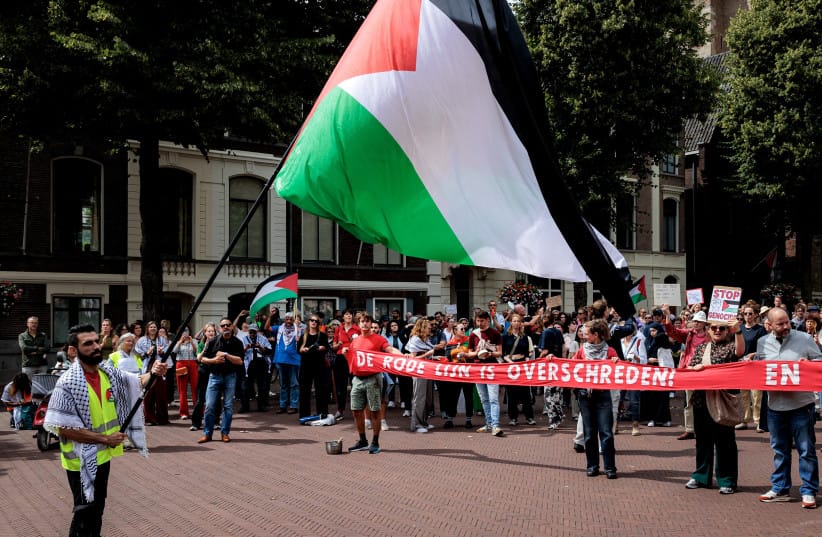
A particularly worrying trend identified in the report is the striking increase in antisemitic incidents occurring at demonstrations. While only one such incident was reported in 2024, this number escalated to eight in 2025. These incidents were predominantly observed at anti-immigration protests and, significantly, at demonstrations related to the ongoing conflict between Israel and Hamas.
During a protest in The Hague in May 2025, for example, participants were seen displaying signs that drew disturbing parallels between the Gaza war and the Holocaust, and equating the State of Israel with Nazi Germany. Such comparisons not only demonstrate a profound lack of understanding but also serve to dehumanise and delegitimise a targeted group.
The Evolving Language of Antisemitism: “Zionist” as a Proxy
Researchers have noted a disturbing evolution in the way antisemitic tropes are disseminated. Traditional antisemitic conspiracy theories are increasingly being repackaged, with the term “Jew” being replaced by “Zionist.” This linguistic shift acts as a subtle but effective proxy, allowing the same discriminatory messages and hateful ideologies to be spread under a different guise, often evading immediate detection or classification as overt antisemitism.
Trivialising the Holocaust: A New Wave of Antisemitic Analogies
A major trend identified in the report is the increasing use of Holocaust analogies in Dutch antisemitic discourse. These often involve depicting historical victims of the Holocaust as contemporary sufferers or framing current conflicts through a distorted lens of historical atrocities. Examples include Anne Frank being portrayed as a Palestinian victim or Gaza being described as “the new Warsaw Ghetto.”
CIDI argues forcefully that such comparisons are not merely insensitive; they actively trivialize the horrors of the Holocaust. Furthermore, they serve to manipulate the historical narrative, effectively shifting Jewish people from their historical position as victims of persecution to alleged perpetrators of atrocities in the present day.
The De-Judaization of Holocaust Memory
Beyond direct analogies, the report also points to a more nuanced, yet equally troubling, shift towards the “de-Judaization” of the Holocaust. This trend is evident in media coverage and public discourse surrounding Holocaust commemorations, where there is an increasing tendency to refer to “millions of victims” or “millions of people” without explicitly acknowledging that these victims were overwhelmingly Jewish. This subtle erasure of Jewish identity from the historical narrative of the Holocaust risks diminishing the unique suffering and persecution experienced by Jewish people.
The Impact on Jewish Visibility and Community Life
The pervasive increase in antisemitism is having a tangible and detrimental impact on the visibility and daily lives of Jewish individuals and organisations in the Netherlands. The report indicates that wearing traditional Jewish symbols, such as a kippah or a Star of David, can unfortunately attract negative reactions, leading many to feel compelled to conceal their religious identity.
This climate of fear and intimidation extends to the organisational level. Jewish organisations are reportedly facing significant challenges in securing venues for their events, with non-Jewish institutions increasingly hesitant to collaborate due to heightened security concerns. This reluctance further isolates Jewish communities and hinders their ability to engage in public life.
CIDI’s Recommendations for Action
In response to these findings, CIDI has put forth several key recommendations for the Dutch government and society to address the escalating problem of antisemitism:
- Adopt the IHRA Working Definition: Implement the International Holocaust Remembrance Alliance (IHRA) working definition of antisemitism as a guiding framework for understanding and combating this form of hatred.
- Boost Law Enforcement Resources: Increase the resources allocated to the police and prosecution services specifically for investigating and prosecuting antisemitic offences.
- Criminalise Nationality-Based Discrimination: Introduce legislation that criminalises discrimination based on nationality. This would provide better protection for various groups, including Israelis, who are often targeted due to their national origin.
The “Tip of the Iceberg”: Reporting Fatigue and Undercounted Incidents
Despite the alarming figures presented, researchers caution that the data may not fully capture the extent of the problem. The phenomenon of “reporting fatigue” is a significant concern, where individuals become disillusioned with the process of filing complaints, doubting its effectiveness.
“People increasingly doubt the usefulness of filing a report or complaint or more often feel that nothing will be done about it,” the report states. Some individuals also fear that reporting an incident could inadvertently lead to further problems or repercussions.
Consequently, the report concludes with a stark warning: “The registered incidents in this Monitor are therefore only the tip of the iceberg.” This suggests that the true scale of antisemitism in the Netherlands may be considerably larger than what is currently documented, underscoring the urgent need for comprehensive and sustained action.