Innovative EV-to-EV Charger Promises to Rescue Stranded Electric Vehicles
A groundbreaking direct electric vehicle (EV) to EV charger, designed to rescue motorists whose electric cars have run flat, has been unveiled by an Australian company. Melbourne-based Alpine Energy is pioneering this new technology, which aims to provide crucial charging support for electric vehicle drivers in regional Australia and on remote worksites, including mines.
Traditionally, charging an electric vehicle has required bringing the vehicle to established charging infrastructure. However, Alpine Energy’s Managing Director and founder, Mark Wexler, explained that their new device, the MGEN M40, is engineered to do the opposite: “The MGEN M40 is built to do the opposite, to bring rapid charging to the vehicle, wherever it is.” He elaborated on the company’s motivation, stating, “The cases that drive us are the hardest ones: getting a stranded driver moving again when there’s no charger for kilometres and keeping fleets running where the grid simply doesn’t reach.”
Officially launched on May 26, Alpine Energy is now inviting roadside assistance companies and fleet operators to participate in trials of the MGEN M40. While some existing vehicle-to-vehicle EV charging solutions are available, they typically do not offer “fast charger” speeds. For context, major roadside assistance providers like the NRMA dispatch dedicated vans equipped with substantial battery packs (around 4.8kWh) to assist stranded EV drivers in areas like Sydney and Canberra. Alpine claims its MGEN M40, powered by the battery of a petrol/electric BYD Shark, can deliver a rapid 40kW charge.
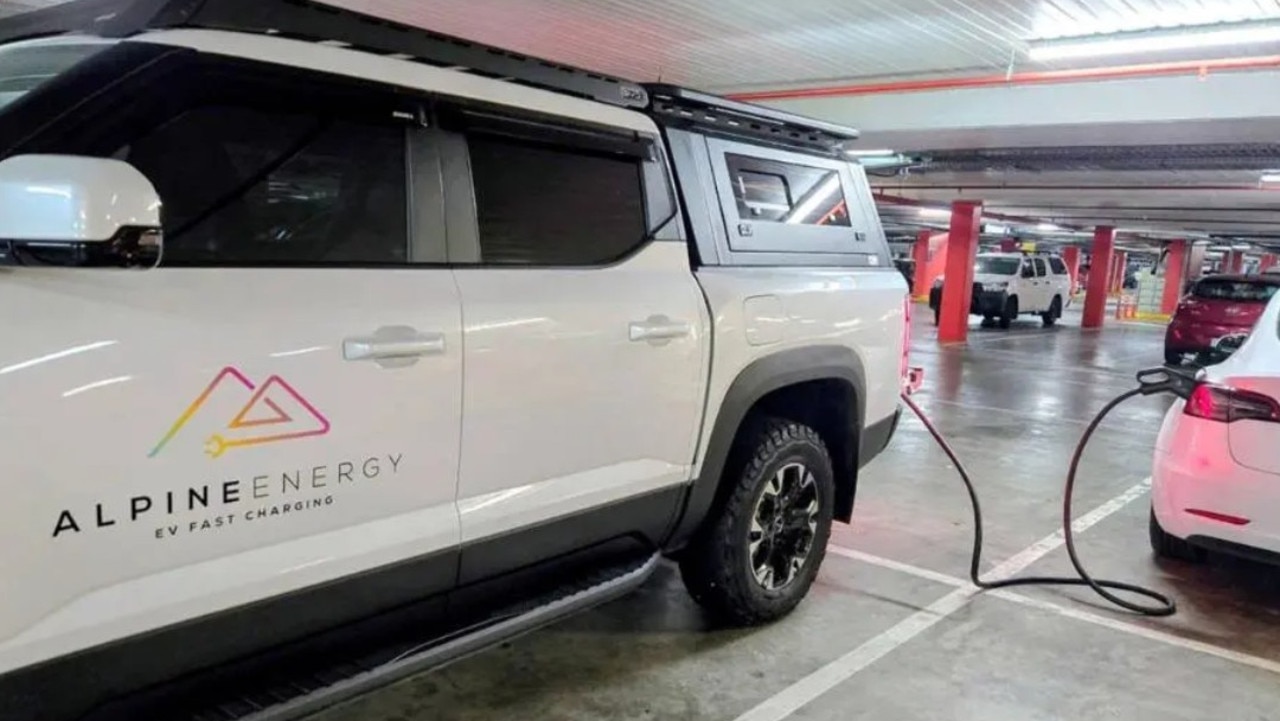
Other solutions in the market involve mounting batteries onto utility vehicles or transporting generators to recharge depleted electric vehicles. However, Mr. Wexler highlighted that Alpine Energy possesses proprietary hardware and software that enables the use of a donor vehicle’s stored battery power to charge a secondary EV. He acknowledges the need for extensive field validation but believes this mobile, vehicle-to-vehicle approach represents a significant advancement in delivering energy precisely where it is most needed.
Alpine Energy has already garnered interest from major Australian roadside assistance and towing companies eager to trial the technology. The initial prototype of the MGEN M40 is capable of delivering enough power to add approximately 65 kilometres of driving range after just 15 minutes of charging. The system is equipped with standard Australian charging connectors, including the CCS2 plug, and the older CHAdeMO plug, along with integrated 4G and satellite connectivity for enhanced functionality.
Collaboration and Future Prospects
Perth-based industrial automation firm EXOR Oceania is collaborating with Alpine Energy, facilitating connections within the mining sector. Carlo Sportiello, founder of EXOR, described the charger as an “innovative approach to mobile energy deployment and EV charging infrastructure, particularly in environments where conventional charging solutions may not be practical.”
Global Support for V2V Charging
The battery powering the Alpine charger is sourced from Bulgarian manufacturer Ampernext. Vasil Merdzhanov, founder of Ampernext, emphasised the growing need for direct current (DC) vehicle-to-vehicle (V2V) charging. “V2V charging is exactly the kind of application our DC-DC technology was built for, and Alpine Energy is approaching it with the engineering rigour the category needs,” Mr. Merdzhanov stated. He further commented, “The MGEN M40 takes mobile fast charging into a genuinely new operating envelope. We’re proud to support what we believe will be a global product as it moves into pilot validation.”
Australian EV Market Growth
The adoption of electric vehicles in Australia has seen significant acceleration, particularly in the first half of 2026, driven by soaring fuel prices that have prompted many motorists to switch to battery electric vehicles. According to the latest report from the Federal Chamber of Automotive Industries, one in every six new cars sold is now a battery EV. The used EV market is also experiencing a surge, with electric, plug-in hybrid, and hybrid vehicles accounting for 27.5 per cent of light vehicle sales in April, a notable increase from 23 per cent in March and 14 per cent a year prior.
While the federal EV subsidy is set to decrease from April 2027, eligible EVs will continue to be exempt from import tariffs. Government figures indicate that the Electric Car Discount subsidy has been instrumental in driving EV adoption, contributing to an estimated 64,000 additional EV sales in Australia over the three years leading up to December 2025. The development of innovative charging solutions like Alpine Energy’s MGEN M40 is expected to further support this growth, addressing range anxiety and infrastructure limitations, especially in more remote areas of the country.