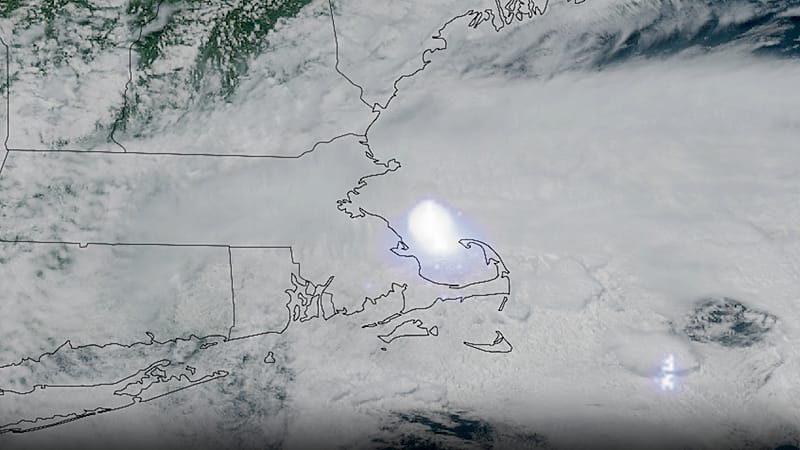
Sky Shakes as Fiery Visitor Lights Up New England Skies
Residents across the northeastern United States were startled on Saturday by a spectacular celestial event: a meteor that exploded high in the atmosphere, unleashing an energy blast equivalent to approximately 300 tons of TNT. NASA confirmed the powerful detonation, which occurred around 64 kilometres (40 miles) above the northeastern reaches of Massachusetts and the southeastern corner of New Hampshire.
The dramatic fragmentation of the meteor was accompanied by significant sonic booms, audible across the entire New England region. These unexpected concussive sounds triggered widespread concern, with numerous reports flooding in from various states, including Massachusetts and Rhode Island, detailing everything from shaking buildings to the unnerving loud noises.
Social media platforms buzzed with firsthand accounts. Many users described hearing two distinct, thunderous booms, while others reported vibrations so intense they rattled the very foundations of their homes and apartments. The sheer force of the atmospheric entry and subsequent explosion left a lasting impression on those who witnessed or experienced its effects.
A Natural Phenomenon, Not Space Junk
Scientists at NASA have clarified the nature of the celestial visitor. The object was identified as a natural meteor, a space rock that entered Earth’s atmosphere at an astonishing speed of roughly 120,000 kilometres per hour (75,000 miles per hour) before breaking apart.
Crucially, NASA has stated that this event was not connected to any known meteor showers currently active. Furthermore, it has been definitively ruled out as originating from man-made space debris or a re-entering satellite. This underscores the natural and somewhat rare occurrence of such a significant atmospheric explosion.
One Massachusetts resident, speaking to local media outlets, likened the sensation to experiencing a minor earthquake. She recounted feeling a distinct and noticeable vibration within her fourth-floor apartment, a testament to the powerful shockwaves generated by the meteor’s demise. Fortunately, as of the latest reports, no injuries or significant structural damage have been attributed to the event.
Understanding the Science Behind the Spectacle
The phenomenon observed is a prime example of a bolide, a type of meteor that explodes in the atmosphere. These events occur when a celestial body, often a stony or metallic asteroid fragment, encounters Earth’s atmosphere. The intense friction and pressure at high altitudes cause the object to heat up dramatically, leading to fragmentation and a brilliant flash of light, often brighter than the sun.
The subsequent sonic booms are a direct result of the shockwaves created as the meteor travels at supersonic speeds through the air. When the object breaks apart, these shockwaves are amplified, propagating outwards and reaching the ground as audible booms. The altitude at which the meteor explodes plays a significant role in how widely the sound is heard and how intense the vibrations are perceived.
While the energy released by this particular meteor was substantial – comparable to a moderate conventional explosion – the vast majority of its energy was dissipated high in the atmosphere. This typically prevents widespread damage on the ground, although localized effects like the shaking of buildings can occur.
The event serves as a powerful reminder of the constant bombardment Earth experiences from space. While most meteors are small and burn up harmlessly, larger ones, like the one witnessed over New England, can offer a dramatic and awe-inspiring display, coupled with a brief period of concern for those below. Scientists continue to monitor near-Earth objects, though the likelihood of a significant impact remains very low. The information gathered from such events helps astronomers refine their understanding of the composition and dynamics of our solar system.