

A federal judge has ordered that religious leaders be allowed to provide spiritual guidance to immigrants detained at the Bishop Henry Whipple Federal Building in Minneapolis. This decision, made by U.S. District Judge Jerry Blackwell on Friday, is seen as a major win for those who advocate for religious freedom.
Judge Blackwell approved an injunction requested by branches of the Evangelical Lutheran Church in America, the United Church of Christ, and a Catholic priest who had taken legal action against the Department of Homeland Security. The ruling guarantees that clergy will be able to visit detainees in person, which is particularly important given the facility’s role in the Trump administration’s enforcement efforts in Minnesota.
The building, which has been the center of protests due to the presence of around 3,000 federal officers in the state, has seen frequent demonstrations. In his ruling, Judge Blackwell stated that the plaintiffs had shown a strong chance of success in their case. He also said that limiting the ability of clergy to minister to detainees causes “irreparable harm.”
The judge has asked both sides to meet within four business days to discuss how access can be provided while considering the government’s security concerns. A plan or competing proposals must then be submitted within seven business days.
Bishop Jennifer Nagel of the Minneapolis Synod of the Evangelical Lutheran Church in America, who was turned away from the Whipple facility on Ash Wednesday when she tried to visit detainees, spoke to reporters after the hearing.
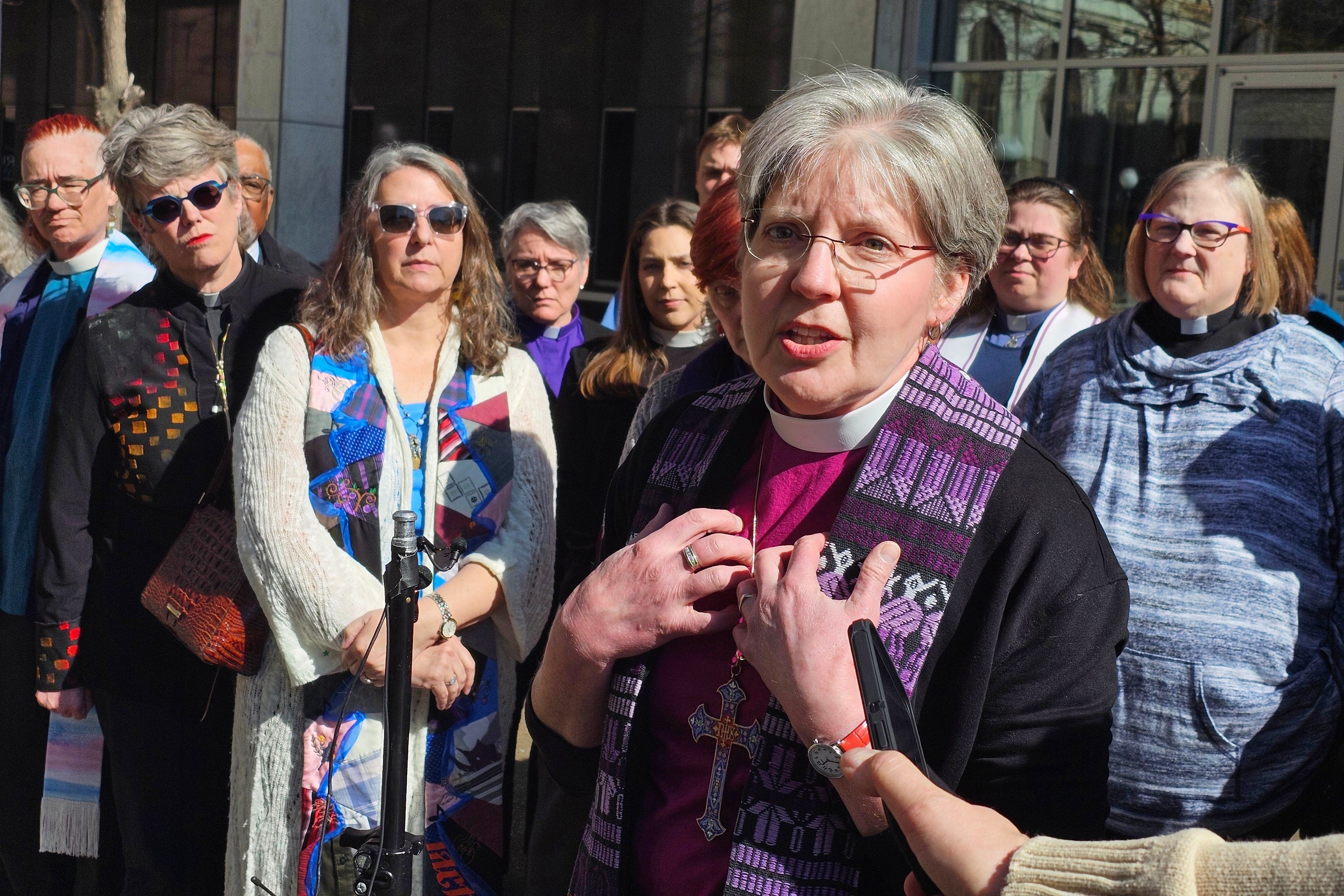
“The trauma that families and individuals are experiencing is enormous. To be able to meet people in those moments is at the heart of what we do as ministers across different traditions,” Nagel said.
The lawsuit claims that the Whipple building, named after Minnesota’s first Episcopal bishop and a 19th-century human rights advocate, now contradicts its namesake’s legacy. It argues that the facility has become a hub for the systematic violation of constitutional and legal rights by the federal government.
Government lawyers responded by stating that Operation Metro Surge ended on February 12. They also noted that new detentions have decreased, leading to a relaxation of temporary visitor restrictions, with clergy visits being allowed for over two weeks.
However, Judge Blackwell supported the plaintiffs’ argument that the issue remains relevant because the government still does not have a formal plan outlining access requirements and conditions for clergy visits.
The request for access received support from various religious leaders, including Catholic and Episcopal bishops in Minnesota, other Christian and Jewish clergy, and the Minnesota Council of Churches. The courtroom was filled with clergy from multiple denominations, such as Lutheran, United Church of Christ, Unitarian Universalist, and Jewish faiths.
Faith leaders across the country have been pushing for better access to immigration detention facilities, especially during significant religious periods like Lent and Ramadan. While ministering to detainees has been a long-standing practice, it has become more controversial amid current immigration enforcement efforts.
Similar legal actions were needed last month for two Catholic priests and a nun to enter an ICE facility in the Chicago suburb of Broadview on Ash Wednesday. Muslim and Christian clergy in Texas have also faced challenges accessing large ICE detention facilities.
Tauria Rich, a senior local ICE official overseeing Whipple, mentioned in a recent filing that visitors to the facility are rare and that any clergy requests are handled individually. She recounted an instance in early March where a clergy member attempted a visit but left because no detainees were present, claiming that the visit would have been allowed if detainees had been there.
ICE classifies the building as a short-term holding facility, distinguishing it from long-term detention centers where clergy visits are typically routine.
Access issues at Whipple extend beyond clergy. Three members of Congress from Minnesota were initially denied entry when they sought to inspect the facility, and upon gaining access, they reported poor conditions. Attorneys have also faced obstacles; another federal judge recently ordered Homeland Security to provide new detainees at Whipple immediate access to legal counsel before their transfer elsewhere. That judge recently held a hearing to consider making her temporary order permanent, with a ruling still pending.


