
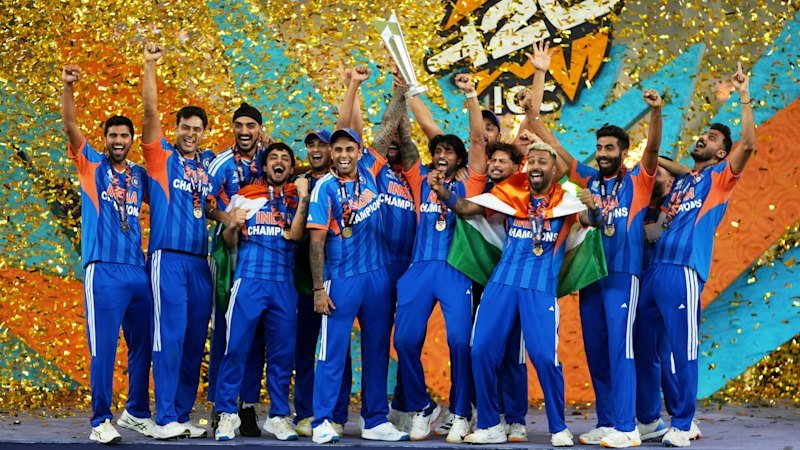
India Dominates T20 World Cup Final, Securing Third Consecutive Global Trophy
Just over two years ago, in a stark reversal of fortunes, Australia famously won the toss and chose to bowl against India in the ODI World Cup final at the colossal Narendra Modi Stadium in Ahmedabad. Pat Cummins’ Australian side executed a masterful plan, stunning the heavily favoured Indian team who had sailed through the tournament with an air of inevitable victory on home soil. That profound defeat has clearly left an indelible mark on India’s white-ball cricket teams, a sting that has now been thoroughly soothed by a commanding performance at the very same venue. India has now clinched its third successive global white-ball trophy, reaffirming its dominance on the international stage.
The script took a dramatic turn in the early hours of Monday morning as New Zealand, attempting a similar tactic of sending India in to bat in the T20 World Cup final, found themselves summarily thrashed. This latest triumph signals a new era for the Indian T20 squad. With the retirements of stalwarts Virat Kohli and Rohit Sharma, the team is now exclusively comprised of players who have honed their skills and built their reputations in the crucible of the Indian Premier League (IPL). This new generation plays with an unburdened fearlessness, evident in their explosive batting assault on the Black Caps.
An Explosive Opening Partnership Sets the Tone
The demolition of New Zealand’s bowling attack commenced with a blistering 52 runs from just 21 balls by 25-year-old Abhishek Sharma. Sharma, who also happens to be Travis Head’s opening partner for Sunrisers Hyderabad in the IPL, had endured a challenging tournament, even being dropped after a string of three consecutive ducks. However, on this pivotal occasion, he unleashed the raw power and audacious flair that earned him his place in the squad.
Sharing the crease with Sharma was wicketkeeper Sanju Samson, who played a sensational innings of 89 runs off just 46 balls. Samson emerged as India’s leading scorer in the tournament, amassing an impressive 321 runs across just five matches at a remarkable strike rate of 199.37. While not a newcomer at 31, Samson’s impact on this tournament is particularly significant as he represents a generation of Indian cricketers whose rise to prominence has been largely fuelled by their stellar performances in the IPL.

This formidable opening duo forged a remarkable partnership, accumulating 98 runs in a mere seven overs. This explosive start provided a crucial foundation, laying the groundwork for a score that New Zealand ultimately proved incapable of chasing. It served as a stark contrast to Australia’s own collapse from a similar strong position against Sri Lanka during their premature exit from the same tournament.
Bowling Analysis: A Nightmare for New Zealand
The bowling figures for the Black Caps were, to put it mildly, grim. Lockie Ferguson, New Zealand’s fastest bowler, conceded 48 runs from his two overs. Jacob Duffy fared only marginally better, going wicketless for 42 runs in three overs, while the usually reliable Matt Henry managed just one wicket for 49 runs in his four overs. At times, the Indian batsmen seemed to be facing bowling machines, as if they had been pre-informed of the exact location and speed of each delivery.
Sustaining the Momentum and Setting a Monumental Target
Ishan Kishan, batting at number three, ensured that the rapid start was capitalised upon fully. He contributed his own half-century, and together with Samson, propelled India to a commanding 1-203 within 15 overs before they were eventually separated. New Zealand briefly sensed an opportunity when Samson, Kishan, and captain Suryakumar Yadav all fell in the 16th over, bowled by Jimmy Neesham. However, Shivan Dube extinguished any lingering hopes, smashing 21 runs from the final over of the innings to propel India’s total beyond the 250-run mark.
With a formidable 5-255 posted on the board, India had amassed a staggering total of 508 runs across the semi-final and final combined. This level of batting destruction represented a significant elevation for the T20 format, mirroring the paradigm shifts brought about by Sri Lanka in the 1996 ODI World Cup and later by Australia in the 50-over game.
Bumrah’s Brilliance Damps New Zealand’s Hopes
Chasing such a colossal target, New Zealand’s faint hopes rested squarely on the shoulders of their aggressive openers, Tim Seifert and Finn Allen. Seifert showed flashes of brilliance, clobbering 21 runs from the second over, delivered by Hardik Pandya. However, this initial flurry of boundaries proved to be unsustainable.
The primary architect of New Zealand’s downfall was the singular brilliance of Jasprit Bumrah, the last remaining “galactico” from India’s previous era of cricketing superstars. Bowling the fourth over, Bumrah struck with his very first delivery, deceiving Rachin Ravindra with a masterful change of pace. The resultant edge was spectacularly caught by a diving Ishan Kishan in the deep, igniting the celebrations. Bumrah later articulated his approach, emphasising that raw pace alone is insufficient at this level.
“Because I’ve played on belters over here, I have also seen the other team, how they were bowling … I have learnt over here when you are trying to bowl too fast, it gets easier,” Bumrah explained.
“Shot-making gets easier, sometimes the ball skids on [to the bat], so keep being smart, keep changing your pace and expect what the batsman is trying to do.”

New Zealand’s innings rapidly unravelled, with the score plummeting to 5-72, effectively sealing the fate of the match. While Seifert continued to battle and captain Mitchell Santner offered some late resistance in a rearguard action, their efforts largely served to prolong the inevitable, allowing the jubilant crowd of 86,824 to savour the imminent reality of back-to-back T20 World Cup triumphs for India. The Kiwis were ultimately dismissed for 159.
A Sweet Victory and a Look to the Future
Watching the jubilant scenes unfold with an ear-to-ear grin was International Cricket Council (ICC) chairman and former BCCI secretary, Jay Shah. He was seated in the very stadium that he had helped his father, Amit Shah, construct a decade prior. The unadulterated joy on display stood in stark contrast to the dejected expressions of 2023, a memory that Bumrah was quick to recall as the trophy was wheeled out for presentation to the victorious Indian side.
“It feels extremely special because I played one final at my home venue and couldn’t win that one,” Bumrah remarked.

“This one feels really special. I was really motivated.”
Spurred on by the pain of their 2023 ODI World Cup final loss, India is now fully capitalising on its unparalleled talent pipeline, amassing global trophies with remarkable speed.
Hours before the final, social media was abuzz with footage of New Zealand bowler Brett Randell, who had claimed a “triple hat-trick” – five wickets in five balls – in a domestic New Zealand match. This serves as a reminder of the talent present in other nations, but it does little to diminish India’s current dominance.
With the ODI World Cup scheduled for South Africa next year, followed by the T20 World Cup in Australia and New Zealand in 2028, and the historic return of cricket to the Olympics in Los Angeles, it would be incredibly bold to predict anything other than a sustained period of success for this formidable Indian side.
Match Highlights:
- India secured victory in the T20 World Cup final at the Narendra Modi Stadium by a commanding 96 runs.
- The home team batted first, posting a formidable 5-255, before bowling New Zealand out for 159.
- Despite the batting fireworks, it was veteran fast bowler Jasprit Bumrah who was named Player of the Final for his exceptional spell of 4-15 from four overs.
- Bumrah’s teammate, batsman Sanju Samson, was deservedly awarded Player of the Tournament for his outstanding batting contributions.
- This triumph marks India’s third consecutive major international white-ball tournament victory, following their wins in the 2024 and 2026 T20 World Cups and the 2025 ICC Champions Trophy.


