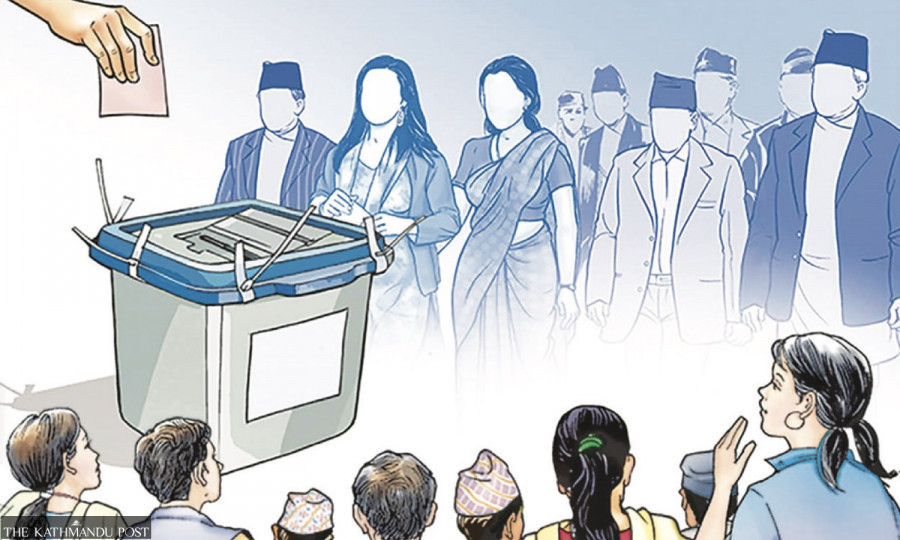
Bridging the Gap: Mother Tongue Voter Education Aims to Boost Electoral Awareness in Makawanpur
In a significant initiative to enhance electoral participation and curb the prevalence of invalid votes, voter education programs are actively being conducted in the mother languages of local communities across several rural municipalities and wards in Nepal’s Makawanpur district. This crucial effort is taking place in anticipation of the upcoming House of Representatives elections, scheduled for March 5.
The program is particularly focused on areas with a higher proportion of marginalized communities and lower literacy rates, where understanding complex election procedures, often conducted solely in Nepali, can pose a significant challenge.
Targeted Outreach in Diverse Communities
In Raksirang and Kailash rural municipalities, areas predominantly inhabited by the Chepang community, volunteers are diligently conducting voter education sessions in the Chepang language. This tailored approach is deemed essential for ensuring that these voters, many of whom may have limited literacy in Nepali, can fully grasp the voting process.
Similarly, in Thaha Municipality, voter education is being delivered in the Tamang language, reflecting the area’s demographic makeup. Anil Lamichhane, a voter education monitoring officer, highlighted the strategic selection of volunteers. “Because volunteers belong to the same communities, they are able to explain voting procedures clearly in the mother tongue, which has increased participation and understanding,” he stated. This community-centric approach is designed to foster trust and facilitate clearer communication.
A District-Wide Initiative for Informed Voting
The comprehensive voter education program commenced on Sunday and is set to encompass all 102 wards within Makawanpur district. Overseen by the Provincial Election Office in Hetauda, the initiative’s primary objective is to significantly reduce the number of invalid votes cast in the forthcoming elections.
The nation is gearing up for snap elections on March 5, a move that comes two years ahead of the original schedule. This early election follows a period of political flux, marked by the toppling of the UML-Congress coalition government in September due to an anti-corruption movement.
Mobilizing Local Resources for Maximum Reach
Election officials have detailed a structured approach to volunteer deployment. Trained monitors, dispatched from each local unit, are responsible for training ward-level volunteers. These volunteers, in turn, are conducting extensive door-to-door voter education campaigns. To ensure that no segment of the population is overlooked, early childhood facilitators and female community health volunteers have also been mobilized. Their involvement is critical for reaching households directly, providing guidance to first-time voters and those who are illiterate on the intricacies of ballot marking and the voting procedures. According to Hari Prasad Dhakal, chief of the Provincial Election Office, the program is slated to continue its outreach efforts until March 1.
Addressing a Persistent Electoral Challenge
Past election data from Makawanpur, a district situated in Bagmati Province with a terrain comprising both hilly and inter-Tarai regions, has consistently indicated a relatively high number of invalid votes. During the 2022 House of Representatives elections, Makawanpur recorded a notable percentage of invalid votes. In Constituency No. 1, these stood at 4.46 percent under the first-past-the-post system and 3.93 percent under the proportional representation system. Makawanpur Constituency No. 2 saw even higher figures, with invalid votes reaching 4.76 percent and 4.85 percent respectively for the two electoral systems.
Makawanpur district is home to a substantial electorate, with a total of 315,334 registered voters. This includes 153,376 women voters and five voters registered under other gender categories. Election officials are optimistic that the mother tongue-based voter education strategy will play a pivotal role in minimizing confusion among voters and encouraging more informed and effective participation in the upcoming polls. The ultimate aim, they assert, is to see a tangible reduction in the percentage of invalid votes.