

Carlton games often carry an air of anticipated disappointment. They’ll draw crowds, they’ll engage in physical contests, and they’ll execute the actions their coach champions. However, their adversaries, and indeed the Carlton faithful, understand that the strategy to overcome the Blues involves weathering their initial onslaught, absorbing their pressure, allowing them to expend their energy, and then launching a decisive counter-attack.
This pattern has been evident for years: their struggles to maintain performance in the latter stages of games, their lapses in skill when fatigued, and their persistent inability or unwillingness to adapt when an opponent gains momentum. On Sunday, in their 11.11 (77) to 15.10 (100) defeat to Melbourne, another significant factor emerged – the presence, the power, and the sheer talent of Kysaiah Pickett.
Pickett, the son of a stand-up comedian, elicited a reaction from the Carlton supporters making a hasty exit that mirrored the feeling of enduring an hour of relentless, unfunny jokes. Their team had held a commanding 43-point lead. The midfield dominance of Patrick Cripps, Jagga Smith, and Sam Walsh had seemingly dismantled the Demons. The outcome appeared a foregone conclusion. But this was Kysaiah Pickett, and this was Michael Voss’s Carlton.
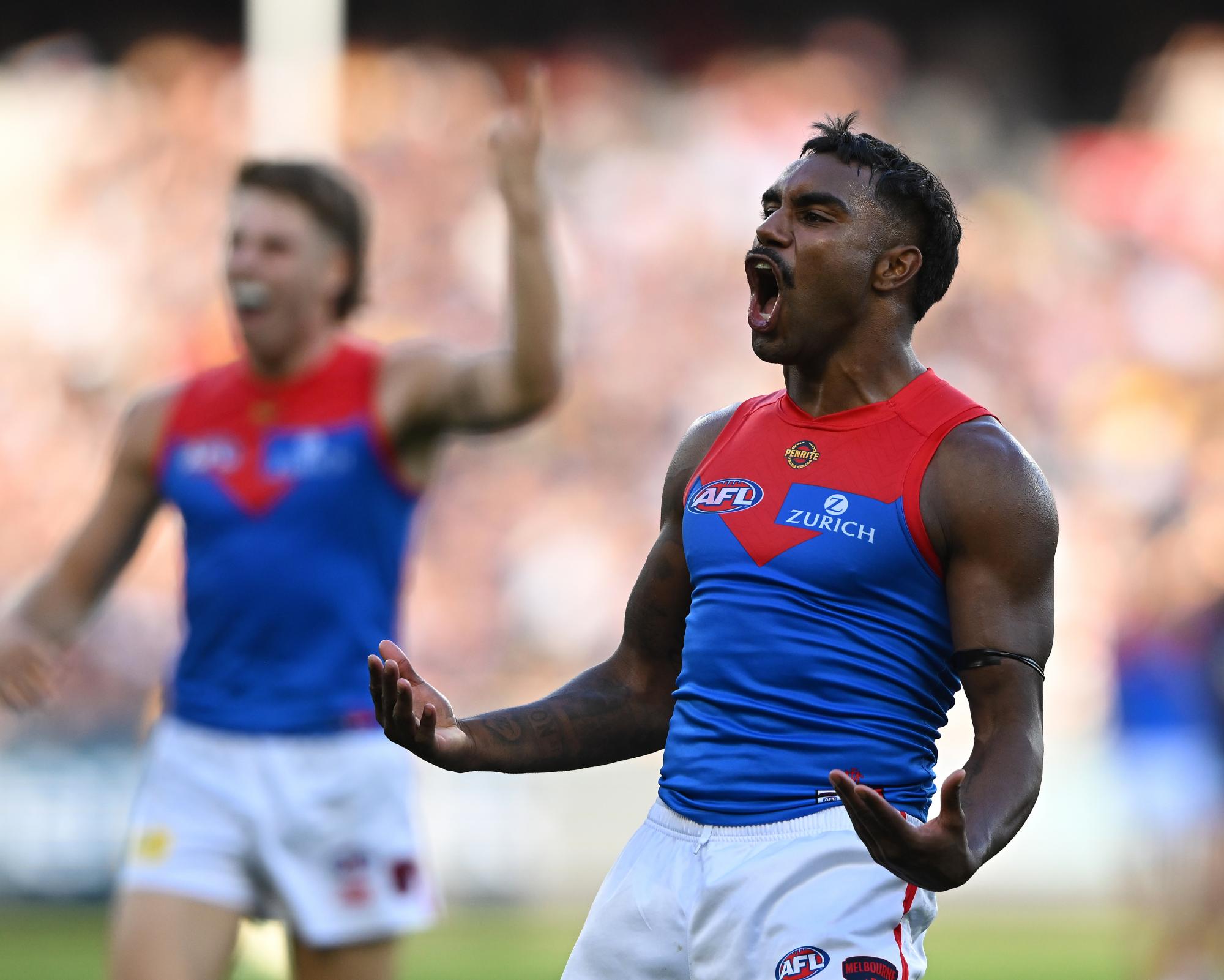
Pickett’s statistics – 24 kicks, 11 contested possessions, and 10 score involvements – only begin to convey his profound impact on the match. While one could focus on his signature moments – his agile escapes from stoppages, his full-speed charges into packs, and his relentless tackling from behind – these still don’t fully capture his influence. Nor does highlighting the subtle aspects of his game, such as his controlled disposal, his measured kicks, his constant readiness at stoppages, and his adept weaving through congested play.
The most effective way to grasp Pickett’s performance on Sunday is to consider it from the Carlton players’ perspective. As he began to exert his influence in the second half, the Blues were understandably, and completely, preoccupied with him. When they possessed the ball and he was nearby, they would make hesitant, nervous movements. At stoppages, their attention would invariably be fixed on him, only for him to glide through the contest effortlessly. In transition play, he would often be the second, fourth, or even sixth link in the chain, leading to finger-pointing, head-shaking, and collisions among the Carlton players. With the game on the line, when he brought a hurried high ball to ground with one hand and then slotted the match-sealing goal with a single step, every Carlton player’s shoulders slumped.
When a player performs at Pickett’s level, having a ruckman of Max Gawn’s calibre is a significant advantage. A fortnight prior, Gawn thoroughly outplayed the inexperienced Tom De Koning, seemingly taking the St Kilda ruckman’s performance personally. It served as a potent reminder, in today’s inflated player market, that many of the league’s most valuable assets are not necessarily the highest earners. Gawn’s 250th game was a masterclass, showcasing the attributes that have established him as one of the game’s all-time great ruckmen: his exceptional craft, his remarkable resilience against physical punishment, and his enduring stamina. Gawn’s ability to look fresher as the game progresses is a particularly valuable trait, especially when facing a team like Carlton.
Coach Michael Voss maintains that his focus is on highlighting the positives and celebrating small victories. However, he admitted to being “filthy” on Sunday night. Winning contested possession is not the issue for his team. Every junior footballer understands the importance of winning the hard ball, and Voss consistently reinforces this message. The glaring problem lies in their kicking, which is frequently poor, particularly the short, 20-metre passes that are crucial for setting up play. While few teams can match Brisbane’s proficiency in this area, these initial short kicks are fundamental to Carlton’s effective play. The Blues simply lack the confidence and the capability to execute them consistently. Footage from February, showing them struggling with short kicks in windy, pre-season conditions, generated considerable amusement. While it was dismissed as a minor issue at the time, it continues to cost them dearly and could ultimately jeopardise Voss’s coaching tenure.
In another match, St Kilda’s encounter with Brisbane started poorly but eventually developed into an entertaining, back-and-forth contest. However, midway through the final term, Brisbane asserted their dominance, exposing St Kilda’s limitations. In critical moments when the game was in the balance, several passages of play illuminated the gulf between the two teams. These included Kiddy Coleman’s goal from a sweeping run, set up by a precise left-hand handball from Lincoln McCarthy, a perfectly weighted around-the-corner kick from Zac Bailey, and three courageous defensive efforts from Darcy Wilmot. St Kilda displayed effort, as is their trademark. Yet, they lacked the depth of talent to match Brisbane’s sustained pressure. Uncharacteristically for a Ross Lyon-coached team in March, they appear to be struggling to maintain their intensity for the entire game.
The Lions wore a striking maroon Fitzroy jumper, complete with dark navy collars and shoulders. While a nostalgic delight for many, it proved somewhat confusing for players and spectators alike in identifying the teams. This minor inconvenience was entirely forgotten when the Fitzroy theme song was played after the final siren. My train journey on Saturday morning was filled with older Fitzroy supporters adorned in club colours. The sight of the Fitzroy jumper and the rousing rendition of the team song, particularly after that final quarter performance, would have undoubtedly warmed the hearts of those devoted “Roy Boy” fans.
“Fitzroy, Fitzroy, the club we hold so dear…”


