
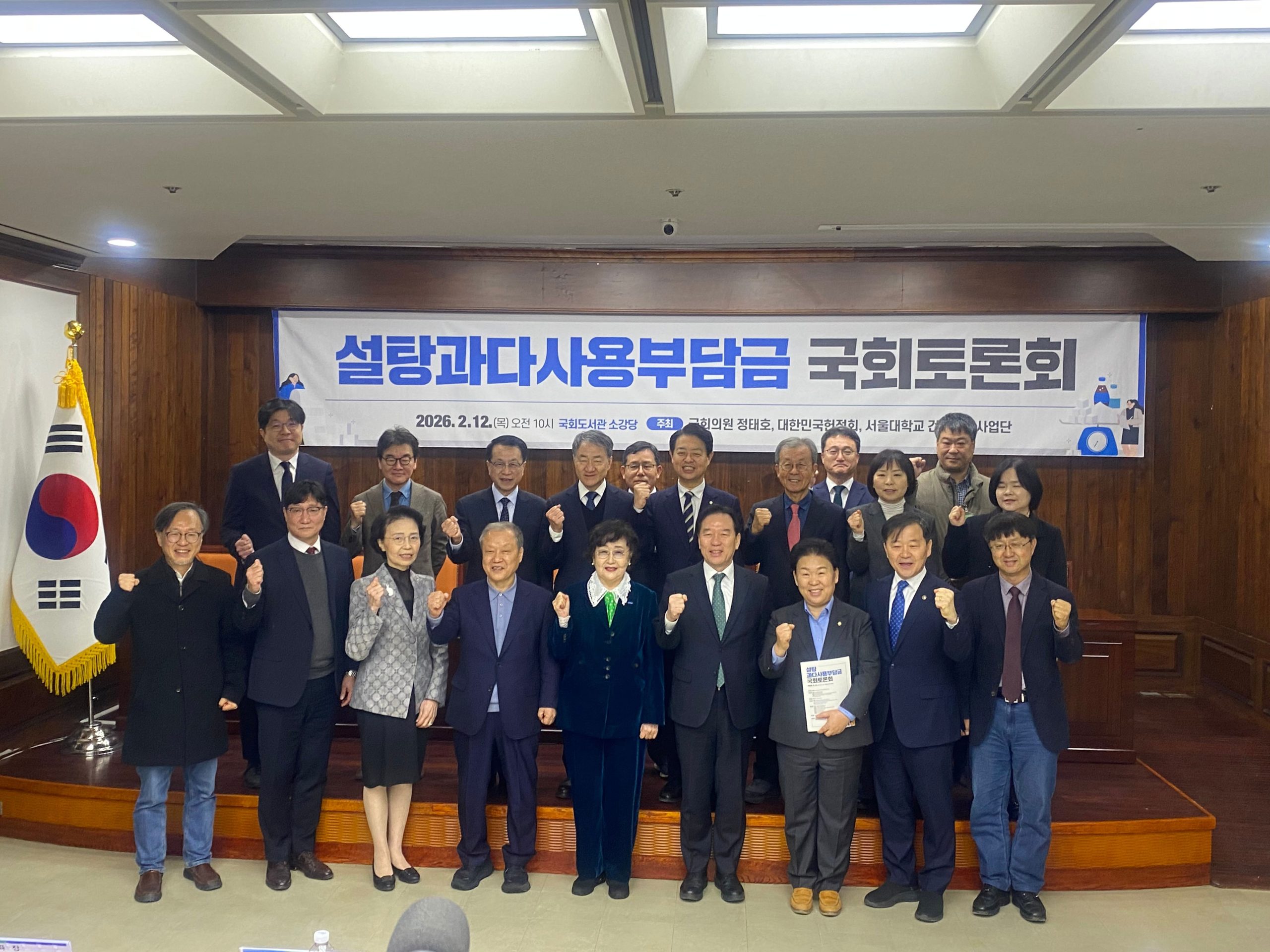
National Assembly Grapples with Proposed Sugar Overuse Levy
A significant debate on the implementation of a “Sugar Overuse Levy” recently took place at the National Assembly Library in Yeouido, Seoul. Organized by Seoul National University’s Health Culture Business Unit and Democratic Party of Korea Representative Jeong Tae-ho, this forum marked the second major discussion on the matter, following an initial session in September of the previous year. The proposal to introduce such a levy has gained traction, with President Lee Jae Myung recently advocating for the redirection of funds generated from it towards bolstering public healthcare infrastructure.
The Rationale and Purpose of a Sugar Levy
Experts at the forefront of this discussion emphasized the potential of a sugar levy to serve the broader public interest. Professor Yun Young-ho of Seoul National University College of Medicine articulated this vision, stating, “The sugar levy should be used for public interests such as strengthening the right to health and resolving health inequalities, in line with its nature as a levy.” He further elaborated on its utility in addressing national health crises, including challenges within regional public healthcare systems and alleviating the financial burden of medical expenses for citizens.
Professor Yun also highlighted the critical need for a meticulously designed framework for fund utilization. While existing legislative proposals outline the imposition of the levy and its intended applications, he stressed that any effective legal incorporation must also consider the perspectives and impacts on both businesses and consumers.
Addressing Public Perception and Potential Challenges
A key point of discussion revolved around the potential public perception of the levy. Lee Sang-wook, head of the Korea Food Industry Association, voiced concerns that, despite its intended purpose, the public might interpret the sugar levy as a direct tax. He argued, “Even if the purpose of the sugar levy is clear, the public may perceive it as a tax. Since it is likely to be seen as a tax policy directly affecting citizens’ lives—not just an administrative levy—social consensus and review must precede its implementation.”
Concerns regarding potential price increases for consumers were also prominent. Jeong Ji-yeon, secretary-general of the Korean Consumer Federation, identified this as a paramount issue. “From a consumer perspective, the more critical issue than where the funds are used is whether the burden will be passed to consumers,” she stated. She underscored the necessity of clearly defining the levy as a measure to address health concerns, rather than a means to expand tax revenue, and stressed the importance of continuous monitoring of price fluctuations post-implementation.
Terminology and Classification
Discussions also delved into the appropriate terminology for the proposed measure. Professor Lee Jin-soo of Seoul National University Graduate School of Public Administration clarified the distinction between a “sugar tax” and a “levy.” He explained, “Using the term ‘sugar tax’ does not necessarily mean it is a tax under national or local tax laws. The key issue is ‘overuse,’ and legally, it should be classified as a levy. The term ‘Sugar Overuse Levy’ is considered appropriate.” This distinction aims to frame the measure as a targeted intervention against excessive sugar consumption rather than a general revenue-generating tax.
Public Support and National Health Concerns
The impetus for these discussions is rooted in alarming public health statistics. Representative Jeong Tae-ho cited data from the World Health Organization (WHO), indicating that “1 in 5 adults and 1 in 3 adolescents in South Korea consume sugar beyond recommended levels, leading to the country being called the ‘Republic of Sugar.’” He asserted that neglecting to debate the sugar levy would signify a dereliction of the state’s responsibility to address this pressing public health issue.
Further underscoring the public’s receptiveness to such measures, a survey conducted last month by Hankook Research, commissioned by Seoul National University’s Health Culture Business Unit, revealed significant support. The poll of 1,030 citizens found that an overwhelming 80.1% backed the imposition of a ‘sugar overuse tax’ on companies utilizing excessive added sugars in their products.
This sentiment was echoed by President Lee Jae Myung, who, on the 28th of the previous month, referenced these survey findings on his X (formerly Twitter) account. He posed a direct question to the public: “What are your opinions on suppressing sugar use through a sugar levy and reinvesting the funds to strengthen regional and public healthcare?”
Divergent Opinions and Evidence
While initial assumptions might suggest a divide in opinion based on income or political ideology, survey results presented during the debate indicated otherwise. Professor Yun explained, “There was debate over whether positions on the levy differ based on income or political leaning, but survey results showed no significant difference in support or opposition. Over 70% of conservatives also support the sugar levy.” This suggests a broad consensus across various demographic and political spectrums regarding the need to address sugar overuse.
The ongoing dialogue signifies a critical juncture in South Korea’s approach to public health and diet-related diseases. The proposed Sugar Overuse Levy, while facing scrutiny regarding its implementation and public perception, appears to be gaining momentum as a potential policy tool to foster healthier consumption habits and bolster the nation’s healthcare system.


