
Asteroid’s Solar Orbit Successfully Altered in Historic Planetary Defence Test
In a groundbreaking development for planetary defence, scientists have confirmed that an asteroid’s path around the sun has been successfully and intentionally shifted. This landmark achievement, the first of its kind, demonstrates a crucial capability that could be employed to deflect potentially hazardous space rocks in the future. The celestial body involved in this experiment, however, never posed any threat to Earth, making it an ideal candidate for this pioneering test.
An international team of researchers has hailed the significance of this orbital adjustment. Their findings, published in the journal Science Advances, highlight a “notable step forward in our ability to prevent future asteroid impacts on Earth.” While the alterations to the asteroid’s solar orbit might seem minuscule – amounting to a reduction of just one-tenth of a second in its orbital period and a change of 720 metres over a two-year journey spanning hundreds of millions of kilometres – their long-term implications are profound.
“Even though this seems small, a tiny deflection … can add up over decades and make the difference between a potentially hazardous asteroid hitting or missing the Earth in the future,” explained lead author Rahil Makadia from the University of Illinois Urbana-Champaign. He emphasised that for any effective planetary defence strategy, “the key isn’t delivering a huge shove at the last minute. The key is delivering a tiny shove many years in advance.”
The DART Mission: A First-of-Its-Kind Impact
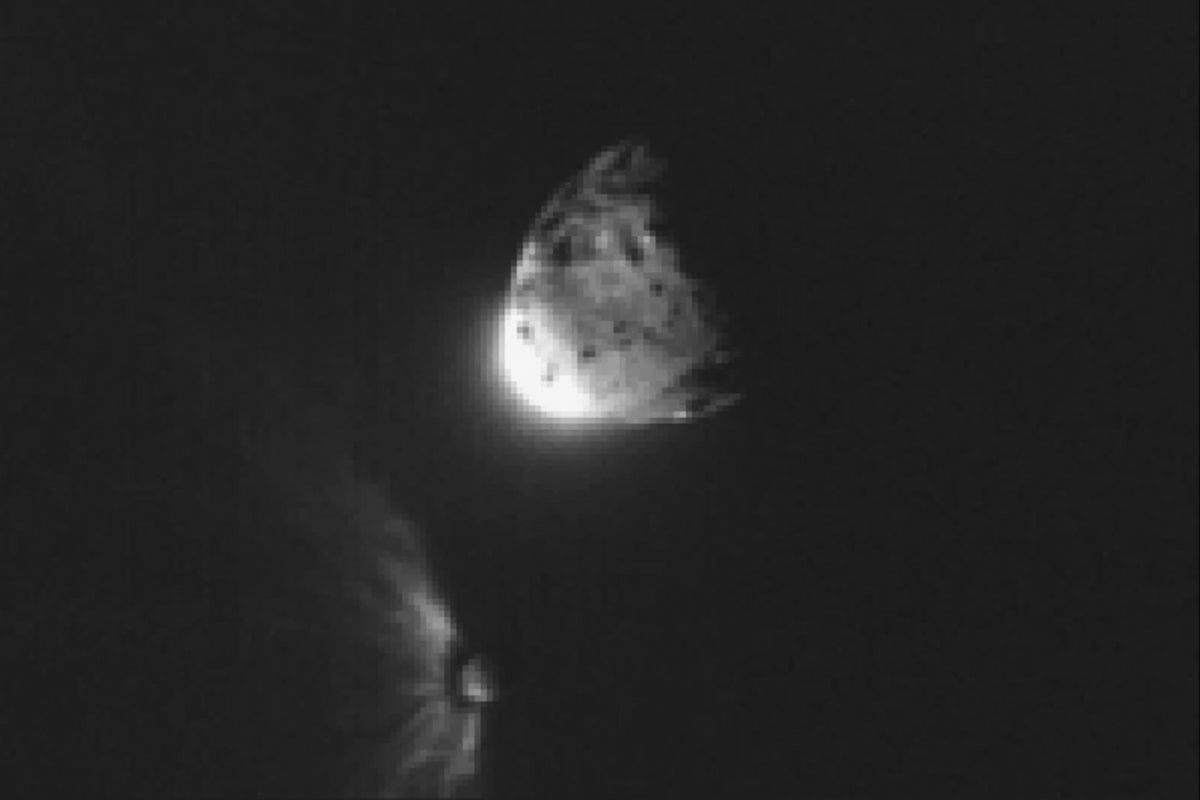
This pivotal experiment was part of the world’s first planetary defence exercise, initiated in 2021 with the launch of NASA’s Double Asteroid Redirection Test (DART) spacecraft. DART was deliberately aimed at Dimorphos, a small asteroid that orbits a larger companion, Didymos, as they both journey around the sun. The immediate aftermath of the 2022 impact indicated that the collision had successfully altered Dimorphos’s orbit around Didymos.
However, it has taken until now for scientists, using observations from observatories worldwide, to definitively confirm the precise impact on their collective solar orbit. The data reveals that the impact shortened the duo’s travel time around the sun by a mere 0.15 seconds. Considering their orbital period of 769 days, this translates to a real-time slowdown of just over 10 micrometres per second. This subtle change has effectively shrunk their 300-million-mile (480-million-kilometre) orbit by 2,360 feet (720 metres).
The Physics of the Push: Ejected Debris Plays a Role
The researchers’ analysis also shed light on the mechanics of the orbital shift. It was found that the considerable amount of rock and debris ejected from Dimorphos during the DART impact contributed significantly to the momentum transfer, effectively doubling the push received by the asteroid. Estimates from a US-Italian team last summer suggest that approximately 35 million pounds (16 million kilograms) of material were ejected from the asteroid’s surface.
Earth Remains Safe: A System Chosen for its Safety
Crucially, the orbital adjustments have not placed Earth in any danger. The rubble-packed asteroid system was specifically chosen for this mission precisely because it posed no threat, as noted by Steven Chesley of NASA’s Jet Propulsion Laboratory, who was involved in the study. “While it is just a single experiment, it is nonetheless an important data point that will be relevant to any future asteroid deflection missions,” Chesley stated.
Future Observations: The Hera Mission’s Role
Further insights into the aftermath of the DART impact are anticipated when the European Space Agency’s Hera spacecraft reaches the asteroid system in November. Dimorphos measures approximately 525 feet (160 metres) in diameter, while its larger companion, Didymos, is about 2,560 feet (780 metres) across. The latest study indicates that Didymos possesses roughly 200 times the mass of Dimorphos.
Unlike the DART mission, Hera will not impact the asteroids. Instead, it will spend months conducting detailed surveys of the system. As part of its mission, Hera will deploy two small experimental probes designed to attempt a landing on Dimorphos, providing unprecedented close-up data on the impact site and the asteroid’s composition. This ongoing research promises to deepen our understanding of asteroid behaviour and refine future planetary defence strategies.


