

The Visionary Architect Zaha Hadid
Zaha Hadid, a British architect of Iraqi origin, established her independent architectural office in London in 1980 at the age of 30. She taught architecture at major universities in the U.S., U.K., and Germany. Her career was marked by groundbreaking designs that defied traditional architectural norms, characterized by non-linear structures and curved forms.
Despite her innovative concepts, Hadid struggled to see her designs realized as actual buildings until the early 1990s. Critics often questioned the feasibility of her ideas, arguing that they were only theoretically possible. However, in 1993, she finally brought her visions to life, marking a significant turning point in her career.
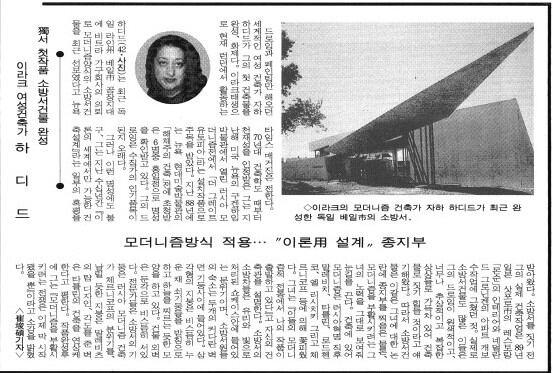
Hadid’s first completed building was a fire station for the Vitra Furniture Company’s factory complex in Weil am Rhein, Rhineland, Germany. This project garnered widespread attention, as it was the first time her theoretical designs were translated into physical structures. Many had previously considered her drawings too vivid and abstract, making them difficult to realize as buildings.
Her later works include the Rosenthal Contemporary Art Center in Cincinnati, U.S. (1998), the Guangzhou Opera House in China (2003), and others. In 2004, she became the first woman to receive the Pritzker Prize, often referred to as the Nobel Prize of architecture.
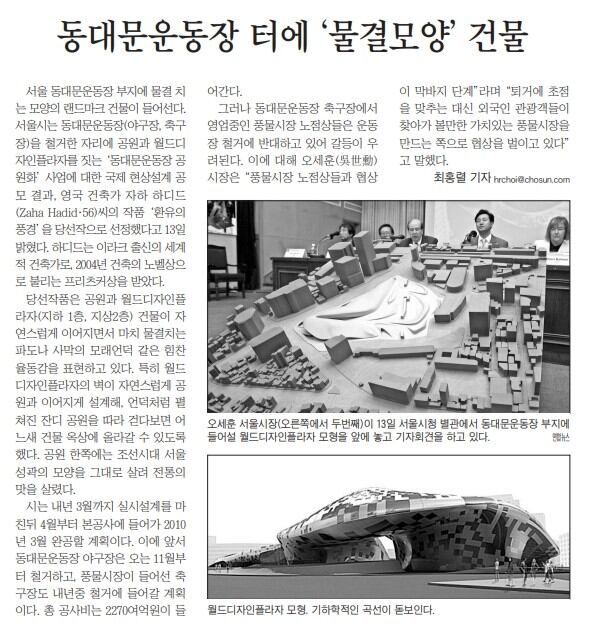
One of her notable projects is Seoul’s Dongdaemun Design Plaza (DDP). It was selected as the winning design in an international competition in 2007. The DDP is a landmark building resembling flowing waves, constructed on the site of the former Dongdaemun Stadium. The design expresses dynamic rhythm, like flowing waves or desert sand dunes, with seamless connections between the park and the underground-first-floor, two-story-above-ground World Design Plaza.
In a 2007 interview, Hadid emphasized the practicality of her work. She stated, “My architecture is practical,” and criticized the conventional thinking that dictated how buildings should look. She explained that she always reads the topography of the site where the building will be located, sets a concept suitable for it, and then thinks about how to use materials effectively. Since most of her works are curved, she conducts extensive research on materials and construction methods.
During a May 2009 interview in Seoul, she reiterated the importance of practicality in innovation. “Although we create things that are amazingly new, the important foundation is practicality. Innovation based on practicality is key,” she said.

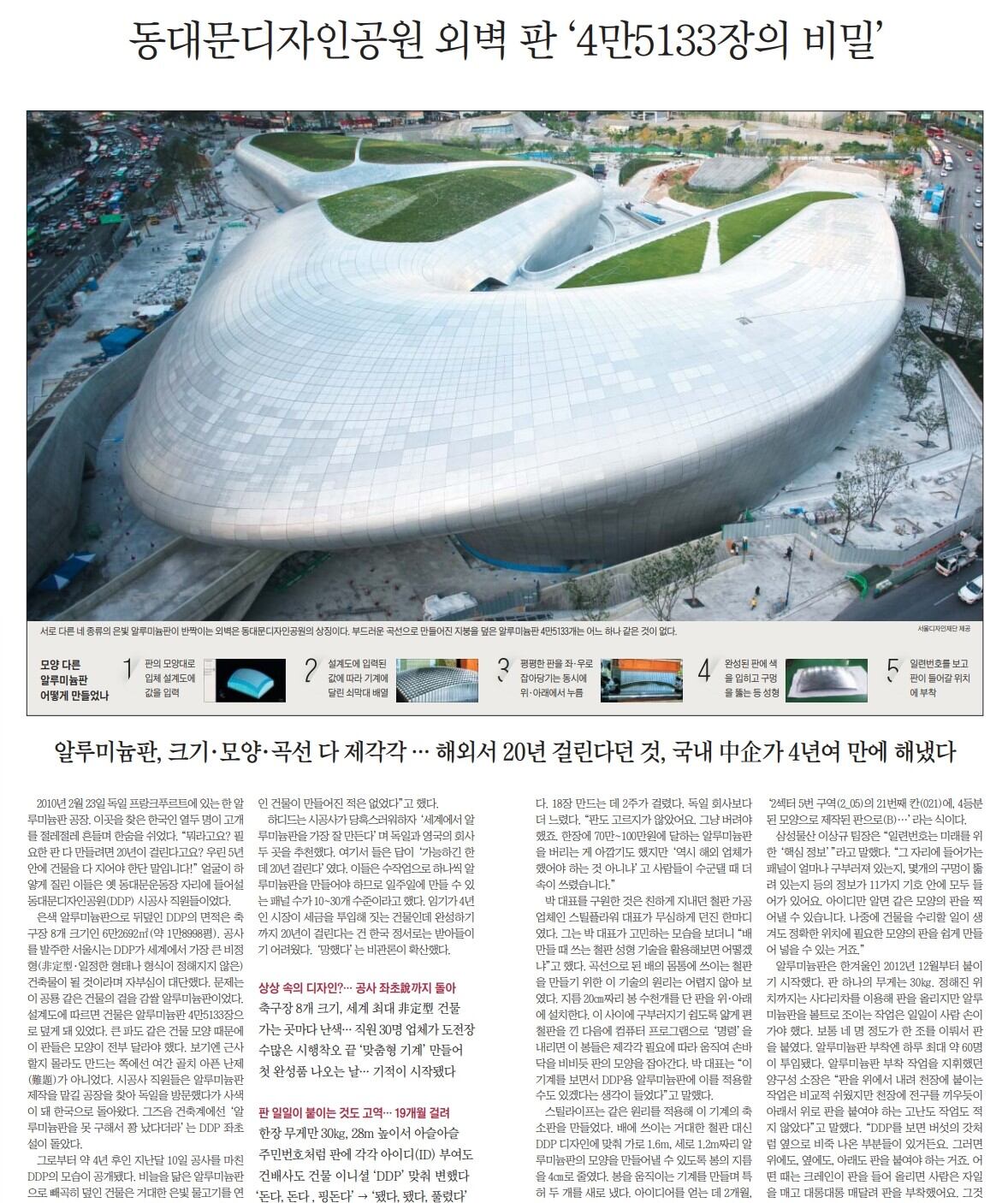
The DDP project began during Mayor Oh Se-hoon’s tenure in 2007 but was completed in 2014 under Mayor Park Won-soon. At the completion ceremony, Mayor Park expressed his satisfaction with the integration of various aspects of Seoul, such as the Hanyang Fortress and traditional markets around the DDP, to make it a hub for creative industries. Hadid expressed satisfaction upon seeing the completed DDP, noting its beauty and the harmony between the site’s topography and the building.
Hadid passed away on March 31, 2016, two years after the completion of the DDP. Her obituary highlighted the praise her architecture received for its originality, despite criticism. Her buildings were often criticized for being “too expensive and overly radical,” but they were recognized for their beauty and originality through the use of non-linear and curved forms instead of straight lines.
She also designed the main stadium for the 2020 Tokyo Olympics, although the Japanese government scrapped her design in July due to excessive costs. Despite these challenges, Hadid’s legacy continues to influence the world of architecture.