

Cosmic Enigma Solved: White Dwarf Binary Unravels Secrets of Rare Radio Bursts
Astronomers have finally cracked the code behind a peculiar and infrequent cosmic phenomenon: long-period radio transients. A groundbreaking discovery by researchers at the University of Sydney, detailed in the esteemed journal Nature Astronomy, has pinpointed a unique binary star system as the source of these elusive signals. This finding, made possible by the cutting-edge capabilities of CSIRO’s ASKAP radio telescope, promises to reshape our understanding of extreme stellar physics.
A Celestial Dance Reveals Its Source
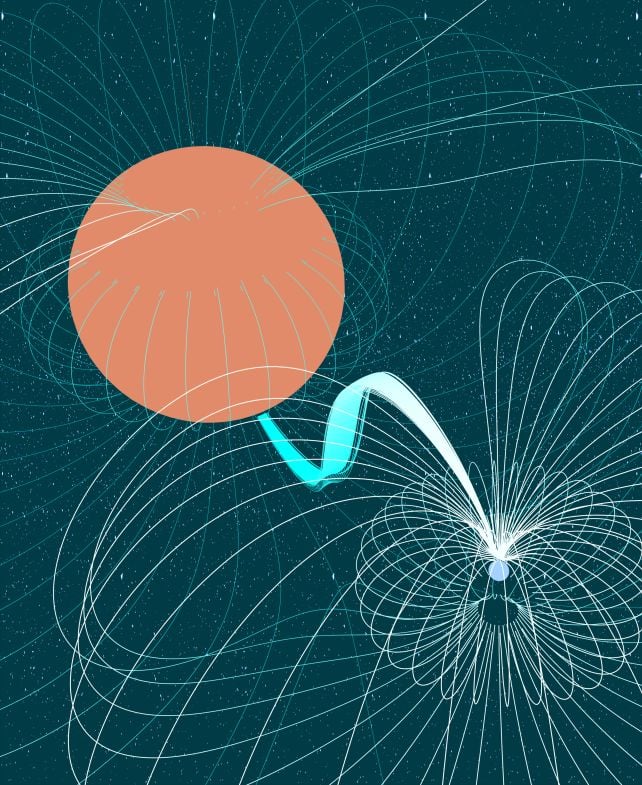
The newly identified cosmic entity, designated ASKAP J1745−5051, is a fascinating pairing of stellar bodies. It comprises a white dwarf – the dense, Earth-sized remnant of a star that has exhausted its nuclear fuel, yet possesses a mass akin to our Sun – locked in a tight embrace with a red dwarf star, considerably smaller, with only about one-tenth of the Sun’s mass.
These two celestial companions are locked in a rapid orbital waltz, completing a full revolution around each other in just over an hour. This intense gravitational interaction fuels a dramatic process: the red dwarf is steadily losing material, which is then siphoned off by the gravitational pull of the white dwarf. As this stellar material spirals inward towards the white dwarf, it heats up to extreme temperatures, unleashing powerful bursts of radio waves and X-rays.
“This is the first time we’ve been able to definitively identify the origin of these signals, confirming them to be from a ‘cataclysmic variable’ – essentially, a white dwarf star that is actively accreting material,” explained Kovi Rose, a Ph.D. student and the lead author of the study. “For years, long-period radio transients have been a genuine puzzle for astronomers. We’ve only detected about a dozen of them, and their sources remained a mystery. Now, we’ve demonstrated that one of these transients originates from a white dwarf actively drawing matter from its stellar partner.”
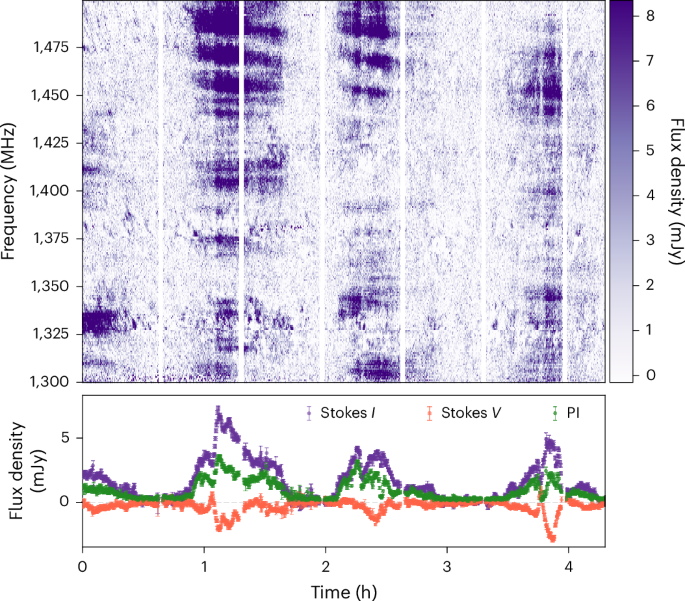
The emissions observed from ASKAP J1745−5051 occur with a striking regularity, directly correlating with the orbital period of the binary system. However, a curious observation is that the peaks in the radio and X-ray emissions are not synchronised, suggesting that these energetic bursts are emanating from distinct regions within the system. “All of these emissions are intrinsically linked to the orbital motion of the system,” Mr. Rose elaborated. “What’s particularly intriguing, though, is that the radio and X-ray signals don’t reach their peak intensity at the same moment, which strongly indicates they are generated in different parts of this cosmic duo.”
Decoding Cosmic Puzzles with Multi-Wavelength Astronomy
Prior to this discovery, the prevailing hypothesis for the origin of long-period radio transients pointed towards slowly rotating neutron stars, also known as pulsars. However, theoretical models suggested that such objects were unlikely to produce the observed signal characteristics, leaving astronomers in search of alternative explanations. The identification of ASKAP J1745−5051 provides compelling, direct evidence that binary systems featuring white dwarfs are indeed responsible for at least a portion of these enigmatic cosmic bursts.
“While some similar celestial objects had previously been tentatively linked to binary systems, this is the first instance where we can clearly observe both stars involved and witness the accretion process in action,” commented Professor Tara Murphy, Head of School at the University of Sydney and a Chief Investigator at OzGrav.
Furthermore, the system exhibits regular X-ray emissions, making it only the second known long-period radio transient to do so, and crucially, the first where the source of this regularity has been unequivocally confirmed.
The remarkable sensitivity, high resolution, and extensive sky coverage offered by the ASKAP telescope were instrumental in making this detection possible, capturing faint signals that might otherwise have remained undetected. The researchers have aptly described ASKAP J1745−5051 as a “stellar Rosetta Stone,” a vital key that could unlock the secrets of other long-period radio transients.
“This system provides us with a framework to decode these signals,” Mr. Rose explained. “It has the potential to help us differentiate whether other long-period transients behave more like pulsars or resemble these white dwarf systems, effectively serving as a stellar Rosetta Stone.”
A Natural Laboratory for Extreme Physics
Beyond its role in deciphering elusive cosmic signals, ASKAP J1745−5051 presents an unparalleled natural laboratory for studying extreme plasma physics, powerful magnetic fields, and the fundamental forces of gravity. By observing matter subjected to intense gravitational forces and exceptionally strong magnetic fields, scientists can investigate processes that are utterly impossible to replicate within terrestrial laboratories.
“These systems are essentially natural laboratories,” stated Mr. Rose. “They allow us to rigorously test our understanding of how matter behaves under the influence of potent magnetic fields and immense gravitational forces.” This significant discovery underscores the profound potential of such rare binary systems to not only advance the field of radio astronomy but also to deepen our fundamental comprehension of astrophysical phenomena.
Expanding the Cosmic Transient Map
The international team of researchers is now planning a comprehensive series of follow-up observations. By employing a combination of radio, optical, and X-ray telescopes, they aim to further investigate the precise mechanisms responsible for generating these powerful bursts and to determine whether similar processes are at play in the broader population of long-period radio transients.
“Every new discovery we make helps us to gradually piece together a more complete picture,” Mr. Rose concluded. “We are truly only at the dawn of understanding this newly identified class of cosmic events.” This groundbreaking discovery, a testament to global collaboration involving researchers from Australia, the United States, China, Canada, Spain, and Israel, represents a significant milestone in humanity’s ongoing quest to unravel the universe’s most enigmatic signals.


