Asia-Pacific Nations Grapple with Middle East Conflict Fallout
The ongoing conflict in the Middle East, initiated by events in Iran, has sent ripples far beyond its immediate borders, reaching the doorsteps of nations in the Asia-Pacific region. A recent call from then-US President Donald Trump for several countries, including South Korea and Japan, to dispatch warships to the Middle East in support of the war effort ignited protests thousands of kilometres away, highlighting deep-seated anxieties about regional stability and the potential for increased involvement in a distant war.
Anti-war activists in South Korea, for instance, staged a rally outside the US embassy in Seoul, unequivocally rejecting both the former President’s request and the war itself. Their concerns are rooted in the potential ramifications of a protracted conflict for their own country. These apprehensions are not unique to South Korea; across the Asia-Pacific, a prolonged war and a potentially distracted White House are raising fears about the delicate peace in the region.
Shifting Defence Assets: A Cause for Concern
Reports have emerged indicating the United States’ redeployment of defence assets previously stationed in South Korea and Japan to the Middle East, ostensibly to bolster its war efforts. This move has sparked a dual concern on two main fronts:
- Deterrence Capabilities: The presence of US military assets in East Asia is primarily intended to act as a deterrent against potential military aggression from North Korea and China. Fears are mounting that a significant redeployment of these assets could destabilise the region, potentially emboldening adversaries.
- Governmental Involvement: Residents in both South Korea and Japan have voiced unease about the extent to which their governments might become embroiled in the Iran war. These concerns were amplified by the former US President’s short-lived, yet pointed, request for warships to patrol the Strait of Hormuz.
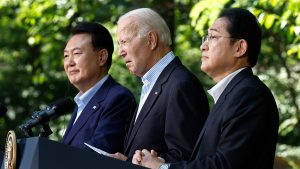
In South Korea, President Lee Jae Myung has attempted to allay public fears, asserting that the nation can maintain its deterrent capabilities against North Korea even with a shift in US assets and weaponry. Meanwhile, Japan’s Prime Minister Sanae Takaichi faces the delicate task of navigating this complex geopolitical landscape during her upcoming visit to the White House.
US Military Assets Head Westward
Throughout the conflict, numerous reports and photographic evidence have surfaced detailing the apparent movement of US military assets from East Asia to the Middle East. These reports suggest that components of the Terminal High Altitude Area Defense (THAAD) and Patriot missile defence systems are being withdrawn from South Korea.
This development occurred mere days after President Lee Jae Myung’s reassurances, and North Korea subsequently launched ten ballistic missiles towards the Sea of Japan. This action was widely interpreted as a response to the annual joint military exercises conducted by South Korea and the United States on the peninsula.
At a protest in Seoul opposing these military drills, Lee Hong-Jung articulated the anxieties of many: “With the war involving Iran ongoing and US forces-Korea assets reportedly heading toward the Middle East, US bases in South Korea could become potential targets at any time.”
In Japan, the leader of the country’s primary opposition party, Junya Ogawa, raised concerns in parliament regarding reports of two US destroyers based in Japan being redeployed. He stated, “Japan has not permitted the stationing of US forces so they can sortie from those bases to fire missiles towards the Middle East,” emphasising that their presence should be for ensuring Japan’s security and regional peace. Further reports indicate that Washington is also planning to move approximately 2,500 marines from Japan.
The former US President’s appeal for allied nations, including South Korea and Japan, to send warships to secure the Strait of Hormuz and ensure the passage of oil, led to palpable frustration at the Seoul protest. One participant, Jeong Young-Lee, expressed her outrage: “I was outraged to hear that he had asked his allies, specifically singling out South Korea, to send troops to Iran, and I could no longer remain silent.”
While many nations issued a firm “no” to the request for naval support, both Japan and South Korea adopted a more cautious approach, seemingly hesitant to antagonise the former US leader. Both countries cited potential domestic legal impediments to their consideration of the request. This did not, however, prevent them from becoming targets of a subsequent social media backlash from the former US President, who appeared to retract the appeal, stating, “we no longer ‘need’ or desire” the assistance. Prime Minister Takaichi is likely to face continued pressure on this issue, and the possibility of further requests for assistance, during her meeting with the former US President in Washington. This could potentially include a request for Japan to supply defensive missiles as American stockpiles diminish.
Japan’s Legal Labyrinth: Weighing Assistance
Like many citizens in Japan, 70-year-old Ikeda san has already experienced the war’s impact, from fluctuating petrol prices to flight delays for her son’s journey home from the United Kingdom due to international travel disruptions following the initial strikes. She is keen for Japan to minimise any further domestic repercussions. “Everyone’s against [Japan becoming involved], I think,” she commented. “So, I don’t think Japan will be able [to provide military support like missiles].”
The nation’s pacifist constitution has offered reassurance to many that Japan will not become directly involved in conflicts, despite existing ambiguities within its legal framework. Fujishita san, 77, believes these legalities will indeed prevent Japan’s participation, though he acknowledges that the law could be amended amidst ongoing debates about the effectiveness of the country’s self-defence forces. “We’re sandwiched between China, North Korea and Russia,” he explained. “It’s a situation where anything could happen at any time.”
Hidenari Kato also recognises the intricate balance Japan must strike. “Japan can’t exactly say we want to participate. But then again, is it not enough simply to say, ‘We are against the war’? I think that’s where the political difficulty lies.” His friend, Tomoaki Ogura, while strongly opposed to war, conceded the importance of “relations with the US to consider.” He expressed hope that “she can manage it so that even if we provide support or help, it wouldn’t affect Japan.”
A High-Stakes Diplomatic Encounter
The meeting between Prime Minister Takaichi and the former US President was already set to be a critical diplomatic event, even before the escalation of the Iran conflict, occurring against a backdrop of heightened tensions between Japan and China. Ms. Takaichi has indicated her intention to engage in “frank” discussions with the former US President concerning the war and potential diplomatic resolutions.
Despite being a staunch ally of the United States, Japan has historically maintained amicable relations with Iran, largely due to its significant reliance on the Middle East for its oil supply. Just days prior to the White House meeting, Japan’s foreign minister held discussions with his Iranian counterpart. His office reported that concerns were raised regarding attacks on neighbouring countries and the safety of vessels in the Strait of Hormuz.
While former Japanese Prime Minister Shinzo Abe once served as a diplomatic intermediary between America and Iran, the current US administration may prioritise requests for military support. Ms. Takaichi has cultivated a close rapport with the former US President since their initial meeting last year. Her subsequent landslide election victory has provided her with a strong political mandate. However, the Iran war has significantly altered the geopolitical landscape, likely compelling her to balance American demands against domestic legal and political sensitivities.
A portion of Ms. Takaichi’s recent political successes has been attributed to her perceived firm stance against China. However, her comments regarding a potential Japanese response in the event of an attack on Taiwan have drawn considerable ire from Beijing. Analysts suggest that this issue is likely to be a primary focus of her discussions with the former US President. China has already taken measures, such as discouraging tourism to Japan and restricting exports to several Japanese entities involved in defence industries, citing efforts to combat the country’s “remilitarisation.” Beijing has also recently imposed restrictions on its rare earth exports, another matter that Japan and the United States are expected to address.
While one superpower issues warnings against Japan’s “remilitarisation,” another is actively encouraging a defence build-up. In this complex geopolitical environment, Japan may find itself increasingly positioned as a middle power caught between competing global interests.