Robert Celestial, a former US Army truck driver, once stood in radioactive water, clad only in shorts and rubber boots. His mission: to drain a crater designated for the disposal of what he believed to be World War II debris. Unbeknownst to him, the very ground beneath his feet was the scar left by a nuclear detonation. “We were on a small island in the Pacific with 500 guys on it, and it was like Alcatraz. You couldn’t escape,” he recounted.
Posted to Enewetak Atoll in the late 1970s as part of a nuclear clean-up effort, Celestial’s orders were deceptively simple: transport “contaminated” soil to a small island and deposit it into a crater. That island was Runit. “We were told it was post-war debris,” he recalled. “Years later, we found out there were 43 nuclear detonations there.”
This revelation casts a grim light on the history of the Marshall Islands. Between 1946 and 1958, a staggering 67 nuclear tests were conducted across Enewetak and Bikini atolls. The US nuclear program, which commenced 80 years ago this year, saw more than 300 Marshallese displaced from their ancestral lands to accommodate these tests.
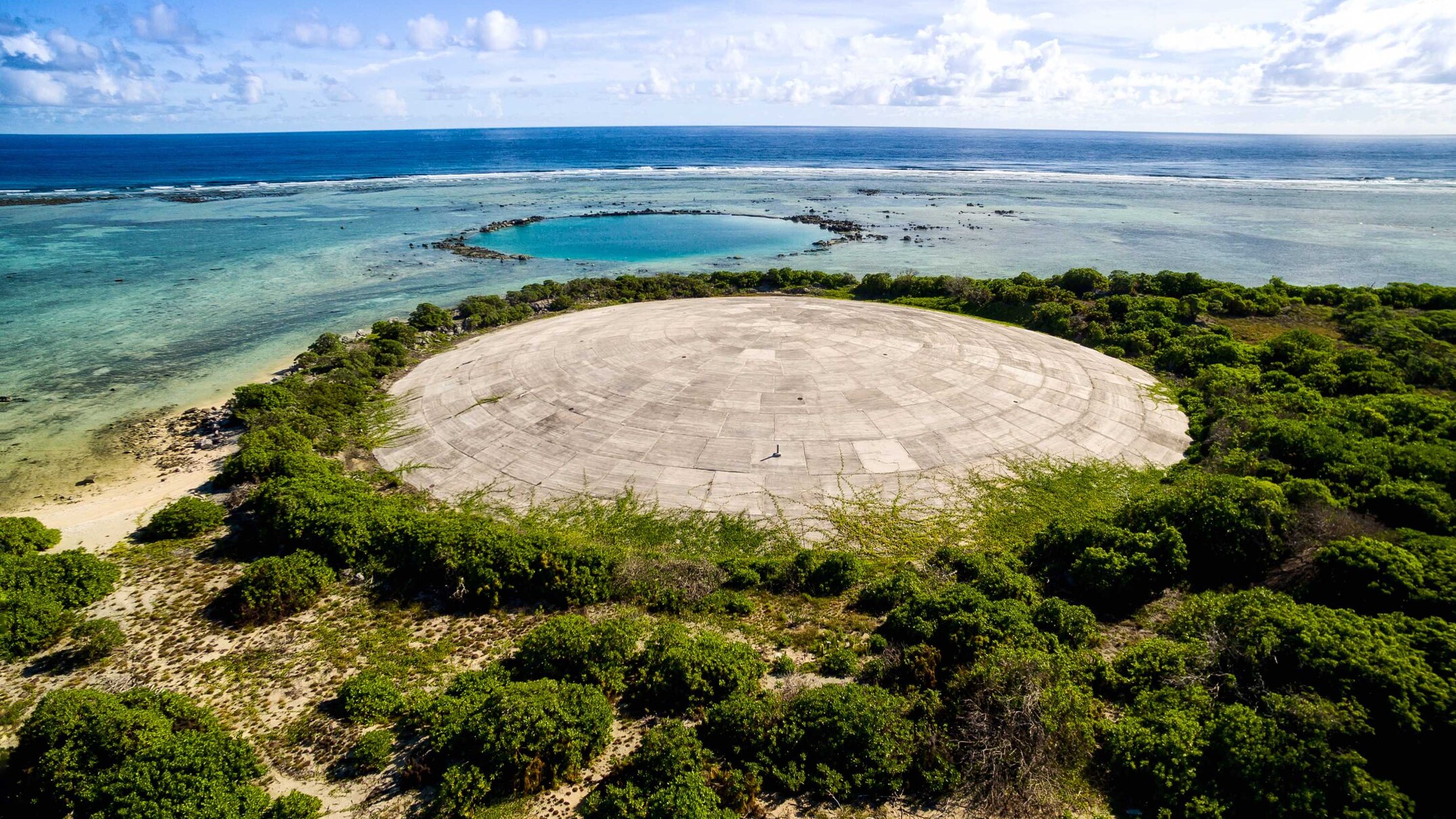
One of the most impactful detonations was the 18-kiloton bomb codenamed Cactus. This blast didn’t just vaporise a portion of Runit Island; it sent a mushroom cloud soaring 6 kilometres into the atmosphere. Two decades later, the 10-metre-deep crater left by Cactus became a repository for over 120,000 tonnes of radioactive soil and debris, meticulously scraped from across the atoll. Celestial was one of many who made countless trips, hauling this hazardous material in the back of his dump truck. Upon completion of the task, the crater was sealed with an 18-inch concrete cap, giving rise to the structure now known as the Runit Dome, or more ominously, “The Tomb.”
The Tomb’s Deterioration and Mounting Concerns
Fifty years on, “The Tomb” is showing undeniable signs of wear and tear. Cracks spiderweb across its concrete shell, and groundwater now flows freely beneath the structure, a conduit for contaminated waste to seep into the surrounding lagoon. Scientists are increasingly worried that rising sea levels and intensifying storms pose a significant threat to the dome’s integrity, potentially endangering nearby communities. Yet, the Marshallese government finds itself in a precarious position, with limited capacity to address this escalating environmental crisis.
The Personal Toll of Nuclear Exposure
For Robert Celestial, the six months spent dumping debris into the Runit crater were among the most harrowing of his life. The ordeal didn’t end upon his return home; he soon began experiencing debilitating boils that erupted all over his body, bleeding profusely and soaking his uniform. These health issues ultimately led to his medical retirement from the armed service after only seven years. In the years since, he has battled a litany of ailments, including brittle bone disease, osteoporosis, arthritis, and kidney and liver problems. Boils continue to plague his legs and back, requiring regular injections. While the direct link between all his conditions and his service remains unclear, the Atomic Heritage Foundation notes that many veterans who served on Enewetak Atoll experienced similar health problems, including cancer and brittle bones. It wasn’t until 2023 that these veterans were officially recognised as “atomic veterans,” granting them access to disability claims. “We couldn’t go to the VA [Veterans Affairs] before that so a lot of guys couldn’t get treatment,” Celestial stated.
Despite his suffering, Celestial considers himself fortunate. He estimates that of the approximately 4,000 troops deployed to Enewetak during the 1970s and 80s clean-up, only a few hundred are still alive today, according to records from the National Association of Atomic Veterans. “Many of them died of cancer but I’m the lucky one because I don’t have cancer yet,” he remarked. What continues to trouble him is the sheer carelessness of the clean-up operation. “We didn’t do a good job,” he admitted. “We didn’t know what the plan was so a lot of the equipment and hot stuff we just dumped into the lagoon.”
Experts Sound the Alarm on the Runit Dome
The structural integrity of the Runit Dome is a growing concern for experts. Recent studies have highlighted the presence of cracks in the concrete cap. Furthermore, the structure was never designed to withstand the impacts of a changing climate, and a United Nations report indicated it is not watertight. With the ebb and flow of the tides, groundwater seeps in and out of the dome’s base, carrying the potential for contaminated materials to re-enter the lagoon.
Professor Ivana Nikolic-Hughes, a senior lecturer in chemistry at Columbia University and president of the Nuclear Age Peace Foundation, witnessed these cracks firsthand in 2018 while measuring radiation levels. She reported elevated radiation in soil samples taken from outside the dome. “Given that sea levels are rising and there’s indications storms are intensifying, we worry the integrity of the dome could be in jeopardy,” she stated. “Runit is about 20 miles from where people live and they use the lagoon, so the implications are potentially devastating.” Approximately 300 people reside in Enewetak today, according to the 2021 census. Bikini Atoll, in contrast, remains uninhabitable due to extreme contamination, even Bikini Island, the Marshall Islands’ highest-lying atoll.
US authorities, however, maintain that the dome is not in imminent danger of collapse. The United States Department of Energy attributes the cracks to aging concrete and points out that the lagoon already contains substantial amounts of radioactive material from past tests. They argue that any contamination emanating from the dome is negligible in comparison to existing environmental levels.
Professor Nikolic-Hughes remains unconvinced. “If there’s so much more waste in the lagoon, why build a dome at all?” she questioned. She also suspects that debris and unexploded bomb material from failed nuclear tests might be buried within the structure, though this has never been officially confirmed. “If you have things like chunks of plutonium, that can be extremely dangerous, it could kill you if you come into contact with it,” she warned. “So there probably was a good reason why they built the dome, but they are certainly not being open about it.” Plutonium-239, a radioactive element used in nuclear weapons, remains hazardous for over 24,000 years. Arjun Makhijani, a nuclear engineer and president of the Institute for Energy and Environmental Research, echoed these concerns, asserting that no concrete structure can endure for even a fraction of such a lifespan. “There are already cracks in it in less than 50 years,” he pointed out.
A Collision of Nuclear Legacy and Climate Change
Irrespective of the dome’s contents, the Marshallese government asserts its inability to manage the situation due to a lack of technical and financial resources. The Compact of Free Association, which granted the nation independence in 1986, provided substantial US funding in exchange for military access. Crucially, this agreement settled “all claims, past, present and future” related to the US nuclear testing program, effectively placing the responsibility for the dome largely on the Marshallese government. However, Marshallese officials contend they lacked a complete understanding of the situation when the agreement was signed.
Former Marshallese health secretary Jack Niedenthal views the dome as a stark monument to America’s past transgressions. “Outside of covering it with cement and doing studies, they really haven’t done a lot to shore it up or fix it,” he stated. “So as we get these rising sea levels where everything is only a few feet above the water at high tide, it’s pretty concerning.” The future of the Runit Dome, and the communities it threatens, remains a deeply troubling legacy of the nuclear age, exacerbated by the escalating realities of climate change.