

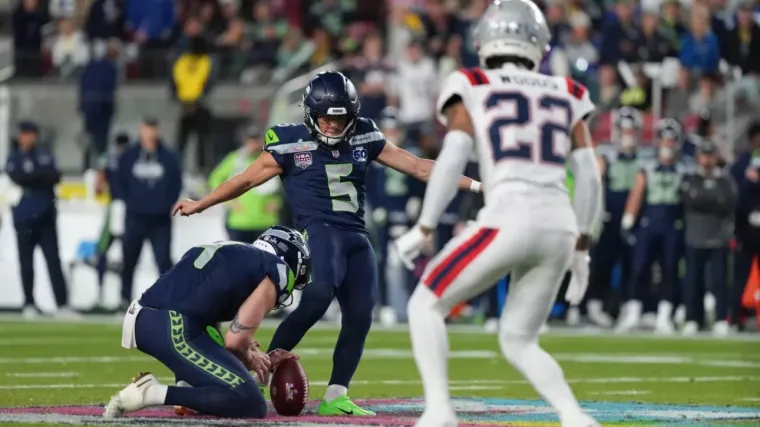
The Unlikely Ascent of Super Bowl 60’s Scoring King: Jason Myers’ Journey
The path to becoming the dominant scorer in Super Bowl 60 was anything but conventional for Jason Myers. His journey is a testament to perseverance, defying expectations and carving out a unique niche in a league increasingly driven by analytics. Growing up in Southern California, Myers attended the athletics powerhouse Mater Dei High School. However, his impressive high school achievements weren’t enough to secure him a scholarship offer from a major college football program. The only avenue for him to continue his kicking career was a move of over 2,400 miles to Marist University in upstate New York. At Marist, he was one of only two players in the program’s history to eventually sign an NFL contract.
Myers’ professional career began far from the bright lights of the NFL, starting in the Arena Football League and then the Indoor Football League. Even after investing in a personal coach and finally earning a contract with the Jaguars, he faced setbacks, being released twice in his first four years as a professional. To be a kicker in the 2020s, especially one establishing himself as a seasoned veteran, presented its own set of challenges.
A Kicker’s Sanctuary in the Age of Analytics
This era is one where the traditional field goal is often viewed as an endangered species. However, under the guidance of Head Coach Mike MacDonald, the Seattle Seahawks provided what might be considered the last bastion of safety for a player in Myers’ position. While the widespread advertising of Artificial Intelligence throughout the game might suggest a threat to kickers’ jobs, it’s actually the increasing reliance on analytics that has driven this perception.
Yet, the performance of the Seahawks and their kicker in Super Bowl 60 against the Patriots, culminating in a decisive 29-13 victory, may have offered a different perspective. Myers etched his name in Super Bowl history by setting a new record with five successful field goals. At that moment, there was even a fleeting thought that he might become the first kicker to be named the game’s Most Valuable Player. While this historically elusive award remained out of reach, even on a weekend where a kicker’s achievements overshadowed those of Pro Football Hall of Fame inductees like Reggie Wayne, Terrell Suggs, and Willie Anderson, Myers’ impact is undeniably significant and potentially more enduring.
The Analytics Revolution and the Devaluation of the Three-Pointer
The NFL landscape has been dramatically reshaped by the infusion of data and analytics. Coaches, eager to gain a competitive edge, have increasingly leaned on statistical models to inform their decisions. This shift has, in many instances, led to a diminished appreciation for the field goal, often viewed with disdain, akin to stand-up comedy at a funeral service. The prevailing sentiment became that field goals were for the less strategic, for those who couldn’t grasp complex probability or demonstrate intellectual superiority on the field.
We’ve witnessed coaches like Detroit’s Dan Campbell and Denver’s Sean Payton seemingly cost their teams potential Super Bowl berths due to their strong aversion to “settling for three points.” However, the ESPN Analytics world, while powerful, often struggles to account for the nuances of circumstance, the strength of the opposition, and the potential consequences of decisions.
While any computer can readily confirm that seven points are superior to three, and indeed, most first-graders understand this basic arithmetic, a crucial element is often overlooked. The three points awarded for a successful field goal can represent an outsized reward for the effort involved in reaching the 30-yard line and executing a kick that has become remarkably routine for modern, gifted kickers. In many situations, it represents nearly half the reward for significantly less than half the work required to achieve a touchdown.
Consider the scenario in the AFC Championship game where Denver, facing the Patriots, opted to go for it on fourth down. This decision meant the Broncos would have needed to achieve more to cross the goal line. Compounding their challenges, they were playing with a quarterback who hadn’t started a game in two years due to an injury, and a snowstorm was on the horizon. A potential 10-0 lead slipped away, and they ultimately lost the game 10-7.
MacDonald’s Strategic Embrace of the Field Goal
Coach Mike MacDonald clearly understands this strategic imperative. This past season, Myers accumulated an impressive 171 points, the highest total for any NFL player without scoring a single touchdown. Remarkably, the Seahawks ranked last in the league in attempts to convert on fourth downs. Despite this approach, they managed to reach the pinnacle of American sports.
Their offensive strategy, even as the Super Bowl commenced, wasn’t heavily geared towards third-down conversions. Their strong embrace of the field goal was evident early in the second quarter. Facing a third-and-12 from the New England 19-yard line, they opted for a conservative, “give-up” play. Even a sack on a pass play likely wouldn’t have pushed them out of field goal range, yet they prioritized the guaranteed three points, demonstrating their immense value for them.
The Seahawks’ 9-0 lead at halftime was entirely the result of Myers’ accurate kicking. While it might not have been the most electrifying prelude to Bad Bunny’s performance, it placed Seattle within striking distance of their second Lombardi Trophy.
A Defensive Masterclass and a Shift in Football Philosophy
It became apparent early on that Coach MacDonald possessed unwavering faith in his defense, a belief as strong as a child’s devotion to fictional characters. And his defense delivered, validating his confidence. The Seahawks managed to sack Drake Maye three times in the first half alone and held the Patriots to a mere 51 total yards.
It was a striking spectacle to witness the Super Bowl’s momentum tilt so decisively towards the defensive side of the line of scrimmage for both teams. For much of the 21st century, quarterbacks like Patrick Mahomes, Peyton Manning, and the legendary Tom Brady had cultivated a narrative that scoring points was the sole path to championship glory. The NFL itself appeared to have adopted this message, with a significant majority of the 10 new head coaching hires this season specializing in offensive schemes.
However, this defensive dominance suggests that these offensive minds might need to cultivate exceptional defensive coordinators. In the first half of the game, there was a notable absence of sideline shots featuring Patriots offensive coordinator Josh McDaniels. While he was undoubtedly present within Levi’s Stadium, his minimal impact made stepping out for a coffee entirely understandable. His unit managed only a couple of late, inconsequential touchdowns in the second half. Crucially, they never got close enough to even attempt a field goal.