A New Kind of Prosperity and Its Discontents
There’s a peculiar kind of vertigo that comes with being an affluent American in 2026. You’ve made it. By nearly every historical metric, you are living in spectacular abundance. You have a six-figure income, a retirement account, a nice car. And yet something feels wrong — crowded, competitive, precarious. The airport lounge is too full. The housing market makes no sense. The life you thought you’d paid for keeps getting more expensive.
This is not an illusion. It is, economists are increasingly arguing, a structural feature of the new American economy — one that a sweeping recent report attempted to describe, but only partially explained. Because the real story isn’t just about income brackets and inflation adjustments. It’s about a nation that has grown so wealthy, so fast, that it has lost the ability to recognize its own prosperity — and about a media environment that has systematically replaced the old, grounded benchmarks of success with an endless, algorithmically curated window into the lives of the ultrarich.
A Century of Progress, Decades of Disruption
To understand what the AEI is really measuring, it helps to zoom out. McKinsey Global Institute director Chris Bradley, speaking at a recent media briefing, offered a striking frame: in terms of GDP, the world of 2025 had wealth roughly 24 times larger than the world of 1925, as measured by the Maddison Project. Calvin Coolidge and Winston Churchill — the two most powerful men of their era — both lost children to infections that penicillin could have cured in an afternoon. The average American of 1925, Bradley noted, lived at a standard of living roughly comparable to South Africa today.
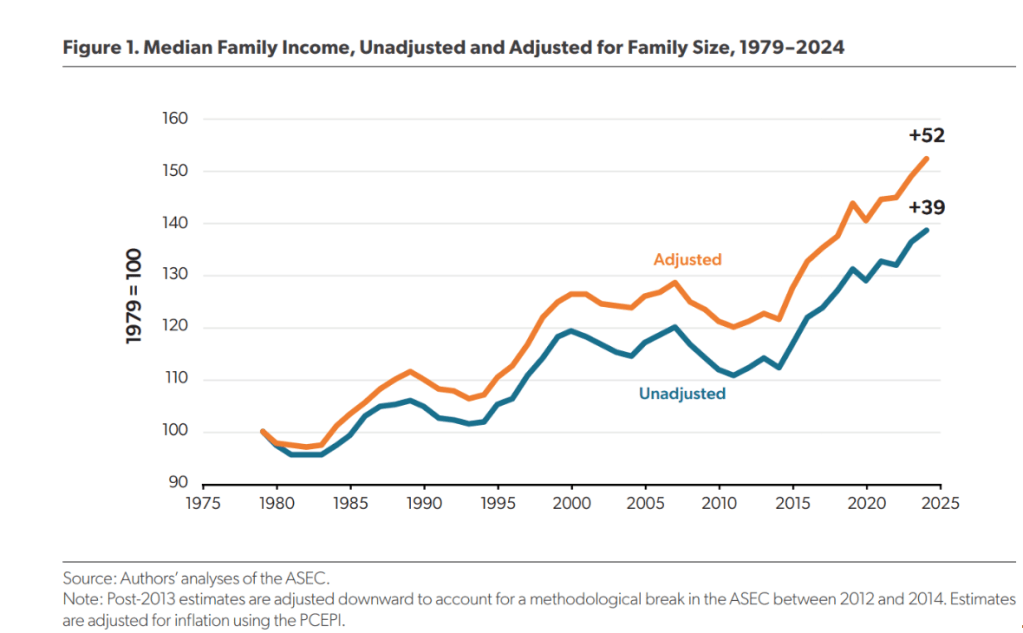
Seen through that lens, the AEI’s central finding is consistent with a story of genuine, broad-based human flourishing. Median family income, adjusted for inflation and declining family size, rose 52% between 1979 and 2024. Even families at the 10th percentile of income were roughly 30% better off in 2024 than their counterparts in 1979. The share of Americans in poverty or near-poverty fell from 30% to 19%. These are not trivial gains. In fact, the authors noted, “there was no net movement of families downward out of the core middle class.”
But Bradley was equally emphatic that the century of plenty has arrived alongside what he called “decades of disruption.” Since the 2008 financial crisis, the developed world has lived through a prolonged productivity drought. The productivity-enhancing investment that generated postwar prosperity slowed dramatically, Bradley argued, not because ideas ran out but because, in McKinsey’s view, the world “stopped building.” The result is an uneven landscape where wealth has surged dramatically at the top — and where the very definition of what it means to be “wealthy” has become contested terrain.
The Problem with the Scorecard
The AEI report deserves credit for its methodological transparency: it uses absolute income thresholds adjusted for inflation rather than the relative thresholds favored by the Pew Research Center. Under Pew’s approach, the middle class can mathematically shrink even when everyone’s income rises substantially — because membership is defined by closeness to a median that keeps moving up. That’s a genuine flaw in much of the conventional wisdom.
But the AEI’s alternative has blind spots of its own. Most critically, the report measures income and largely ignores wealth, debt, and geographic reality. A family earning $140,000 in San Francisco or Manhattan — technically “upper-middle class” by AEI’s definition — may be renting indefinitely, carrying six-figure student debt, and priced out of ownership in the neighborhoods where good schools exist.
Nick Maggiulli, chief operating officer at Ritholtz Wealth Management and author of The Wealth Ladder, captured the paradox in conversation with last year: “The economy wasn’t built to handle this many people with this much money.”
Maggiulli’s framework, which classifies Americans by wealth rather than income, finds that the population of Americans with between $1 million and $10 million in net worth — his “level 4” affluent class — has more than doubled, rising from 7% of U.S. households in 1989 to 18% by 2022–23. These people are, by any historical standard, extraordinarily successful. And yet, Maggiulli told * , “there’s a good portion of them that feel like they don’t have enough … they feel like they’re just getting by.” The reason is competition: as the upper-middle class has exploded in size, it has flooded the markets for housing, elite education, premium travel, and luxury amenities — inflating prices at every level and making the lifestyle associated with prosperity feel perpetually out of reach.
The Broken Mirror
But competition for scarce goods is only half the story. The other half is about who Americans think they’re competing with — and how dramatically that reference point has shifted.
A generation ago, your sense of where you stood was shaped by the people you could actually see: your neighbors, your coworkers, your brother-in-law’s new deck. The benchmarks were local, concrete, and roughly within reach. A family doctor didn’t spend much time thinking about how investment bankers lived, because that world was mostly invisible to him.
That architecture of comparison has been demolished. Social media, and the broader content economy built around aspiration, has replaced the neighborhood with an infinite scroll of curated wealth. The family earning $175,000 — a household income that would have felt unambiguously prosperous in any prior decade — now spends its evenings absorbing content from people who vacation in the Maldives, renovate kitchens that cost more than a median home, and treat business class as a hardship. The algorithm doesn’t show you people who are doing roughly as well as you are. It shows you people who make your life look small.
This isn’t just envy. It’s a genuine perceptual distortion. When your daily media diet is dominated by the top 0.1%, the top 10% starts to feel like the middle. A paid-off mortgage, two reliable cars, an annual trip to the coast, a fully funded 401(k) — by any sane historical standard, this is an extraordinary life. It is better than what 95 percent of all humans who have ever lived experienced. It is better than what most humans alive right now experience. But it doesn’t feel extraordinary, because the screen in your pocket has redefined what extraordinary looks like.
A Unique Condition of Affluence
What the AEI report ultimately captures — even if it doesn’t frame it this way — is not the decline of the middle class but the arrival of a society wealthy enough to generate entirely new categories of scarcity.
When only a small fraction of Americans could afford to fly, airport lounges felt luxurious. When million-dollar net worths were rare, a $1 million home purchase felt like a clear signal of having made it. As Maggiulli noted, a net worth of $1 million placed someone in the top 5% of Americans in the late 1990s; today, that same threshold places you in the top 20% — and the gap keeps widening. The goalposts are not stationary, and no inflation adjustment can fully capture the social and psychological experience of that shift.
Bradley said he sees this as part of a broader signal failure: the world’s “antenna,” as he puts it, is still tuned to the old frequency, while the underlying economic reality has changed its rules. The AEI’s instinct is correct that relative-income definitions of the middle class obscure real progress. But the lived experience of the upper-middle class — stretched by housing costs, anxious about status, competing ferociously for a fixed supply of desirable neighborhoods and elite colleges — is also real. And it is made immeasurably worse by a media ecosystem that has turned the wealth of the few into the wallpaper of everyone’s daily life.