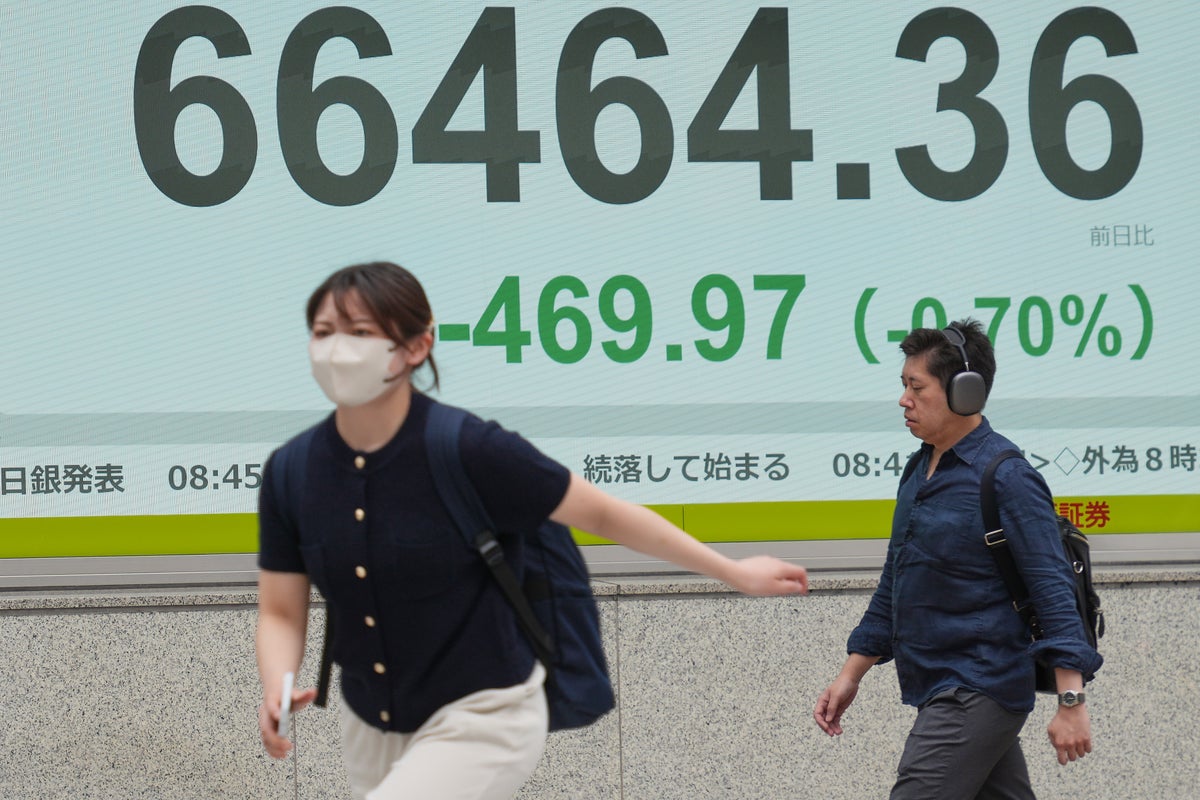
Asian Markets Waver Amidst Geopolitical Tensions and Oil Price Volatility
Asian share markets experienced a general downturn on Tuesday, with renewed conflict between the United States and Iran casting a shadow over investor confidence. This geopolitical uncertainty has also impacted U.S. futures, which saw a decline.
In Japan, the benchmark Nikkei 225 index registered a significant drop of 1.6%, closing at 65,833.49. Similarly, South Korea’s Kospi index dipped by 1.7% to 8,642.82. In contrast, Hong Kong’s Hang Seng index bucked the trend, gaining 1.2% to reach 25,698.75, while the Shanghai Composite in mainland China saw a marginal slip of less than 0.1%, settling at 4,056.56.
Australia’s S&P/ASX 200 also felt the pressure, shedding 0.4% to trade at 8,692.20.
This cautious sentiment in Asia followed a mixed performance on Wall Street on Monday. U.S. stocks had managed to reach new record highs, with the S&P 500 adding 0.3% to close at 7,599.96. The Dow Jones Industrial Average edged up by 0.1% to 51,078.88, and the Nasdaq Composite climbed 0.4% to 27,086.81.
Oil Prices and Their Impact on Global Markets
The rising price of oil is a significant concern for global economies, particularly for companies with substantial fuel expenditures. U.S. airlines were among the hardest hit. United Airlines saw its stock fall by 2.6%, while Alaska Air Group experienced a steeper decline of 3.3%. These drops occurred as the price of Brent crude oil, the international benchmark, climbed in overnight trading.
In early Tuesday trading, U.S. crude futures lost 39 cents, trading at $91.77 a barrel. Brent crude, the global standard, slipped by 28 cents to $94.70 a barrel. These figures remain considerably higher than the approximately $70 a barrel observed before the recent escalation of conflict.
A critical factor influencing market stability is the potential for a U.S.-Iran agreement to reopen the Strait of Hormuz. This waterway is a vital chokepoint for oil shipments from the Persian Gulf, and its unhindered passage would alleviate upward pressure on inflation.
Japan, a nation heavily reliant on oil imports, is particularly vulnerable. While the government has released its strategic oil reserves to mitigate immediate price impacts on gasoline and other products, the sustained high cost of crude poses an ongoing challenge.
Spreading Fuel Squeeze Affects Refiners and Economies
The ripple effects of crude oil shortages are extending beyond raw material prices. “Crude shortages have already forced refiners across Asia and Europe to aggressively reduce runs,” noted analyst Stephen Innes. “The result is that the squeeze is no longer confined to crude inventories. It is spreading into the fuels that actually power economies: gasoline, diesel, jet fuel, LPG, and naphtha.” This means that the cost of essential fuels powering transportation and industry is also on the rise, potentially impacting economic activity across the board.
Geopolitical Developments and Market Reactions
The renewed fighting between the U.S. and Iran has been a focal point. On Monday, the United States announced it had conducted airstrikes on Iranian radar and drone sites following Tehran’s downing of an American drone. Iran, in turn, claimed to have targeted U.S. soldiers in Kuwait with missiles, which the U.S. stated were intercepted.
However, there was a glimmer of hope on the diplomatic front. U.S. President Donald Trump indicated that Israel and Hezbollah had agreed to de-escalate their conflict. This development followed discussions between President Trump and Israeli Prime Minister Benjamin Netanyahu, as well as communications with the Lebanon-based militant group through intermediaries.
Nvidia Leads Wall Street Gains
On Wall Street, technology giant Nvidia emerged as a strong performer, significantly boosting the market. The company’s stock surged by 6.2% after CEO Jensen Huang unveiled several new product updates at a recent conference. Nvidia’s market dominance and its influence on the broader tech sector, and consequently the U.S. stock market, underscore the significance of such announcements.
Currency Markets
In currency trading, the U.S. dollar saw a slight increase against the Japanese yen, rising to 159.70 from 159.66 yen. The euro remained stable, trading at $1.1631.