First Home Buyers Face Mortgage Minefield as Government Schemes Spark Negative Equity Concerns
The Australian Treasurer, Jim Chalmers, has recently addressed anxieties surrounding first home buyers who might find themselves owing more on their mortgages than their properties are worth. These concerns stem from federal government initiatives designed to lower the entry barrier for homeownership, allowing individuals to purchase with deposits as small as 2 per cent. While this significantly reduces the initial financial hurdle, it introduces a palpable risk, particularly in a fluctuating property market.
With property values experiencing a downturn in major cities like Sydney and Melbourne, and forecasts suggesting the end of a three-decade-long housing boom, recent purchasers who opted for minimal deposits could soon be facing negative equity. This situation arises when the outstanding loan amount on a property exceeds its current market value.
When questioned about what has been termed the “dark side” of slowing house price growth, Mr. Chalmers expressed a lack of concern regarding new buyers entering negative equity through these taxpayer-backed schemes. He underscored that property is fundamentally a long-term investment, and most homeowners do not typically sell their properties after only one or two years.
“The Treasury is still assuming that prices continue to grow but a bit more slowly,” Mr. Chalmers stated in a radio interview. “That 5 per cent deposit scheme has been a really important way we’ve been helping first home buyers into the market.”
Young Buyers Leverage Government Support
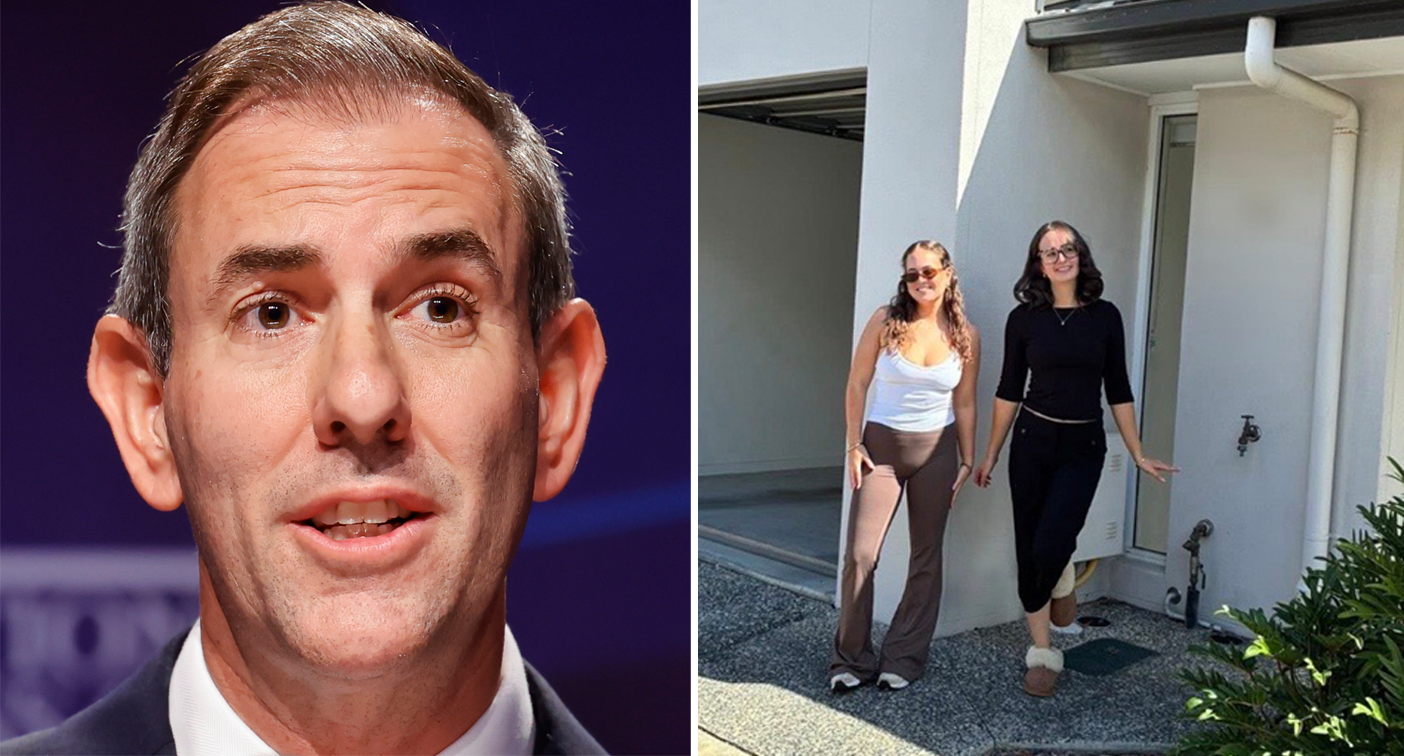
Sophia, a 23-year-old from Brisbane, along with her 22-year-old sister, successfully entered the property market using the federal government’s ‘Help to Buy’ scheme. This program enables eligible borrowers to secure a home with a deposit as low as 2 per cent. For the sisters, this meant a deposit of just $17,000 – or $8,500 each – was required to purchase a unit valued at $850,000 in the city’s northern suburbs.
By pooling their resources, the young sisters, who had been living with their parents, bypassed the rental market entirely and transitioned directly into homeownership, with the government’s support acting as a crucial facilitator.
“When we did our budgets to see if we could actually afford living out of home and what type of property we could buy… we obviously calculated the minimum repayments and what they would be,” Sophia shared.
“And since calculating the other day, we had a figure in mind and realised it had already increased again because of the interest rates. So that’s definitely adding a bit of pressure, especially from moving out of home and managing all those different living expenses for the first time and knowing the mortgage repayments are rising, and potentially rising even more. It’s definitely a little bit stressful to think about.”
Taxpayer Exposure: The ‘One-Way Bet’
Analysis from the Reserve Bank of Australia (RBA) indicates that homeowners are more prone to defaulting on their mortgages when they are in negative equity. Default typically occurs when a borrower falls significantly behind on payments, often exceeding 90 days, and receives a formal default notice from their lender.
“Evidence from Australia and abroad suggests that borrowers who experience an unexpected fall in income are more likely to default if their loan is in negative equity,” the RBA has previously noted in its research.
Dr. Peter Tulip, a former RBA economist and now with the Centre for Independent Studies, argues that the government’s low-deposit schemes, while intended to address housing affordability, undoubtedly “increase the likelihood of people hitting negative equity.”
The core of the concern lies in the government’s guarantee. When the taxpayer backs a significant portion of the deposit, any shortfall incurred by the lender in the event of a forced sale and a subsequent loss is covered by the government.
Dr. Tulip explains that a default is most probable when a borrower experiences a job loss concurrently with falling property prices – a scenario involving “two bad things” happening simultaneously, though he acknowledges such events have occurred historically. Other life circumstances, such as relationship breakdowns, can also compel recent buyers to sell their properties.
One Melbourne-based first home buyer, who utilized government schemes to purchase a two-bedroom unit, recounted selling the property at a loss after approximately three years. He calculated that he was around $70,000 worse off compared to renting a similar property, after factoring in bank interest, transaction costs, and strata fees.
Last year, the Albanese government significantly expanded the 5 per cent deposit scheme, which also assists single parents with a 2 per cent deposit. These enhancements included the removal of income and property price caps, making the scheme accessible to a broader range of buyers and properties.
Government documentation for the 5 per cent deposit scheme explicitly states: “If you default on your home loan, and selling the property doesn’t cover the outstanding amount you owe on your mortgage, then Housing Australia ‘guarantees’ to pay the lender a shortfall up to a pre-agreed limit. For the Scheme, the pre-agreed limit is up to 18% of the Property Value. The exact amount is set during the application process and depends on your deposit and the Property Value when you bought it.”
Dr. Tulip has previously characterised the scheme as “gambling with the taxpayers’ money.”
Risks and Market Outlook
“Essentially the government is providing home buyers with a one-way bet,” Dr. Tulip told Yahoo Finance. “If prices go up, they make a huge capital gain; if prices go down, then it’s the taxpayer that’s on the hook… so there’s no longer a brake on house price bubbles.”
He posits that these schemes “encourage risky buying, risky bidding, and risky borrowing, and so the likelihood of people entering into negative equity and then defaulting on the loans at a cost to initially the bank, but then compensated by the government, is all going to increase. I think that’s a clear problem.”
Regarding the recent federal budget changes, Dr. Tulip anticipates they will have a limited impact on property prices. He notes that the budget papers themselves projected a reduction of only about 2 percentage points in house price growth over the next two years. “My sense is that’s in line with a whole bunch of other credible estimates,” he commented.
However, following years of robust price appreciation, the potential for peaking interest rates, and ongoing economic uncertainty, many in the property industry are preparing for a possible market correction. Analysts at Morgan Stanley suggest that changes to tax concessions outlined in the budget could be a tipping point, potentially leading to a 10 per cent decline in property values. While high levels of immigration continue to fuel demand, the cessation of other long-term factors that have driven price increases, such as financial deregulation and the rise of dual-income households, has led some to declare the end of Australia’s housing super cycle.
Devastation for Young Buyers?
Financial journalist Alan Kohler has expressed concerns on social media, suggesting that a sustained period of minimal price growth is necessary to address housing affordability. However, he highlights a significant “dark side” for young and new market entrants who have acquired properties with substantial debt.
“Young families who bought a house with too much debt hoping, expecting, to build equity and wealth, will be devastated,” Kohler warned.
The current market conditions are still in their early stages of evolution. Data from CoreLogic reveals that Sydney and Melbourne experienced property value declines of 0.9 per cent and 1.5 per cent respectively in the March quarter. Nevertheless, other Australian property markets have continued to record growth.