

The rise of artificial intelligence (AI) has sparked widespread concern among white-collar professionals and investors alike. The prevailing sentiment among tech leaders and financial market watchers is that AI will not only automate millions of existing jobs but could fundamentally alter the nature of work itself, potentially rendering traditional employment obsolete.
Software and services stocks have already felt the pinch, with valuations experiencing a significant pullback. This downturn is largely attributed to investor anxieties about AI’s capacity to automate a vast spectrum of knowledge-based tasks. Prominent figures in the tech industry have issued stark warnings. Elon Musk, for instance, has predicted that AI and humanoid robots could make work “optional” within the next decade or two, paving the way for a post-scarcity economy where money may lose its relevance. This sentiment is echoed by other tech luminaries, including OpenAI CEO Sam Altman, who has suggested superintelligence could soon surpass even the most accomplished corporate executives. Microsoft’s AI chief, Mustafa Suleyman, and Anthropic CEO Dario Amodei, have projected that widespread white-collar automation could materialise within a one-to-five-year timeframe. While economists acknowledge the potential for disruption, many remain sceptical of these rapid timelines, suggesting that the “apocalyptic narrative” might also serve to justify current astronomical tech valuations.
A More Grounded Perspective: Evolution, Not Extinction
Amidst this widespread apprehension, a recent cross-asset research report from Morgan Stanley offers a more reassuring outlook for anxious employees and volatile markets. The report’s central thesis is that rather than facing permanent unemployment, most individuals will transition to new roles, many of which do not even exist yet.
The Morgan Stanley analysts, addressing the pervasive fear of mass job displacement and unemployment, draw a parallel with historical technological advancements. Over the past 150 years, transformative shifts, from electrification and the tractor to the computer and the internet, have profoundly reshaped the labour force. Crucially, these innovations “did not replace labor.”
Historical Precedents of Technological Change and Employment
Consider the advent of spreadsheet software in the 1980s. While it automated many tedious aspects of financial modelling and reduced the need for certain bookkeeping roles, it also liberated analysts to focus on more complex tasks and, importantly, gave rise to entirely new financial professions. The firm argues that AI will similarly transform the landscape, altering “job types, occupations, and needed skills.”
The report elaborates: “While some roles may be automated, others will see enhancement through AI augmentation, and other, entirely new roles will be created.” Instead of a catastrophic “mass extinction event” for white-collar workers, Morgan Stanley envisions the corporate world undergoing a significant evolution.
Emerging Roles in the AI-Driven Economy
So, what might these new jobs entail? Morgan Stanley has identified several emerging professions that are poised to become commonplace in businesses.
Executive-Level AI Leadership: As AI becomes integral to business strategy, companies are expected to appoint “chief AI officers” (CAIOs) to oversee and guide the adoption of AI technologies across all departments.
AI Governance and Compliance: A substantial increase in roles focused on AI governance is anticipated. These positions will be critical for ensuring data compliance, policy oversight, and information security, particularly in highly regulated sectors like healthcare.
Blended Tech Roles: Within the technology sector, hybrid roles are likely to proliferate. For example, the “product manager/engineer” blend could become more prevalent. With the aid of natural language coding tools, product managers may increasingly engage in “vibe coding,” prototyping and iterating on concepts themselves before handing them over to engineers for full development.
Highly Specialised Industry Roles: Across various industries, new, specialised roles will emerge:
- Consumer Sector: “AI personalization strategists” and “AI supply-chain analysts” will combine data science expertise with a deep understanding of customer experience and logistical operations.
- Industrials: The industrial sector will see demand for “predictive maintenance engineers” and “smart grid analysts,” leveraging AI for operational efficiency and infrastructure management.
- Healthcare: The medical field will require “computational geneticists” and specialists dedicated to “AI diagnostic oversight,” pushing the boundaries of precision medicine and diagnostic accuracy.
Market Reaction and Underlying Fundamentals
From Morgan Stanley’s perspective, the current panic surrounding AI’s disruptive potential in financial markets appears premature, if not entirely unfounded. The report highlights that the services and cyclical industries, which have experienced significant underperformance due to disruption fears, constitute only about 13% of the S&P 500’s market capitalisation.
This observation aligns with previous analyses from other Wall Street economists, suggesting that the market may be experiencing a self-induced panic not entirely supported by fundamental economic indicators. This trend could be exacerbated by the growing presence of retail investors in the equities market, leading to increased volatility. Economists have noted a rise in the number of S&P 500 stocks experiencing substantial daily price swings, coupled with elevated options activity, indicative of heavy retail speculation and leverage. This market structure, they warn, is becoming “more fragile and more vulnerable to an abrupt, outsized move.”
The “This Time Is Different” Argument
While Morgan Stanley’s report provides a welcome dose of reassurance, it’s essential to consider the possibility that the current AI revolution might indeed be fundamentally different from past technological paradigm shifts. The report’s optimistic outlook, while historically grounded, may not fully account for the unique capabilities of contemporary AI.
In a separate, influential paper published concurrently, Nobel laureate economists Daron Acemoglu and Simon Johnson, along with prominent labour economist David Autor, argue that “this time really could be different.” Their work, “Building Pro-Worker Artificial Intelligence,” published by the Hamilton Project, cautions that “pure automation technologies” do not necessarily collaborate with workers. Instead, they can “commodify human expertise, rendering it less valuable and potentially superfluous.” This suggests that the specialised knowledge and skills that have historically formed the bedrock of human expertise could become obsolete with the widespread deployment of advanced AI systems.
The Morgan Stanley thesis, rooted in historical optimism, may not perfectly translate to a scenario where the shift is from tools that amplify labour to systems that replicate cognition. A speculative analysis by Citrini Research suggests that AI could generate productivity gains that decouple corporate profits from employment even more dramatically than during the computing era. If companies can achieve significant output scaling with largely automated workforces, their incentive to re-employ human workers at historical rates may diminish.
Tangible Returns and Future Indicators
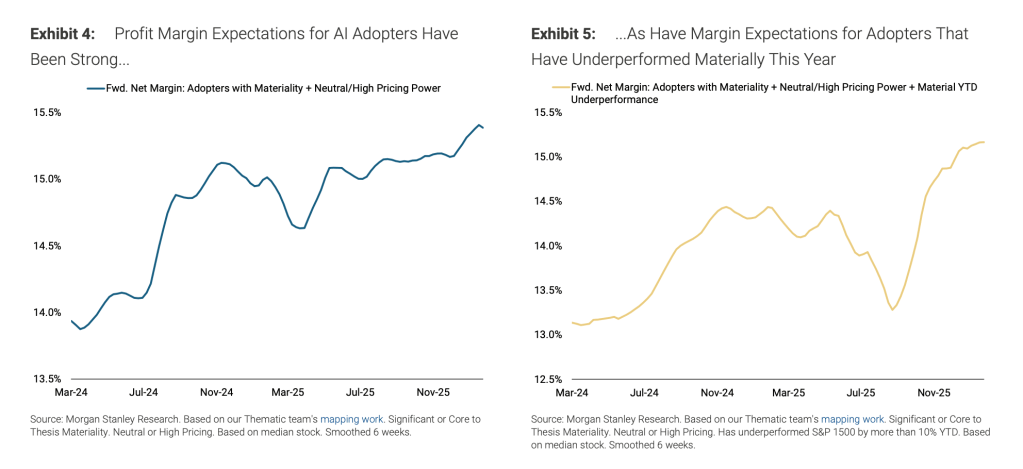
Morgan Stanley does cite evidence that corporate America is already experiencing concrete benefits from AI adoption. By the fourth quarter of 2025, a significant 30% of companies identified as AI “adopters” reported measurable financial or productivity improvements from the technology, a notable increase from just 16% a year earlier. Consequently, forward profit margin expectations are accelerating for companies effectively integrating AI. The ultimate validation of Morgan Stanley’s prediction will hinge on how these margins continue to expand and, crucially, how many new jobs these AI-empowered companies ultimately create.


