ABC Services Disrupted as Staff Embark on 24-Hour Industrial Action
Australian audiences experienced significant disruptions to their usual programming on ABC services yesterday, as staff walked off the job for 24 hours as part of industrial action over pay and conditions. The nationwide strike, which commenced at 11 am AEDT on Wednesday and concluded at 11 am AEDT on Thursday, saw the national broadcaster deviate sharply from its standard schedule.
The most immediate and noticeable impact was on the ABC’s 24-hour news channel. Promising continuous breaking news coverage, the channel instead switched to a feed from Britain’s public broadcaster, the BBC. Viewers tuning in were met with BBC World News America, presented by Carl Nasman, with a prominent grey bar across the top of the screen indicating the content was “RECORDED.”
Meanwhile, the main ABC television channel broadcast a rerun of a previous episode of Foreign Correspondent. Local news programming was slated to return to the ABC TV guide from 7 pm on Thursday.
Pre-Strike Reporting and Public Apologies
In the hours leading up to the staff walkout, the impending industrial action was not a major headline on the news channel itself. Instead, main TV news bulletins focused on other developing stories, including arrests related to an alleged abduction and murder, the Australian government’s stance on fuel rationing discussions, an increase in US troop deployments to the Middle East, and the path of tropical cyclone Narelle in Western Australia.
During a standard report on the strike, ABC News Mornings presenter Gemma Veness did issue a warning to viewers. “There will be disruption to programming,” she stated, adding, “The ABC will continue delivering some services. Emergency broadcasting will not be affected by the strike.” These remarks were reiterated at the broadcast’s conclusion. However, the specifics of what this disruption would entail for the audience were not elaborated upon in the news report.
Instead, the segment featured audio clips from interviews conducted earlier that morning by ABC Sydney presenter Hamish Macdonald. These interviews with ABC managing director Hugh Marks and Media, Entertainment & Arts Alliance chief executive Erin Madeley provided context for the planned walkout. Veness relayed that “Mr. Marks apologised to audiences as staff prepared to walk off the job.”
Hamish Macdonald also alerted his radio listeners to the impending disruption shortly before 11 am on ABC radio, informing them that he would not be back on air until Friday. “We are coming up to 11 o’clock here on 702 ABC Sydney… Different programming will follow throughout the 24 hours of industrial action, including BBC World Service programming,” he announced. “You won’t hear the news at 11 o’clock. You’ll switch straight to conversations, and we’ll be back Friday morning.”
Following Macdonald’s sign-off, a pre-recorded message was played: “Due to industrial action, we can’t bring you your usual program. We apologise for the interruption. Regular ABC radio programs will resume as soon as possible.” In place of the scheduled news bulletin, the 1988 hit song “Waiting for a Star to Fall” by Boy Meets Girl began to play.
A Day of BBC News and Reruns
The programming schedule for the 24-hour strike period indicated a significant reliance on BBC content and a substantial number of reruns. The planned 7 pm bulletin was cancelled, with the ABC opting to air an episode of Australian Story instead. This was scheduled to be broadcast between two episodes of Hard Quiz. The special Hard Quiz: Battle of the Networks, which originally aired in December, was selected to replace the usual 7.30 program on Wednesday night.
As previously noted, The Weekly with Charlie Pickering was scheduled to air in its regular 8.30 pm slot. This program is pre-recorded on Tuesday evenings and is independently produced, meaning most of its staff are not directly employed by the ABC, thus allowing it to proceed unaffected by the industrial action.
On the dedicated news channel, the ABC was set to rely entirely on BBC programming for the duration of the strike. The only local content scheduled was Tim Ayres’ address to the National Press Club, which was also to be broadcast on the main ABC channel, and a live feed of Parliament and Question Time.
Radio Services Also Impacted
The industrial action also significantly affected ABC radio services across the country. On ABC Melbourne, radio presenter Raf Epstein signed off just before 11 am, informing his listeners that he would be participating in the strike with his colleagues and would return on Friday.
“I won’t be on your radio tomorrow morning,” Epstein stated, confirming that programs such as the Conversation Hour, the breakfast show, and his morning show would be disrupted. “None of that is going to be on your radio,” he explained. “We’re all going out on strike because it’s an argument about sustainable work.” He elaborated, “Staff and management disagree on how we get those sustainable and secure jobs… That’s the reason for the strike. We don’t like not talking to you and being with you, but I’ll be back on Friday.”
At the youth radio station Triple J, presenters Lucy Smith and Jack James also signed off, explaining the temporary shift in the station’s soundscape for the next 24 hours.
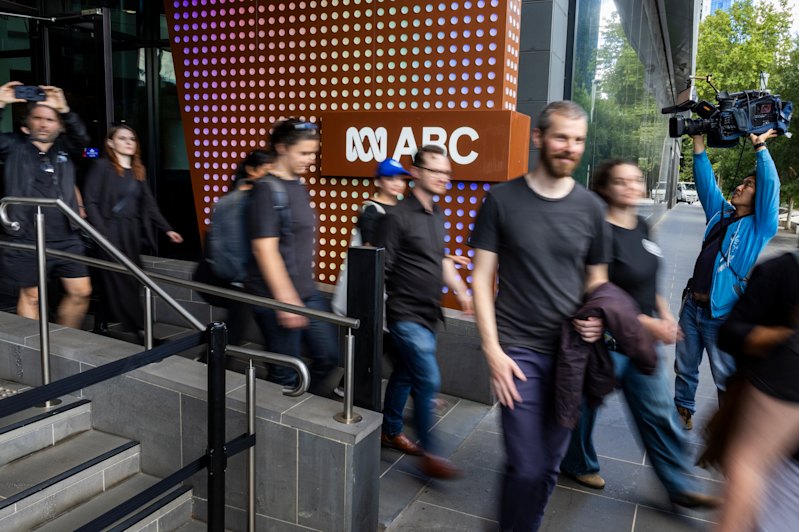
“Over the weekend, ABC staff rejected the second pay offer from management. More people voted no to the second offer than they did to the first offer. So talks have stalled because of that,” James explained. “We’re walking off [with] staff at bureaus all across the country, including people who are really the engine room of the ABC. They’re all tools-down. Management have apologised to listeners and audiences for the disruption, but because things are going to grind to a halt, you’ll hear a bit of pre-programmed, automated music over the next day on Triple J.”
The presenters confirmed that normal programming at Triple J would resume around lunchtime on Thursday. To mark the commencement of the strike, the first song played at 11 am was NWA’s “Express Yourself.”
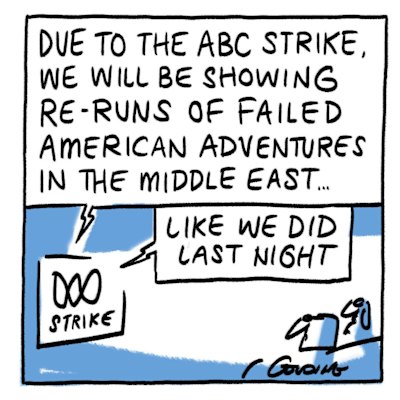
This track carries a notable history of protest at the broadcaster. In 1990, the station played the song repeatedly throughout the day in response to the ABC’s censorship of the album and the suspension of a news editor who had broadcast a segment of its controversial track, “F— Tha Police.” This protest tactic proved successful, leading management to revoke the suspension shortly thereafter.