London Victoria Gold Project Shows Promising Extension Below Pit Floor
Recent drilling results from Adavale Resources’ (ASX:ADD) London Victoria gold project in New South Wales are painting a compelling picture of significant resource growth potential. The latest assay results from Phase 2 of the company’s drilling program have confirmed that the gold mineralisation extends well below the current pit floor, remains open down plunge, and continues along strike. Crucially, these promising findings were only achieved by testing a fraction of the project’s extensive 1.5-kilometre open pit length.
The success of Phase 2 has not only validated Adavale’s geological model for the London Victoria site but has also provided strong evidence for the controls influencing the mineralisation. The project currently boasts a defined resource of 3.14 million tonnes grading 1.06 grams per tonne of gold, equating to approximately 107,000 ounces. However, the new findings suggest this figure is set to expand considerably.
Key Discoveries from Phase 2 Drilling
The final seven holes from the Phase 2 program delivered several noteworthy intersections, highlighting the continuity and depth of the gold mineralisation:
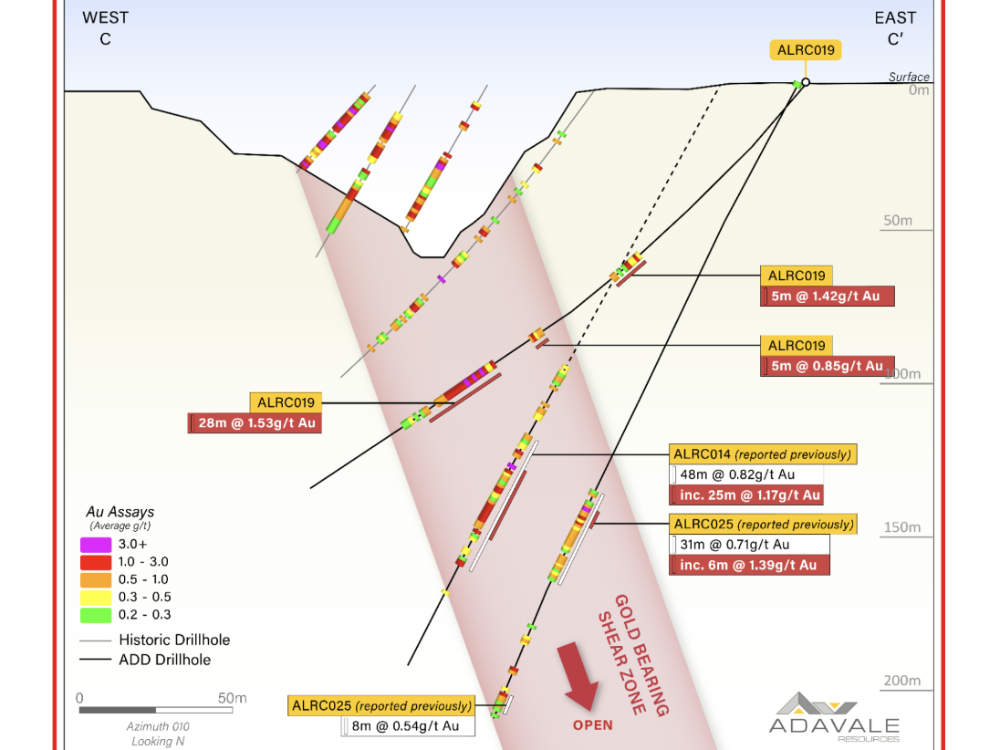
Hole ALRC019: This drill hole returned an impressive 28 metres grading 1.53 grams per tonne of gold from a down-hole depth of 137 metres. This intersection included a higher-grade zone of 11 metres at 2.62 grams per tonne from 141 metres. This result is particularly significant as it intersected the mineralised zone approximately 40 metres below the existing pit floor, largely outside the current resource envelope. Furthermore, it represents the highest-grade intersection encountered by the company to date at London Victoria, a notable achievement given the surrounding resource area averages between 0.65-0.75 grams per tonne.
Hole ALRC021: Located towards the southern end of the tested strike, this hole intersected 21 metres grading 1.4 grams per tonne of gold from a depth of 162 metres. This included two distinct higher-grade intervals: 5 metres at 2.33 grams per tonne from 163 metres and 6 metres at 2.17 grams per tonne from 172 metres. Similar to ALRC019, this intersection also occurred around 40 metres below the pit floor and partially extends beyond the existing resource estimate, suggesting a substantial uplift is likely in the updated resource calculation.
Hole ALRC023: This northernmost hole of the batch yielded 20 metres grading 1.26 grams per tonne of gold from a depth of 102 metres. Within this, a significant 14-metre section averaged 1.62 grams per tonne from 108 metres. This intersection is located well outside the current resource boundary, further underscoring the project’s untapped potential.
Collectively, the Phase 2 results indicate the presence of multiple south-plunging, higher-grade zones. These zones appear to be associated with repeated fold structures, which in turn suggest excellent continuity in both grade and width below the pit, particularly north of the ALRC023 intersection. These areas are prime targets for the upcoming Phase 3 drilling program.
Scaling Up: Phase 3 Program Underway
The encouraging outcomes from Phase 2 have provided Adavale Resources with the confidence to accelerate its exploration efforts. The company has embarked on an expanded Phase 3 drilling program, building on the success of its recent $5.15 million capital raising. This placement saw strong support from investors, positioning Adavale well to advance its brownfields, near-term production opportunity at London Victoria.
David Ward, Adavale’s Managing Director, highlighted the strategic significance of the Phase 2 findings. “The Phase 2 program tested just approximately 150 metres of strike with holes spaced at approximately 25-metre intervals – representing only about 10% of the 1.5-kilometre open pit length,” Ward stated. “These results provide strong confidence to expand the Phase 3 drilling program, targeting the substantial known strike of mineralisation immediately below the existing pit floor.”
Executive Chairman Allan Ritchie echoed this sentiment, emphasizing the project’s scale and the company’s strategic position. “The results demonstrate the scale of London-Victoria, giving us confidence to accelerate resource growth with the expanded Phase 3 drill program,” Ritchie commented. “Combined with the overwhelming support from our investors in the recent $5.15 million placement, the company is exceptionally well positioned to grow the resource base and further advance our brownfields near-term production opportunity at our London Victoria gold mine.”
Next Steps and Future Exploration
The Phase 3 program is set to encompass an initial 6,000 metres of drilling. Beyond this, Adavale is also implementing comprehensive geochemical logging. This process will be instrumental in refining lithological and geochemical discrimination, and in confirming the distribution of the host andesite and sedimentary sequences.
Furthermore, the company is actively integrating new structural data to continuously refine its geological and resource models. This iterative approach will directly guide near-term drilling strategies and efforts aimed at resource expansion.
Adavale is also planning additional geophysical surveys, including airborne and/or ground magnetic surveys. This initiative is driven by the strong correlation observed between magnetic signatures and gold mineralisation at the project.
In parallel, exploration activities are continuing at Adavale’s Parkes project. Further geochemical surveys are scheduled to define new targets, with the Parkvale South area identified as a high-priority zone requiring additional rock-chip sampling and ground magnetic surveys.