
Aussie Investors Brace for Bearish Sentiment as Market Woes Mount
The Australian investment landscape is experiencing a significant downturn, with investor sentiment plummeting to its lowest point since the inception of recent surveys. This bearish outlook, exacerbated by soaring fuel prices and broader geopolitical instability, is prompting a re-evaluation of market strategies and sector performance.
Investor Sentiment Plummets
Recent data reveals a stark shift in investor confidence. The latest survey indicates the most bearish sentiment recorded since the survey began last July. The only other period that came close to this level of pessimism was the week ending 15 February 2026, highlighting the current market’s extreme negativity.
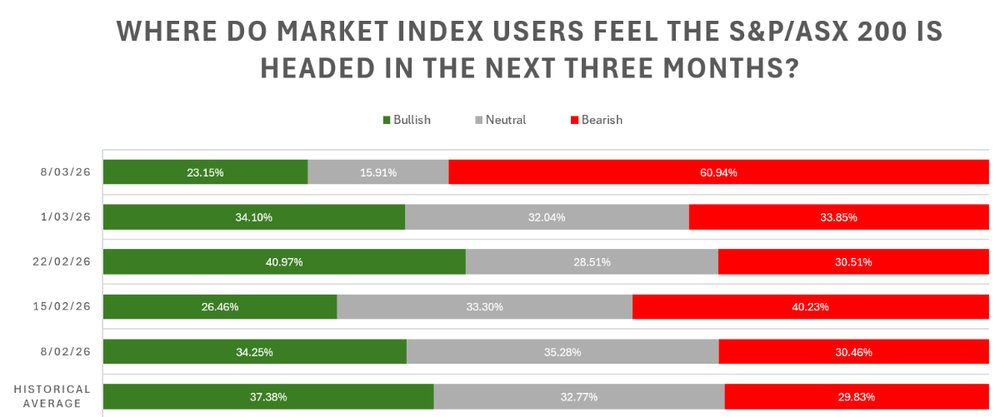
When asked about their expectations for the Australian stock market over the next three months, the overwhelming majority of respondents indicated a bearish outlook, with significantly fewer expecting a bullish or neutral market.
Echoes of 2022?
The current market conditions are drawing parallels to the volatile period following Russia’s invasion of Ukraine in 2022. During that time, various Australian sectors experienced significant fluctuations.
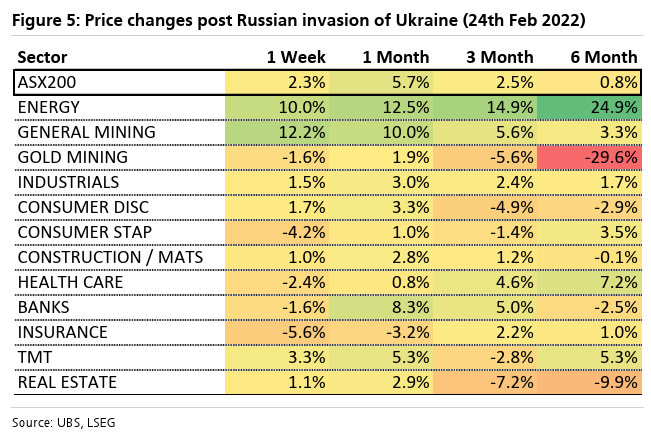
This historical context is crucial as investors assess the potential impact of current geopolitical events on the Australian market. The performance of key sectors during the 2022 turmoil serves as a cautionary tale and a potential roadmap for navigating present challenges.
The Enigma of Energy Stocks
Despite a significant surge in global oil prices, Australian energy stocks have failed to mirror this performance. West Texas Intermediate (WTI) crude oil has seen substantial gains, approximately 46% since February 27th, while the S&P/ASX 200 Energy Index has only managed a modest 10% increase.
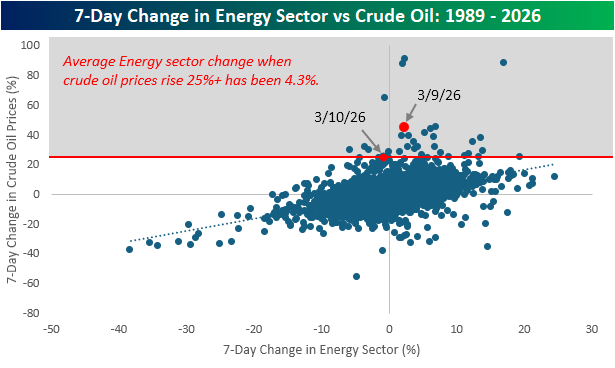
Several factors contribute to this disconnect:
- Discounted Future Cash Flows: Stock prices are inherently forward-looking, reflecting discounted future cash flows. Even with current high spot prices, only a fraction of future production is realised at these elevated rates, especially when the market is in deep backwardation.
- Hedging Constraints: Energy producers face limitations in hedging all future production. The substantial collateral required for margin on futures positions can historically lead to significant losses if market movements turn unfavourable.
- Broader Equity Risk: Energy stocks, as equities, are still influenced by broader market risk premiums. Surging oil prices can negatively impact key market drivers such as bond yields and inflation expectations, creating a drag on the sector.
The true re-rating of energy stocks is likely to occur when the geopolitical dust settles and prices establish a new, structurally higher base.
Analyst Concerns Over Energy Valuations
Leading financial institutions are expressing caution regarding the valuations of major energy stocks. Macquarie, for instance, holds a generally downbeat view, anticipating a normalisation of energy prices and deeming current valuations stretched.
- Woodside Energy (WDS): Rated Neutral with a raised target of $30.00. Earnings per share (EPS) upgrades for CY26 and CY27 are driven by higher oil and spot LNG price assumptions. However, the stock is now trading above its long-term discounted cash flow (DCF) valuation.
- Santos (STO): Rated Outperform with a raised target of $8.10. EPS upgrades for CY26 and CY27 are attributed to similar commodity tailwinds, with increased inclusion of projects like Papua LNG, Pikka phase 2, and Dorado. Nevertheless, the upside to its valuation is diminishing.
- Beach Energy (BPT): Rated Underperform with a raised target of $0.70. While EPS upgrades for FY26 and FY27 reflect higher oil and spot LNG prices, the improved commodity environment may complicate merger and acquisition (M&A) activities.
- Karoon Energy (KAR): Rated Underperform with a raised target of $1.60. CY26 EPS shows a significant surge due to unhedged oil exposure and higher price assumptions, with modest upgrades in outer years and minor production increases from Bauna.
Macquarie’s modelling forecasts Brent crude to average US$68.95 in FY26, declining to US$65.67 in FY27, suggesting they may be underestimating the potential for sustained higher prices.
Banks Under Pressure from Geopolitical and Macroeconomic Headwinds
The S&P/ASX 200 Banks Index has shown resilience, remaining up approximately 7.5% year-to-date, a notable achievement given stretched valuations and the sector’s sensitivity to rising fuel prices and interest rate expectations. However, concerns are mounting.
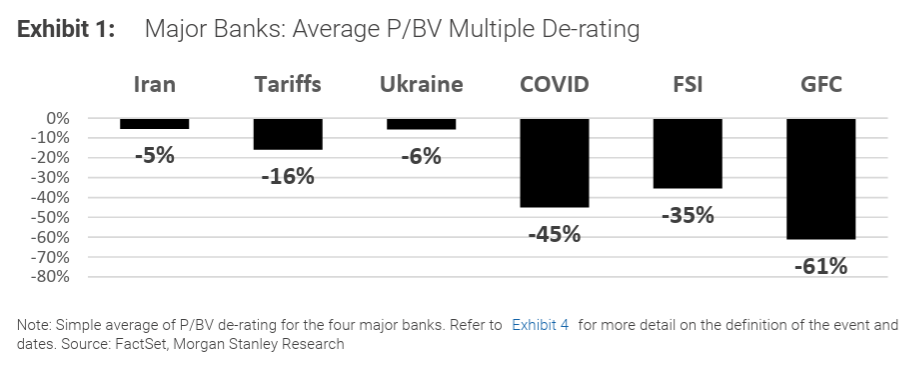
Morgan Stanley highlights that escalating geopolitical and macroeconomic conditions are increasing the likelihood of a de-rating for major Australian banks. The current elevated multiples leave little room for error, making the sector more vulnerable than in previous periods of market uncertainty.
Key threats include:
- Stagflation Risks: The Australian domestic economy is particularly susceptible to a persistent supply shock and energy price surge, which could fuel inflation and complicate the Reserve Bank of Australia’s (RBA) monetary policy. Economic growth risks are also escalating.
- Downgrade Risk: While base case forecasts for FY26 and FY27 anticipate moderate loan growth, stable margins, and low loss rates, a slowdown in the domestic economy could trigger significant downgrades.
Beyond Oil and LNG: Broader Supply Chain Disruptions
The impact of current events extends far beyond oil and LNG markets, affecting critical global supply chains.
- Helium Shortage: Qatar’s shutdown of LNG production at Ras Laffan has idled roughly a third of global helium output, impacting chipmakers reliant on the gas for semiconductor manufacturing.
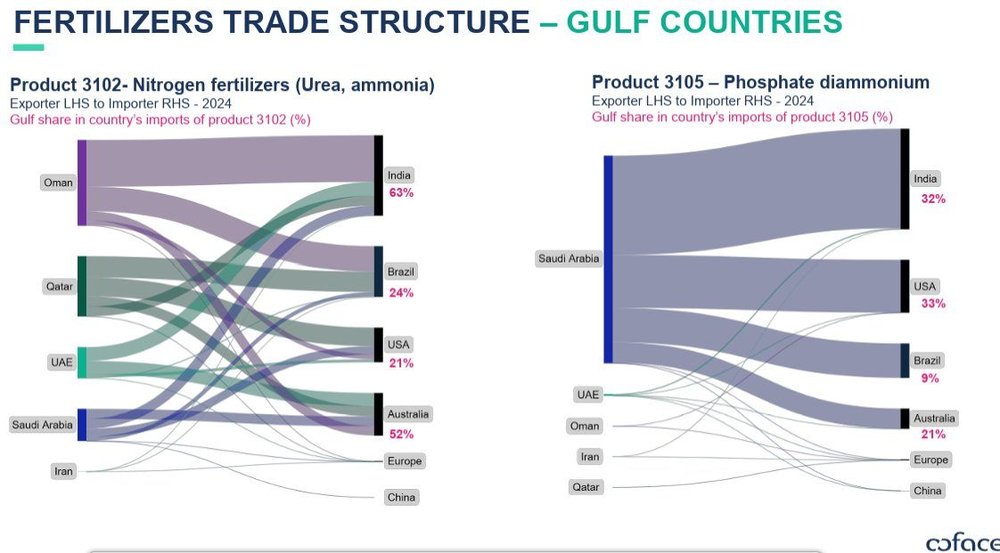
- Sulphur and Fertiliser: The Middle East accounts for approximately 25% of global sulphur production, a key component in sulphuric acid used in nickel, copper, and fertiliser industries. Furthermore, the Strait of Hormuz is a vital conduit for global fertiliser exports, including nearly half of the world’s urea.
The immediate impact of these disruptions may be felt through higher energy prices, but the full effect on consumer goods and essential products is expected to manifest in the coming months.
Threats to Key Australian Industries
For Australian businesses, the surge in diesel prices is just the tip of the iceberg. Energy price inflation is creating a cascade of increased costs across multiple operational lines.
- Refined Fuel Costs: Crack spreads have widened significantly, meaning refined fuel prices are rising at a faster pace than crude oil alone. This is evident in the dramatic increase in jet fuel prices, which have more than doubled for some airlines.
- Electricity Costs: Regardless of the generation source – gas, coal, or diesel – electricity prices are expected to rise.
- Labour and Logistics: The cost of transporting workers to remote sites (fly-in, fly-out operations) and moving products to ports is set to increase.
- Explosives and Chemicals: Upward pressure on explosives costs is anticipated, given Saudi Arabia’s significant share of global DAP production and the role of Gulf nations in supplying chemicals for ore processing.
- Food Costs: The increasing cost of feeding workforces at remote sites represents another often overlooked inflationary pressure.
Beyond the direct cost increases, the demand side presents a significant risk. Higher energy prices erode consumer discretionary income, leading to weaker demand for the very commodities these Australian companies produce.
The Last Laugh?
Amidst the market turmoil, a dark humour has emerged, with some “diabolical” memes circulating about the energy situation.

For investors seeking to navigate these challenging times, access to comprehensive market data and research is invaluable. Tools offering broker consensus, ASX announcement data, dividend information, and more can provide a crucial edge.
Market Index offers a suite of free investment tools and ASX research, empowering investors with the information needed to make informed decisions.