A Journey Through History and Geography
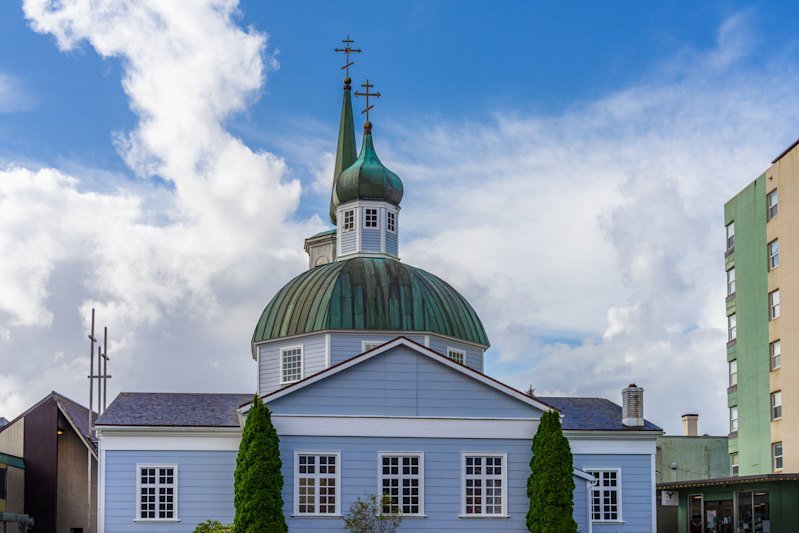
America’s northernmost state feels decidedly foreign. The Alexander Archipelago is crammed with islands and islets bearing Slavic names: Volga, Bamdoroshni, Aleutski, Baranof. The latter protrudes like a flinty spearhead into the Gulf of Alaska; on its midsection stands Sitka, where the verdigris dome of St Michael’s Russian Orthodox Cathedral mushrooms between a huddle of downtown buildings.
It was in this sleepy settlement that Russia ceded ownership of Alaska to the US 158 years ago.
“I think that President Andrew Johnson and Secretary of State William Seward, who acquired Alaska, recognised they weren’t quite sure what they were getting,” says Kenneth Walsh, former president of the White House Correspondents’ Association and guest speaker on Silversea’s Silver Nova. “They just didn’t want Russia to have it.”
A savvy preemptive move, given contemporary geopolitics; after all, the Alaskan Panhandle’s southern frontier lies just 800 kilometres from mainland US. The borderline signifies a convoluted territorial arrangement, when considered from the ship’s observation deck: we set sail from Vancouver, Canada, trace the British Columbian coastline for a day and two nights, and – without turning around – arrive back in the US when we dock in Ketchikan, Alaska. Now we’re gliding into Sitka Sound, its shoreline tufted with clouds, its waters vapoured with the spouts of humpback whales.
American politics is looping on the TV screen in my luxurious suite; President Donald Trump appears to be emulating Seward by proposing the acquisition of another foreign, frozen territory: Greenland.
There’s no sign of the sea otters that drew Russian fur traders to this region at the behest of the Russian-American Company in the late 18th century.
But human history is omnipresent: shell middens attest to the Tlingit people’s 1000-year-long presence, and artefacts unearthed from the ruins of Russian-American Company buildings – clothing fragments, coins, samovar spigots – signify Russian occupation.
It’s a short climb to the flattened summit of Castle Hill (Noow Tlein), where Tlingit clan houses were supplanted by Baranof Castle, the official residence of Russian Alaska’s first governor, Alexander Baranof. The town was christened Novo-Arkhangelsk (New Archangel), and became Russian America’s capital.
The hilltop vista is a peaceful contrast to this discordant tale: Sitka Sound, speckled with fishing vessels; O’Connell Bridge, stretched across the channel to Japonski Island; the spires of the Russian orthodox cathedral, framed by oak leaves.
I take the path downhill to this landmark – the first Russian orthodox cathedral built in America, and seat of North America’s Russian Orthodox Diocese in the mid-19th century.

When the wooden structure caught fire during the Sitka fire of 1966, residents were able to save precious objects: icons, a chandelier, the bishop’s throne carved by St Innocent Veniaminov, Siberian priest and bishop of New Archangel from 1840.
Today, many of these objects adorn the rebuilt cathedral. Most revered is Our Lady of Sitka, written by Catherine the Great’s portraitist, Vladimir Borovikovsky, more than two centuries ago. But alas, it must be on one of its regular countrywide pilgrimages, for in its place today is a printed replica. Mother and child gaze dully, their gilded rizas rendered flat beneath the glassed frame.
We’ll be setting sail when mass begins at 5pm, so I must imagine too the liturgy, which is said to be laced still with Slavonic and Tlingit language.
In the end, Russia colonised Alaska for less than a century. The sprawling territory had become a liability; America, alert to the strategic possibilities, seized the opportunity. A deal was struck, and the Alaska Purchase was officially completed atop Castle Hill on 18 October 1867. The price? $US7.2 million – a steal at just two cents an acre (or less than one cent per hectare).
New Archangel’s name reverted to Sitka, and Baranof Castle later burned down. In 1959, Alaska became the union’s 49th state.
Only the sea-facing cannons on the hilltop – now Baranof Castle State Historic Park – remain as a tangible reminder of the disputes, deals and territorial redrafts that occurred on this site. The politics buzzing on my TV screen aboard the Silver Nova cast this history in a riveting light.
“You can imagine the fix we’d be in today,” Walsh says, “if Russia still had Alaska.”
Cruise Details
Sitka is one of eight ports of call on Silversea’s seven-day cruise from Vancouver, Canada to Seward, Alaska. Prices from $6300, including all meals, the services of a personal butler and complimentary shore excursions (select excursions at additional cost). See silversea.com
The writer travelled as a guest of Silversea.