

Rocket Engine Test Mishap Raises Concerns for Lunar Ambitions
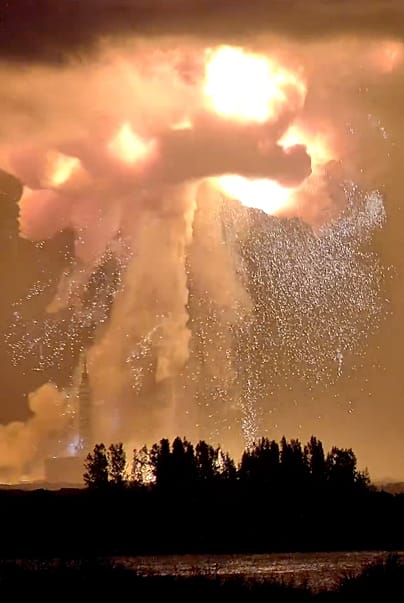
A significant setback for Blue Origin, Jeff Bezos’s private space company, has sent ripples of concern through the international space community, potentially impacting ambitious lunar exploration programs. Images and reports detailing the explosion of a New Glenn rocket during an engine test at a Florida launch pad have left many, including the Director General of the European Space Agency (ESA), Josef Aschbacher, deeply troubled.
“Saddened” and “concerned” were the words Aschbacher used to describe his reaction to the incident, noting the “quite big” damage sustained by the launch pad. While Amazon founder Jeff Bezos confirmed that no personnel were injured and all staff were accounted for, the material damage is substantial.
“It’s certainly a huge setback; this is not good for anyone in the space community,” Aschbacher stated in an interview.
A Setback for the Commercial Space Race and Lunar Goals
The explosion is more than just a blow to Blue Origin’s aspirations to rival SpaceX in the burgeoning commercial space race. It also casts a shadow over the lunar ambitions of NASA, ESA’s American counterpart. Aschbacher highlighted the immense effort invested in rocket and engine development, making such failures particularly devastating.
“This was only one of the very first flights, so therefore it’s really in the ramp-up phase, and this is certainly something that concerns me,” Aschbacher elaborated.
NASA had pinned considerable hopes on the New Glenn rocket as a crucial component of its multi-stage Artemis program, designed to return astronauts to the lunar surface. The recent Artemis II mission, a successful 10-day crewed lunar flyby in April, was a significant step. The subsequent Artemis III mission, slated to feature two commercial lunar landers built by SpaceX and Blue Origin for a low-Earth orbit flight, was intended to provide crucial testing time for the launch systems required for a Moon landing. This mission was originally scheduled for next year.
Until this recent explosion, Blue Origin was widely considered to be further along in its preparations than its competitors. However, the incident now casts doubt on the feasibility of landing on the Moon by 2028 for Artemis IV, and even more recent plans for establishing a permanent moon base.
“You have seen the explosion. The launcher base, I think, is pretty much destroyed, something that will take quite some time to rebuild, but also to investigate the reason why this explosion happened. And this, I know, takes quite a lot of time,” Aschbacher explained.
The Vision for a Lunar Outpost and Europe’s Role
The implications of the Blue Origin setback are amplified by NASA’s recent unveiling of its ambitious plan for a permanent moon base. This initiative, envisioned to eventually pave the way for human missions to Mars, aims for full-time human habitation on the Moon by 2032.
“So that means infrastructure on the lunar surface. It may sound a bit science fiction to imagine that on the moon, astronauts will be walking, driving with rovers, and taking measurements. There will be other rovers extracting something from the soil on the surface. There will be factories producing bricks for making buildings and infrastructure,” Aschbacher described the futuristic vision.
He acknowledged the significant challenges involved in establishing such infrastructure and economy. “But really, creating this infrastructure in this economy is quite a challenge. It will happen, but we are at the beginning of it.”
When questioned about Europe’s contribution to these lunar aspirations, Aschbacher affirmed ESA’s integral role. “These days, I am very intensely negotiating with NASA on the various elements that we can provide in this larger context,” he stated. ESA has been engaged in discussions with NASA regarding enhanced cooperation on lunar projects since 2022, having already funded several key initiatives.
Among these contributions are:
- Argonaut: ESA’s lunar lander program, which will support Artemis missions by transporting equipment from Earth to the lunar surface.
- Moonlight: Europe’s inaugural constellation of lunar satellites, designed to provide telecommunications and satellite navigation services.
- Orion Capsule Engine: The European Service Module for the Orion capsule, a critical component of the Artemis program, is powered by an engine provided by ESA.
“The engine for the Orian capsule [the European Service Module] is provided by the European Space Agency. So yes, we are part of a very close and dense cooperation with NASA already,” Aschbacher confirmed.
Navigating Uncertainties in Artemis Missions
Despite these contributions, ESA’s involvement in the Artemis III mission has faced recent uncertainty. The agency was tasked with developing the Lunar Gateway, a space station intended to orbit the Moon as part of the Artemis III program. However, earlier this year, NASA placed development of this crucial element on hold, a decision that has resulted in years of hard work and millions of euros invested by the European space sector being put on pause.
While European technology is set to remain a part of the Artemis missions, the question of European astronaut participation is a significant one. “That is a big question. I wish I could answer it,” Aschbacher admitted.
“I hope before the end of the decade. We will, of course, partner with NASA, our partner for astronaut flights. This is not yet agreed; I just want to be very clear [on that]. But we are discussing with NASA very intensely to make this possible for Europeans as fast as possible.”
German ESA astronaut Alexander Gerst is considered a leading candidate to be among the first Europeans to journey to the Moon, potentially as part of the Artemis IV mission. The crew for the Artemis III mission is scheduled to be announced on June 9th.


