

Astronomers, armed with the unprecedented capabilities of the James Webb Space Telescope (JWST), have made a groundbreaking discovery: a colossal stellar bar nestled within the distant galaxy GN20. This galaxy, observed as it was just 1.5 billion years after the Big Bang, presents a significant challenge to our current understanding of how galaxies formed and evolved in the nascent universe, revealing a level of complexity and dynamism far earlier than anticipated.
Stellar Bars: The Unsung Architects of Galactic Evolution
Stellar bars are not just aesthetically pleasing formations; they are fundamental architectural elements within galaxies. These elongated structures, composed of densely packed stars, stretch across the central regions of many galaxies and rotate in unison. In galaxies closer to us, stellar bars are a common sight and are known to be powerful engines driving galactic evolution. Their rotation acts like a cosmic conveyor belt, efficiently funneling vast quantities of gas from the outer reaches of a galaxy towards its core. This inward flow of gas is a potent catalyst for a flurry of activity, igniting intense bursts of star formation, providing sustenance for central supermassive black holes, and ultimately contributing to the growth of dense galactic nuclei. Even our own Milky Way galaxy is home to a prominent stellar bar, which significantly influences its central structure and dictates the patterns of star birth.
However, the prevailing cosmological models painted a picture of the early universe as a rather inhospitable environment for the formation of such elaborate structures. Young galaxies were thought to be awash in gas, and established theories suggested that these high gas fractions would actively suppress or at least significantly delay the development of stellar bars. Furthermore, it was widely believed that bars required billions of years of cosmic time to mature into substantial formations. The discovery of a bar spanning an impressive seven kiloparsecs in GN20 therefore stands as both a profound surprise and a revolutionary finding.
JWST Pierces the Cosmic Veil
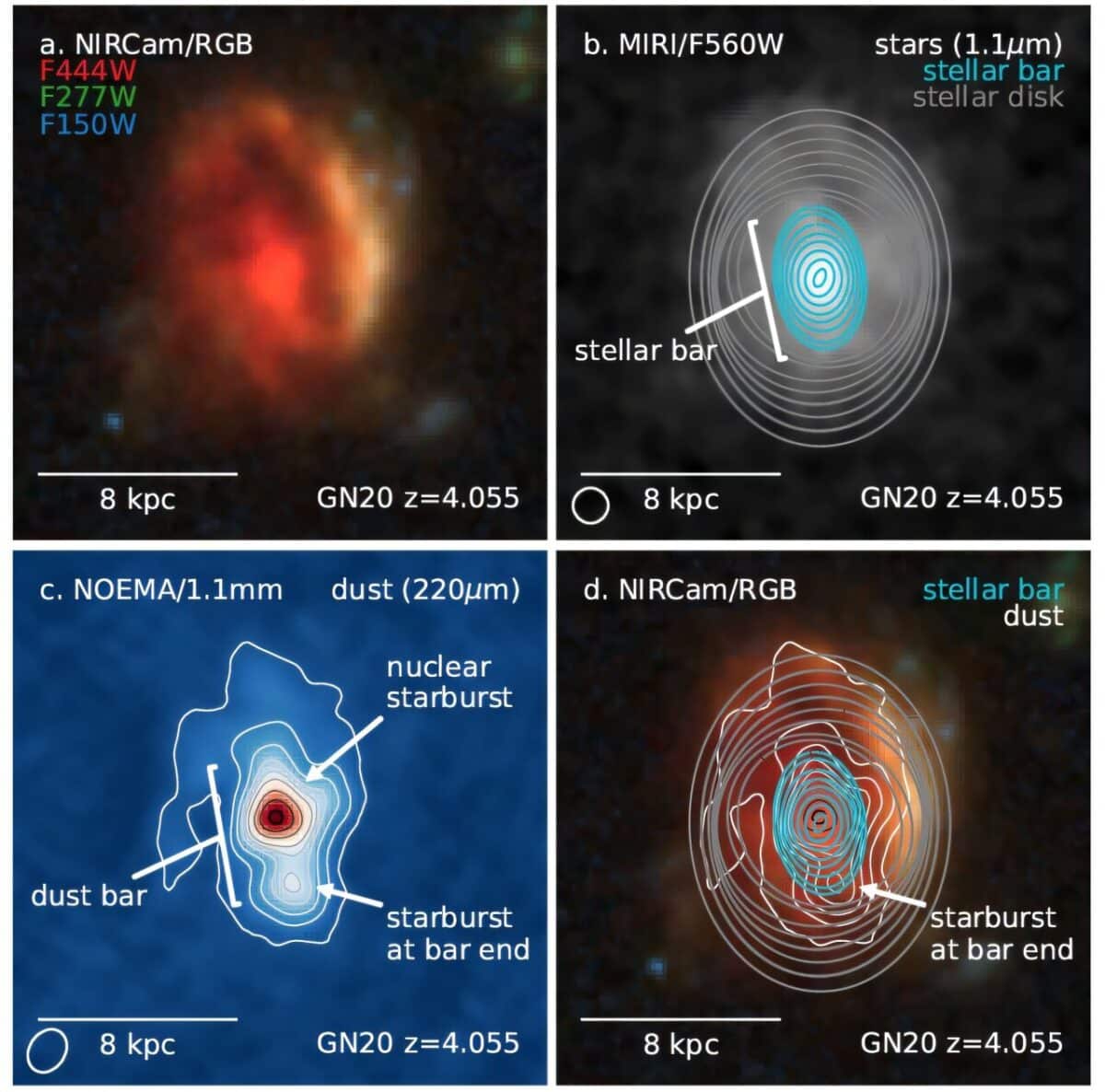
GN20, by its very nature, presents a formidable observational challenge. It is a faint, incredibly distant galaxy, shrouded in a thick veil of cosmic dust that has historically rendered detailed study nearly impossible. It was the advanced suite of instruments aboard the JWST, specifically its Mid-Infrared Instrument (MIRI) and Near-Infrared Camera (NIRCam), that finally allowed astronomers to penetrate this dusty shroud. These instruments provided an unparalleled view into the galaxy’s internal architecture, revealing its structure with exquisite detail. The imaging data clearly depicted a distinct bar-shaped feature. This observation was further corroborated by an independent analysis using isophotal analysis, a sophisticated technique that measures the distribution and rotation of light intensity emanating from a galaxy’s centre outwards.
Adding further weight to the discovery, complementary observations from the Northern Extended Millimeter Array (NOEMA) revealed a remarkable alignment between the stellar bar and a similarly shaped bar evident in the distribution of dust within the galaxy. This striking congruence highlights the deeply intertwined relationship between stars, gas, and dust in orchestrating a galaxy’s evolutionary trajectory. These pivotal findings, initially detailed in a submission to arXiv, underscore the transformative potential of the JWST in not only observing the distant universe but also in challenging long-held assumptions about the processes that governed galaxy formation in its earliest epochs.
Redefining the Rules of Early Galaxy Formation
The presence of a substantial stellar bar in GN20 directly contradicts established expectations in at least three critical areas:
- Gravitational Instability: In environments with high stellar densities, such as those expected in early, massive galaxies, stellar bars are theorised to be inherently unstable and prone to collapse under their own immense gravitational forces.
- Formation Timescale: The development of a bar as extensive as the seven-kiloparsec structure observed in GN20 was believed to necessitate a timescale of billions of years, far exceeding the age of the universe at the time GN20 is observed.
- Gas Fraction Inhibition: As previously mentioned, the prevailing scientific consensus held that a high proportion of gas within a galaxy would actively hinder or entirely prevent the formation of a stellar bar.
The research team themselves articulate this challenge within their paper: “Our new results demonstrate that all three of these obstacles can be overcome by a single ingredient directly implicated by the observations: the presence of highly turbulent gas across the inner disk at high gas fraction.”
It appears that this intense turbulence within the gas plays a crucial role in stabilising the nascent bar structure, allowing it to form and grow with remarkable speed. This mechanism provides a plausible pathway for early galaxies to develop these complex features at a pace far exceeding previous theoretical predictions.
Bars as Accelerators of Star Formation
The stellar bar in GN20 is far more than just a curious structural anomaly; it is an active participant in shaping the galaxy’s evolutionary destiny. Observations indicate that at the points where the bar interfaces with the outer regions of the galactic disk, gas accumulates. This concentrated inflow of gas acts as a powerful trigger, igniting a hotspot of exceptionally intense star formation. Simultaneously, within the very heart of the galaxy, the bar diligently channels material inwards, feeding a vigorous nuclear starburst and potentially powering an active galactic nucleus (AGN) or a supermassive black hole.
The researchers elaborate on this phenomenon: “Part of this high SFR is likely being driven by the bar funneling gas and dust into the center, where it triggers an intense nuclear starburst in the gas-rich disk, and fuels the potential active galactic nucleus.” With a star formation rate that is estimated to be exceeding a staggering 1,000 solar masses per year, GN20 offers a captivating glimpse into the mechanisms by which massive, rapidly evolving galaxies may have coalesced and grown in the early universe.
A Crucial Missing Link in the Galactic Evolutionary Puzzle
Galaxies like GN20, with their exceptionally active and rapid formation processes, may not represent a transient cosmic phase but rather a critical, formative stage in the emergence of the massive elliptical galaxies that populate the local universe today. Once the gas supply in the central regions, fuelling the intense star formation, is eventually depleted, the galaxy naturally transitions into a quiescent state, with star formation winding down significantly. This evolutionary pathway could provide a compelling explanation for how certain massive galaxies in our cosmic neighbourhood managed to quench their star formation remarkably early in their history, thereby resolving a long-standing enigma in astrophysics.
Ultimately, this remarkable discovery underscores the profound and transformative power of the James Webb Space Telescope. By unveiling previously hidden structures and processes in the early universe, JWST is providing astronomers with an increasingly clear and detailed understanding of how galaxies, such as GN20, were able to defy conventional cosmic expectations and construct their stellar populations and central cores in what, from a cosmic perspective, is record time.


