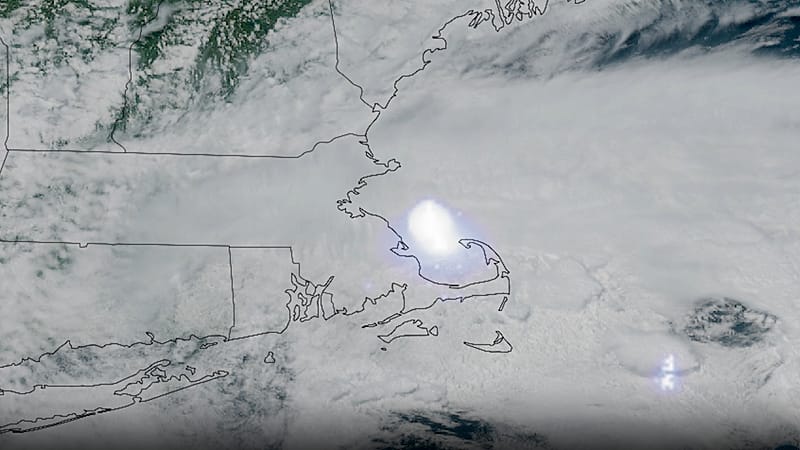
Dazzling Fireball Lights Up US Skies, Sonic Booms Rumble Across New England
A spectacular celestial event unfolded over the northeastern United States on Saturday, captivating onlookers and causing a stir as a blazing meteor streaked across the sky. The fiery visitor, a natural meteor, met its end in Earth’s atmosphere, exploding with an energy release equivalent to approximately 300 tons of TNT, according to data from NASA.
The dramatic disintegration occurred at an altitude of roughly 40 miles (64 kilometres) above the region where northeastern Massachusetts and southeastern New Hampshire converge. This explosive fragmentation triggered powerful sonic booms, the thunderous echoes of which reverberated across the entire New England area, leaving residents in awe and a little unnerved.
Residents Report Shaking Buildings and Eerie Sounds
The unexpected and forceful sonic booms left many residents perplexed and concerned. Reports of buildings visibly shaking and loud, disorienting noises flooded in from various states, including Massachusetts and Rhode Island. On social media platforms, eyewitnesses shared their experiences, with some recounting hearing two distinct, powerful booms in succession, while others described vibrations so intense they rattled the very foundations of their homes and apartments.
One Massachusetts resident, speaking to local media outlets, drew a parallel between the sensation and a minor earthquake. She described feeling a distinct and unsettling vibration even from her fourth-floor apartment, highlighting the significant impact of the atmospheric event. Fortunately, as of the latest reports, there have been no confirmed injuries or significant property damage directly attributed to the meteor’s fiery demise.
A Lone Visitor from Space
NASA officials confirmed that the celestial object was a natural meteor, not associated with any known meteor showers currently active. It was travelling at an astonishing speed of approximately 75,000 miles per hour (120,000 kilometres per hour) at the time of its fragmentation. The agency also clarified that the object was not a piece of space debris or a re-entering satellite, reinforcing its natural origins. This solitary journey through the cosmos ended in a brilliant, albeit brief, display over our planet.
The Science Behind the Spectacle
The phenomenon observed is a classic example of a meteoroid entering Earth’s atmosphere. When a space rock, known as a meteoroid, encounters the dense gases of our atmosphere at high velocity, friction causes it to heat up intensely, creating the luminous streak we call a meteor, or a shooting star. If the meteoroid is large enough and survives its fiery descent, it can explode in the atmosphere. This explosion generates shockwaves that travel to the ground as sonic booms. The energy released, measured in tons of TNT equivalent, gives an indication of the meteoroid’s size and the intensity of the atmospheric disruption.
The altitude at which the meteor broke apart, around 40 miles, is a common range for such events. At this height, the atmosphere is still thin enough for the meteoroid to maintain much of its velocity but dense enough to generate significant friction and heat. The subsequent fragmentation often leads to a more widespread and noticeable sonic boom event.
A Reminder of Our Place in the Cosmos
While the event caused a momentary disruption and a degree of surprise for those on the ground, it serves as a compelling reminder of the constant cosmic ballet happening above us. Earth is regularly bombarded by small particles from space, most of which burn up harmlessly in the atmosphere. Occasionally, however, larger or more energetic events like this one provide a breathtaking visual spectacle and a palpable physical sensation, underscoring the dynamic nature of our solar system and our planet’s place within it. Scientists continue to monitor space for potential threats, but events like Saturday’s meteor are a common and generally harmless occurrence, offering a glimpse into the vastness of space and the natural processes at play.