

The Black Market for Cooking Gas in Delhi
A man pulls up on a bicycle with a gas cylinder strapped to the back. I ask him what he wants for it. After a bit of negotiating, we settle on 3,500 rupees — just more than $50. It’s nearly four times the official price of gas. I hand over the cash and he drags over the cylinder before riding off. The entire exchange takes less than an hour and appears to be one of countless others happening on Delhi’s streets against the backdrop of the Iran war.
India sources about 60 per cent of its LPG from overseas, making it the world’s second-largest importer. Much of it flows from the Middle East through the Strait of Hormuz, a critical waterway now squeezed by the conflict between the United States, Israel and Iran. But the Indian government categorically denies there is a problem with getting cooking gas.
“India’s petroleum and LPG supply situation is fully secure and under control,” said a statement issued by the Ministry of Petroleum and Natural Gas in late March. “The Ministry calls upon citizens not to be misled by a deliberately mischievous, coordinated campaign of misinformation that is being carried out to spread unjustified panic.”
Queues for Cooking Gas in Delhi
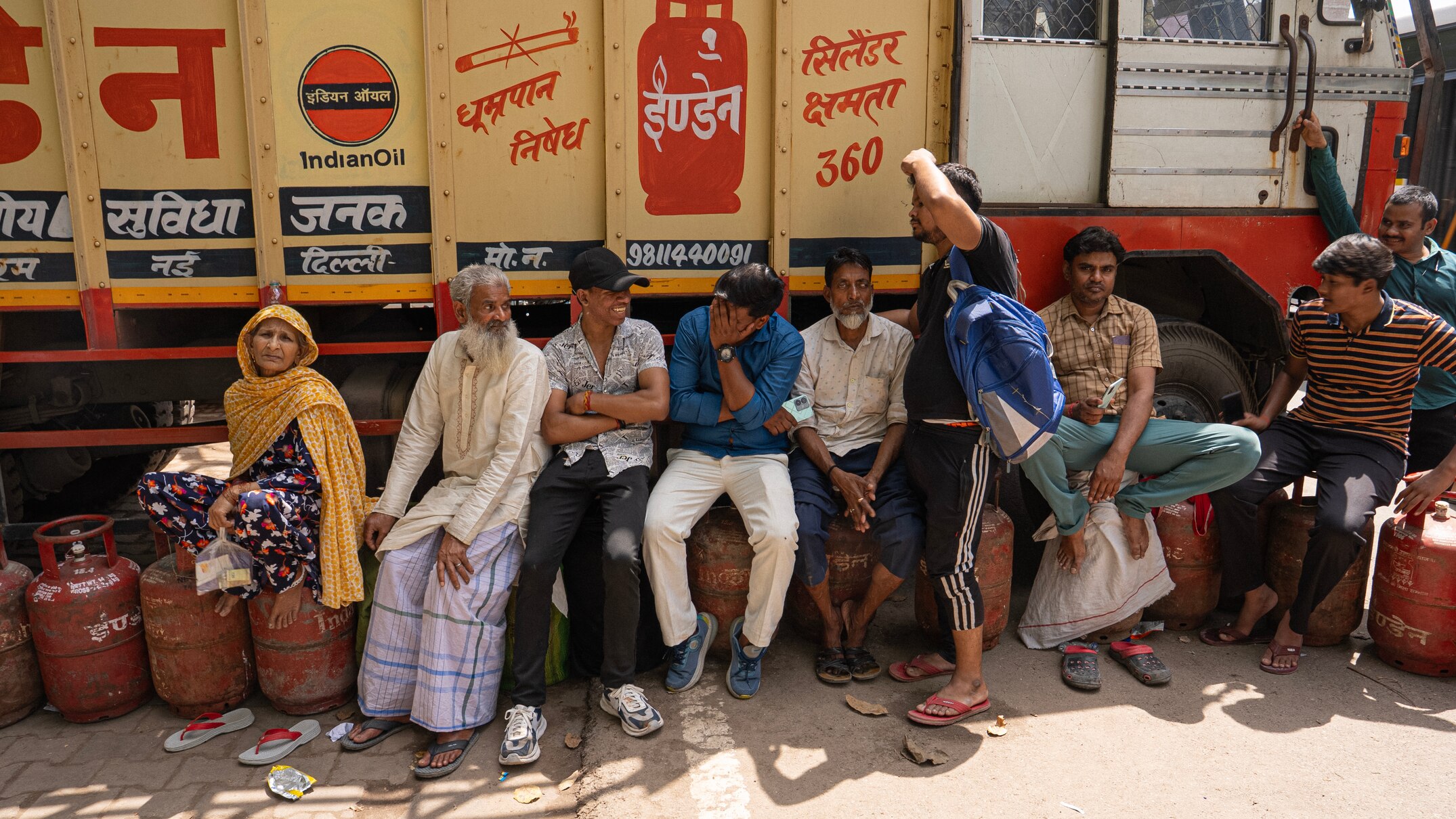
Across the city, people are waiting days and sometimes weeks for cylinders they are told are available and booked for them. Yet the ABC has found the same gas can be sourced quickly on a thriving black market — for those who can afford it.
At a government depot in south-west Delhi, a crowd has been gathering since early morning. By midday, it has not moved at all. “I’m waiting here since 8am,” Rahul Kumar tells the ABC. “We still don’t know if the servers are working or not.” As the hours drag on, frustration is building. “If it was up to me, I’d burn this place down,” Riyasat Ali says.
To collect a cylinder, customers must provide a Delivery Authentication Code (DAC) — a one-time code sent to their phone when they book gas and checked against the company’s system at pick-up. The code is intended to ensure that deliveries are made to the correct recipient and to prevent unauthorised transactions. Officials say the crowds are being driven by people without these codes, and by panic buying.
“If your DAC has been issued, you will get a cylinder,” says depot worker Amrinder. But queued up people tell me they have had their codes for days, and still no gas. “We come every day and they send us away saying you’ll receive some kind of number. It’s been 30 days now,” another customer named Komal tells the ABC. “They are torturing the public and they’re going to starve us to death.”
Alternatives to Cooking Gas
The only alternatives to cooking gas is induction, which is expensive because of panic buying and also depends on consistent electricity. Otherwise, there is a clay oven using firewood, which is time-consuming, inefficient and, at times, dangerous.
“Finding firewood is a problem,” Pooja says. The 30-year-old lives in an informal settlement in south-west Delhi and says her entire neighbourhood is struggling to find cooking gas. “We have to go into the jungle and I get scared going there by myself. It’s a lot of trouble,” she says. “It’s never been an issue since we use gas, but now, we are helpless.”
How Does the Black Market for Gas Work?
The ABC spoke with more than a dozen people and every one of them agreed there was no gas shortage in India. Instead, they have alleged the supply was being diverted to the black market. Police and industry officials say the diversion typically follows a predictable pattern.
Cylinders meant for households are first siphoned out of the official supply chain, often by distributors or delivery workers. From there, gas can be extracted using transfer pipes — small amounts taken from multiple cylinders before they are delivered — and then sold separately. In other instances, stock is deliberately hoarded to create artificial scarcity, allowing it to be sold at significantly higher prices.
The system operates through informal networks — often out of small businesses like stove repair shops, grocery stores, or private storage spaces. “If I ask them to give me one illegally, they’ll charge me 3,500 rupees or 5,000 rupees and give it to me immediately,” Komal says of government gas depot officials.
Testing the System
While officials maintain that supply is stable, delays in access appear to be driving some consumers towards informal markets, where gas is available more quickly — but at significantly higher prices. The ABC attempted to purchase a gas cylinder outside the official system to test these claims.
We start by calling a few suppliers. “There is none available,” one tells me. We stop a vendor on the street with a truck full of cylinders. “If you don’t have a code, you can’t get one,” he says. After a few dead ends, we decide to go to another government depot. Finally, a man approaches us and says he can arrange a cylinder, for the right price. No DAC is required and once the deal is done, he moves on to his next delivery.
The ABC sent Delhi Police detailed queries about the illegal trade, but did not receive a response. We gave the gas cylinder we bought to Pooja.
Authorities Crack Down on Gas Black Market
What is emerging is a gap between how the system is designed to function and how it is operating in practice. In Delhi alone, police carried out 76 raids between March 1 and March 26, registering 22 cases and seizing more than 1,700 cylinders in a crackdown on alleged hoarding and illegal diversion.
Investigators say many of those cases involved gas agency staff or delivery workers — pointing to how deeply embedded the issue may be within the supply chain. The crime branch alone seized more than 1,100 cylinders in just three cases. Similar action has been reported in other cities, including Noida and Nagpur.
In Hyderabad, police recently uncovered more than 400 cylinders hidden in a graveyard, detaining 10 people and suspending the distributor involved. According to Sujata Sharma, a senior official in the Ministry of Petroleum and Natural Gas, thousands of inspections have been carried out in recent weeks, with hundreds of cylinders seized.
For millions across Delhi, the issue is not whether there is a cooking gas shortage. It is whether they can obtain it through the system intended to deliver it.