
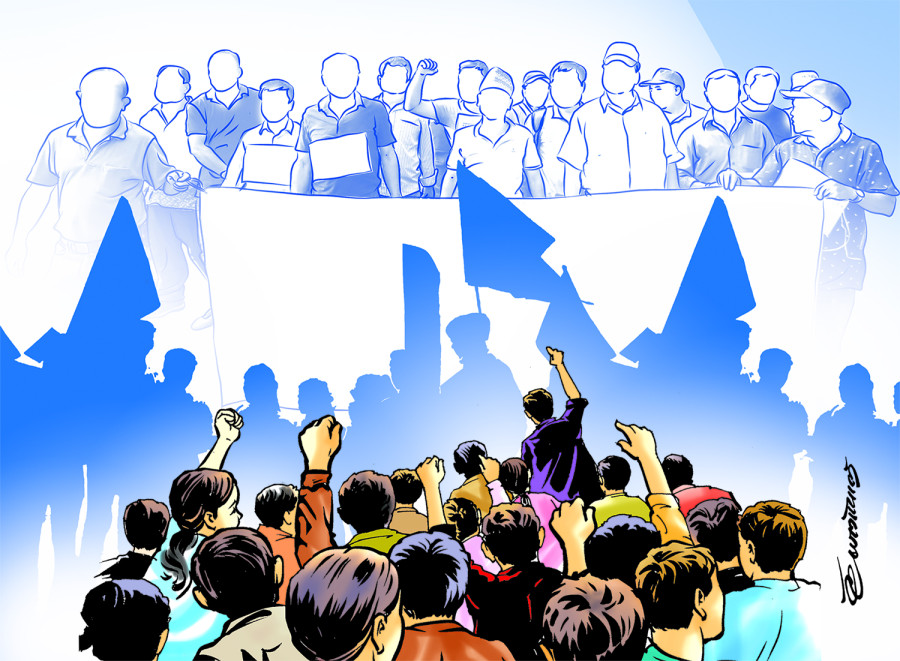
Nepal is currently experiencing an unprecedented political moment, defined by the anticipation of an upcoming general election. This pivotal event has ignited a spectrum of discussions, reflecting diverse approaches and patterns of engagement among both established political parties and emerging forces. The prevailing sentiment appears to be divided between outright skepticism and uncritical enthusiasm, with a notable lack of thorough situational analysis in many quarters. The sudden call for snap elections and the subsequent preparations present significant challenges not only to political actors but also to academics, social scientists, writers, and artists.
The abruptness of the political shift, unfolding over a matter of weeks or even days, has had discernible impacts on the fabric of daily life and the established power structures. A segment of the populace, accustomed to holding power or operating on its fringes, has reacted to these changes with considerable apprehension. However, they have found themselves unable to entirely dismiss the unfolding developments. In a surprising turn of events, former Chief Justice Sushila Karki, a figure who might have been overlooked for leadership in Nepal’s traditionally male-dominated political landscape, was entrusted with guiding the nation through this critical juncture. Her mandate was to oversee the crucial general election scheduled for March 5, 2026, leveraging the full constitutional authority vested in her caretaker government. Amidst an atmosphere charged with skepticism, dissent, and political fervor, her administration is steadfastly moving forward with the organization of this historic electoral process.
Ironically, even those who played pivotal roles in shaping modern Nepal, such as facilitating the integration of the Maoist insurgency through the Comprehensive Peace Accord signed in 2006 with seven parliamentary parties, continue to voice doubts. The elections, which included the Maoists, were conducted following the adoption of the current constitution, at a time of immense national challenge. It is noteworthy that the same political factions credited with resolving the complex issues of guerrilla disarmament and demobilization are now expressing reservations, claiming that elections cannot proceed until all weapons reportedly looted during the “Gen Z uprising” of September 8-9, 2025, are recovered. These skeptical party leaders, whether feigning ignorance or deliberately sowing seeds of uncertainty regarding the government’s electoral capacity, are actively engaged in campaigning. They are utilizing every available medium—verbal, written, and electronic—to articulate their positions. The pervasive reach of contemporary media, in its current omnipresence, would likely astonish even Marshall McLuhan, the pioneer of media theory.
The evolving political landscape and the impending elections are clearly reflected in the varied responses and alignments observed. Due to space constraints and the essay’s focus on broader trends rather than exhaustive party analysis, only a few illustrative examples will be highlighted. These include the formation of new alliances, such as the Rastriya Swatantra Party, the announced merger of Upendra Yadav’s Janata Samajbadi Party-Nepal (JSP-Nepal) and Mahanta Thakur’s Loktantrik Samajbadi Party (LSP), and the emergence of new political entities like Kulman Ghising’s Ujyalo Nepal Party. Furthermore, a significant consolidation of various communist factions—excluding the CPN-UML, Netra Bikram Chand’s Maoist party, and Narayan Man Bijukshe’s Nepal Majdoor Kisan Party—has occurred under the banner of the Nepali Communist Party.
These are but a few instances of the dynamic shifts occurring. A particularly significant development is the dramatic leadership transition within the Nepali Congress, the nation’s oldest and largest party. Millennials and Gen Z members have ascended to leadership positions, wresting control from older stalwarts. This signifies a notable evolution in Nepali political dynamics. The overarching challenge for these newly formed and reorganized parties is to move beyond the rigid structures and ideological confines of the past.
The Enduring Influence of Individual Charisma
The impact of individual leaders on Nepali politics warrants careful examination, particularly concerning the concept of political charisma. As defined by the German sociologist Max Weber, charisma refers to the distinctive personal qualities of a leader that inspire widespread respect and devotion. To fully grasp the allure of leadership in Nepal, a psychopolitical perspective is essential.
Historically, Nepal’s institutions, including the monarchy and the long-standing Rana oligarchy, offered little room for individuals to cultivate and express their unique personalities independently. While B.P. Koirala’s 1977 court testimony marked a rare instance of an individual directly confronting the system, the deep-seated impact of the feudal past persisted. Even after the dismantling of this system, Nepali politics retained many of its characteristics, often hindering individuals from asserting their distinctiveness.
A poignant anecdote from the 2038 BS (Nepali calendar) Panchayat parliamentary elections illustrates this point. Nani Maiya Dahal, an independent candidate, secured a resounding victory over a traditional Panchayat candidate. Her campaign was marked by an unconventional style of speech and action, embodying a spirit of rebellion. The evening of her victory was celebrated with a grand procession through the city, with Dahal seated on a chariot constructed by citizens. Mark Tully, a BBC journalist who recently passed away, was present at New Road, Kathmandu, awaiting this procession. He inquired if I believed this display of public enthusiasm signaled a profound transformation in Nepali politics. Years later, at a SAARC Writers and Literature conference where Tully and I shared a literary award in 2010, I recalled that evening. Tully, possessing a keen understanding of Nepali political nuances, acknowledged the pervasive “cult persona” prevalent in South Asian politics.
Navigating the National Psyche and Political Ambitions
To truly comprehend the “zeitgeist,” or the prevailing mood of our times, it is crucial to analyze how Nepal’s national psyche shapes collective actions. It is almost a truism to state that the pursuit of power is a significant motivator in Nepali politics. However, the current trajectory of Nepali politics emphasizes the projection of individual leaders’ unique qualities over the articulation of well-defined political philosophies. Leaders across the political spectrum are actively vying to showcase the distinctive personal attributes of their respective figures. While individual qualities can indeed play a role in a democratic electoral process, an overly enthusiastic or euphoric emphasis on personal charisma and uniqueness might betray a lingering psychological legacy of Nepal’s feudal past.
Nepali politics and its leaders would benefit from tempering their inclination to excessively highlight the personal qualities of political or governmental figures. Learning from the consequences of misguided approaches is paramount. Nepal’s rich and varied history offers invaluable lessons that can guide the nation forward.

