
Manly Sea Eagles: An Era of Extremes and the Path Forward
Since the dawn of 2025, the Manly Sea Eagles have carved out a peculiar statistical niche in the NRL: they are the team involved in the most matches decided by a margin of 13 points or more. A staggering 21 of their last 27 encounters have fallen into this category, with the Sea Eagles emerging victorious in 10 and succumbing in the other 11. This tendency for decisive outcomes is so pronounced that it rivals some of the most dramatic statistical anomalies in the league’s history. In fact, Manly themselves hold the record for the most games decided by 13-plus margins in a single season, achieving this feat in 2021 – a year marked by the now-familiar sound of the set restart.
This “all-or-nothing” approach perfectly encapsulates the tenure of former coach Anthony Seibold. The Sea Eagles under his guidance have been a team of stark contrasts – brilliant one moment, unraveling the next. While the current record might paint a picture of inconsistency, it also highlights a significant underlying truth: there is considerable upside for any future long-term coach. The squad is brimming with talent, and a promising crop of young players is emerging, suggesting that while the roster requires renovation, there is ample scope for strategic rebuilding.
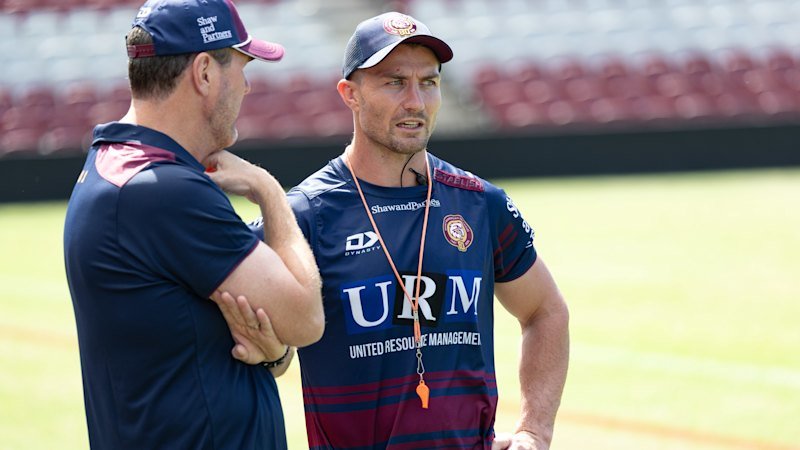
For now, the reins have been handed to caretaker coach Keiran Foran, a beloved figure in Manly’s history. With his coaching debut against the Dolphins looming, Foran faces the immediate challenge of instilling a new approach, one that ideally mirrors the playing style that made him a legend: a potent blend of individual brilliance and unwavering resilience.
The NRL landscape is evolving, particularly with rule changes like the “six-again” that can create extended periods of momentum, allowing teams to dominate possession for significant stretches. In this environment, where possession and territory are paramount, the Sea Eagles, as they currently stand, are not optimally built for sustained dominance in either.
A Game Built on Speed and Flair, But Lacking the Foundation
Manly’s offensive strategy has often revolved around early shifts designed to exploit the blistering speed of players like Tolu Koula and Jason Saab. This approach has, at times, made them the NRL’s most dangerous side when attacking from their own half, leading to spectacular long-range tries. Their expansive ball movement, which saw them averaging 258 passes per game last season – second only to the Penrith Panthers (262) – further underscores this attacking philosophy.

When this game plan clicks, it’s a joy to watch. However, it relies heavily on having front-foot ball or at least a relatively even contest in the ruck and wrestle to maintain its effectiveness. The harsh reality for Manly over the past two years is that they have frequently lost the ruck battle. Their three losses so far this season have seen a significant drop in their passing game, averaging 30 fewer passes per game, a direct consequence of being starved of possession and field position.
Several injuries to a forward pack already lacking depth have exacerbated these issues, particularly the absence of key players like Taniela Paseka last year. The perceived decline of Jake Trbojevic adds another layer to these concerns. In terms of pure yardage, Manly has been thoroughly outplayed in their defeats against Canberra, Newcastle, and the Sydney Roosters. The statistics from these games are stark:
- Against Canberra: Manly was outrun by an astonishing 185 metres.
- Against Newcastle: The Knights amassed 401 more running metres.
- Against the Roosters: Manly conceded 331 more metres.
The territory statistics from these same matches are equally concerning, making it a wonder how Manly remained competitive at all. Against the Raiders, a significant 58 per cent of the golden-point loss was played in Manly’s own half. The Knights controlled 56 per cent of the territory, and in their recent clash with the Roosters, a staggering 68 per cent of the game was played at Manly’s end of the field.
The Immediate Challenge: No Easy Fixes
The predicament facing Foran and the Sea Eagles is the lack of an immediate, simple solution. Wingers like Jason Saab and Lehi Hopoate, while possessing electrifying pace, are not typically known for their tough, yard-gaining carries. Veteran props Siua Taukeiaho and Nathan Brown were unavailable in a recent match, but even when fit, they haven’t consistently bent the defensive line. This has also been a characteristic absent from Jake Trbojevic’s game in recent seasons.

Consequently, Manly’s expansive game plan, designed to create space for dynamic talents like Tom Trbojevic, Haumole Olakau’atu, and Tolu Koula, falters when the crucial passes don’t stick. This can lead to frustrating periods, as evidenced by the numerous unforced errors against Newcastle.
While five-eighth Luke Brooks thrives on front-foot ball, and Jamal Fogarty offers a valuable long-kicking game to salvage sets, the team’s overall structure is susceptible to pressure. Seibold’s decision to hold back the highly-rated 19-year-old Joey Walsh from immediate inclusion in a struggling side is understandable, perhaps drawing parallels to the difficult development of Tom Dearden at the Brisbane Broncos, who endured a lengthy period of losses that significantly impacted his confidence.
In an era where set restarts place immense pressure on defensive structures, Manly often appears to wilt too easily. However, fleeting glimpses of the tenacity required to match their undeniable talent do emerge. The stirring upset victory over Melbourne in Melbourne last winter, and even the strong first-half performance against a near-perfect Roosters outfit, offer moments of hope. Yet, the repeated concession of three tries in five minutes early in the second half against the Roosters, and the ill-advised short kickoff that followed – which drew commentary from Queensland Origin coach Billy Slater as a sign of surrender – highlight the ingrained issues that need addressing.
Foran, a player renowned for his wholehearted commitment throughout his distinguished career, is ideally placed to lead by example. The Manly Sea Eagles could do far worse than to adopt the spirit and resilience that defined his playing days.


