
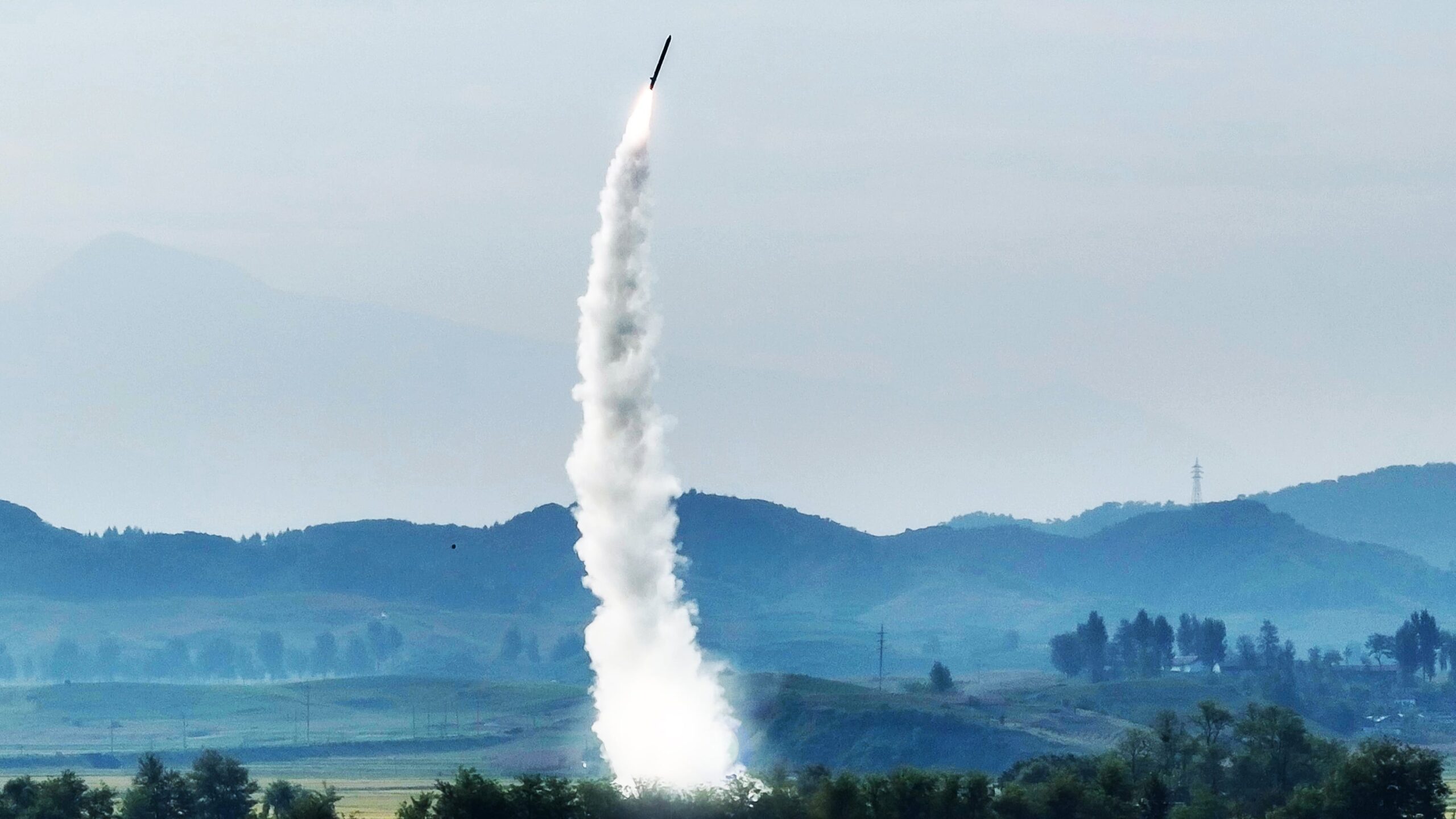
North Korea Conducts Ballistic Missile Test Amidst Regional Diplomacy
On the 4th, North Korea staged a significant display of military capability with the launch of an unidentified ballistic missile toward the East Sea. This provocative act occurred just one day prior to a crucial summit between South Korean President Lee Jae-myung and Chinese President Xi Jinping. The timing of the launch has drawn considerable attention, with analysts suggesting it serves as a pointed message to the United States, particularly in light of recent events in Venezuela.
The Joint Chiefs of Staff (JCS) in South Korea confirmed the launch, reporting that multiple projectiles, presumed to be ballistic missiles, were detected departing from the vicinity of Pyongyang around 7:50 a.m. local time. These missiles are estimated to have traveled approximately 900 kilometers before impacting the East Sea. While the JCS indicated that detailed specifications are still undergoing rigorous analysis, reports from Japanese media, including Kyodo News, suggest that Japan’s Ministry of Defense assessed the launched missiles to have landed outside of Japan’s Exclusive Economic Zone (EEZ).
Potential for Advanced Missile Testing
Military experts are keenly observing the possibility that this launch represents a maximum range test of North Korea’s KN-23 series ‘Hwasong-11-Ma’ hypersonic missile. Such a test would underscore the ongoing development and sophistication of Pyongyang’s missile program.
This latest ballistic missile launch marks the first such event by North Korea in the current year. It follows a period of relative quiet, with the previous notable launch being a short-range ballistic missile test on November 7th of the preceding year, approximately two months prior.
Strategic Timing Amidst Diplomatic Engagements
The timing of the missile launch is particularly noteworthy, coinciding precisely with the commencement of President Lee Jae-myung’s state visit to China. The South Korean president’s four-day trip, at the invitation of President Xi Jinping, is scheduled to include significant discussions on the critical issue of North Korea’s denuclearization. The missile test is widely interpreted as a deliberate effort by North Korea to assert its presence and influence on the regional agenda just ahead of these high-level diplomatic talks.
A Message to the United States?
Furthermore, the missile launch has been contextualized within the broader geopolitical landscape, specifically in relation to recent U.S. military actions in Venezuela. The United States announced on the 3rd that it had orchestrated an operation to apprehend and transport Venezuelan President Nicolas Maduro and his spouse. In this context, some analysts suggest that North Korea’s missile test could also be interpreted as a defiant stance against the U.S., drawing a contrast between its own demonstrated military capabilities and the situation faced by Venezuela. The implication is that North Korea is signaling its resolve and capacity to resist external pressures, stating, in essence, “We are different.”
In response to the launch, U.S. Forces Korea issued a statement assuring that the incident does not appear to pose an immediate threat to U.S. personnel, territory, or allied nations in the region. The statement reiterated the U.S.’s unwavering commitment to the defense of its homeland and its allies in the Indo-Pacific.


