
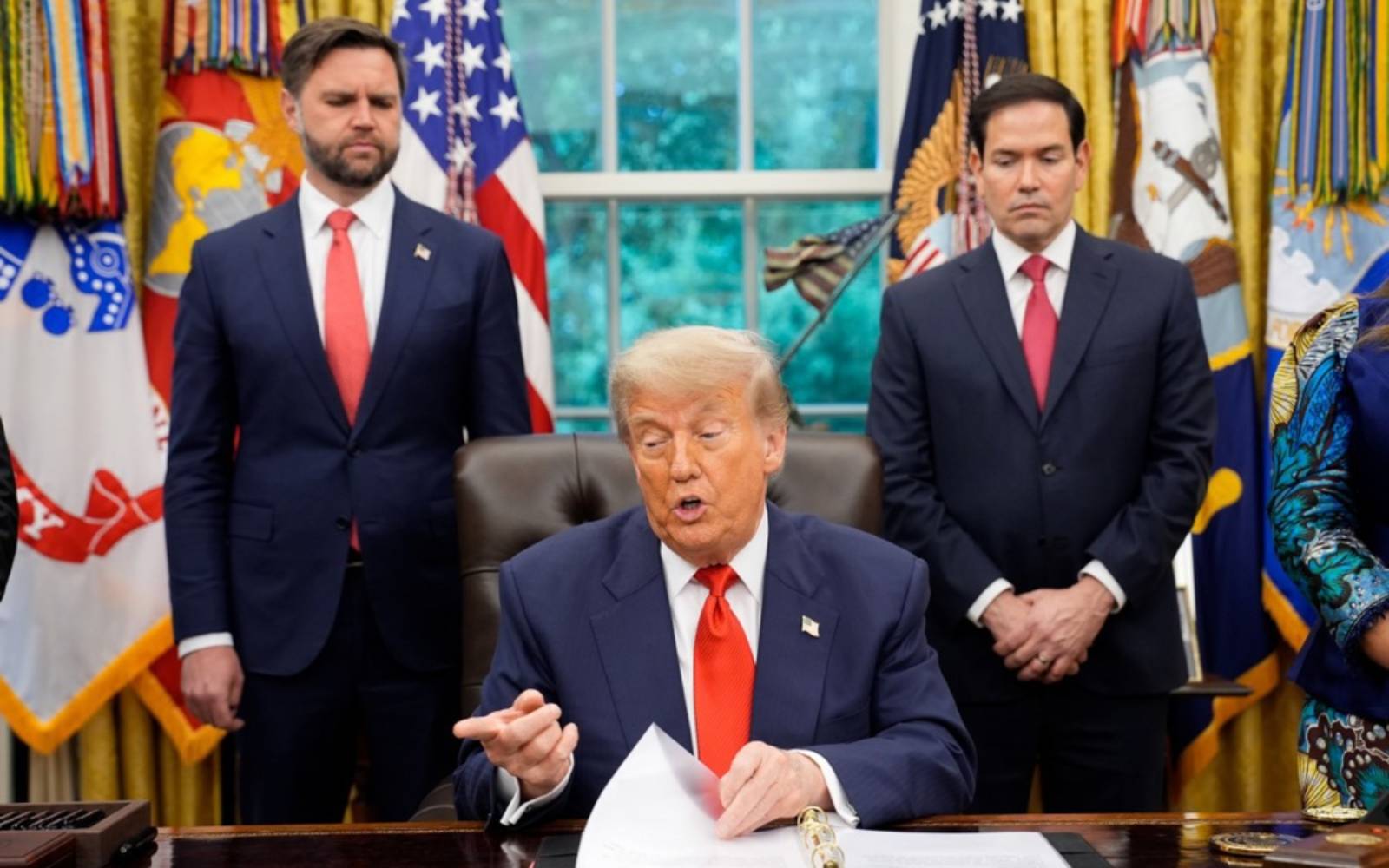
Trump Praises Potential Republican Successors, Remains Tight-Lipped on 2028 Ticket
President Donald Trump has lauded both Vice President JD Vance and Secretary of State Marco Rubio as “fantastic,” while strategically sidestepping direct questions about endorsing either for the Republican presidential nomination in 2028. Speaking to reporters aboard Air Force One, Trump indicated that discussions about future leadership were premature, with three years remaining in his current term.
“It’s something I don’t have to worry about now. I’ve got three years to go,” Trump stated when pressed on his potential support for Vance or Rubio in the upcoming election cycle. He elaborated, “JD is fantastic. And Marco – they’re both fantastic.” Trump specifically acknowledged Rubio’s performance, remarking, “I think Marco did a great job in Munich.”
This deliberate ambiguity follows a pattern of the President maintaining a degree of mystery regarding his preferred successor. While Trump has consistently mentioned both Vance and Rubio when the topic of post-presidency leadership arises, he has avoided making definitive commitments.
Last year, Trump had previously suggested that Vance was “most likely” to inherit the mantle of the Make America Great Again (MAGA) movement. However, he has also voiced his belief that Rubio would be a formidable nominee. This dynamic has fueled ongoing speculation about a potential rivalry brewing between the two prominent Republicans.
Contrasting Styles on the Global Stage
The recent focus on Vance and Rubio’s potential leadership emerged following significant appearances at the Munich Security Conference. Secretary of State Marco Rubio garnered positive reception for his address, where he articulated a shared heritage with European nations and advocated for a common future trajectory. His remarks, while acknowledging the Trump administration’s established positions on Western dominance, immigration, and climate skepticism, adopted a notably more conciliatory tone compared to Vance’s address a year prior.
In his 2023 speech at the same conference, Vance delivered a more confrontational message, criticising European allies and emphasizing cultural divergences. This speech was widely interpreted as exacerbating existing tensions between the United States and the European Union. When questioned about Vance’s remarks, Rubio, in an interview with Bloomberg News, stated he was not dismissing Vance’s perspective but aimed to provide context for the Trump administration’s rationale.
A Tale of Two Political Ascents
The profiles of Rubio and Vance offer a compelling contrast within the Republican landscape, each embodying different facets of the party’s appeal.
Marco Rubio: At 54 years old, Rubio is a seasoned politician with a long-standing reputation as an anti-communist hawk. He has adeptly navigated the political arena by embracing President Trump’s assertive foreign policy while simultaneously exploring avenues for discreet negotiation and deal-making. His experience and established foreign policy credentials position him as a more traditional, yet still Trump-aligned, contender.
JD Vance: In contrast, the 41-year-old Vance is a more recent figure in national politics. His rise to prominence was significantly propelled by his memoir, which offered a candid look at life in small-town Ohio and Kentucky. Vance is seen as a strong embodiment of the MAGA movement’s anti-elite sentiments and President Trump’s characteristic approach to disruptive and unconventional deal-making. His background resonates with a segment of the Republican base that values authenticity and a rejection of established political norms.
President Trump himself has, over several months, both privately and occasionally publicly, alluded to a potential rivalry between Vance and Rubio. He has strategically suggested at different times that each man, in turn, is best positioned to carry forward his political legacy and lead the Republican Party into the future. This ongoing narrative of potential succession, punctuated by Trump’s carefully chosen words of praise and subtle comparisons, continues to shape the discourse surrounding the future leadership of the Republican Party.


