Unravelling the Mystery: Victoria’s True Last Fatal Shark Attack
For decades, official records have pointed to 1987 as the year of Victoria’s last fatal shark attack, placing the incident off the rugged coast of Wilsons Promontory. However, a deep dive into historical records has uncovered a compelling, and largely forgotten, story that shifts the timeline and reveals the true identity of the victim. This investigation, prompted by a librarian’s persistent hunch, has corrected a long-standing error in Australia’s official shark incident database.
The enduring image of a windsurfer’s untethered board bobbing on the deep, swirling blue, a solitary marker for a lost life, is etched in the memory of retired sergeant Jim Lowe. He recalls the sheer scale of the presumed attack, a testament to a “monster” of a shark. Yet, the narrative that emerged and persisted for years was one where the truth became obscured.
A Librarian’s Doubt Sparks an Investigation
The persistent discrepancy began with Michelle Stillman, a librarian, who noticed the recurring 1987 date in shark attack timelines. Her concern was simple yet profound: where were the corroborating newspaper reports? This figure had been consistently cited in Australia’s official shark incident database, maintained by the Taronga Conservation Society Australia, and echoed by authoritative bodies like the Victorian Fisheries Authority, since at least 2012.
“In Australia, if you so much as murmur the word ‘shark’ on a beach, everyone pays attention and yet, supposedly, someone was killed by a shark in Victorian waters – a rarity – and there’s no record at all?” Stillman questioned, her voice reflecting the ingrained skepticism of a seasoned researcher. “It just didn’t ring true. But I still had to include it as a possibility as the incident was listed as having occurred on official sites.”
Tracing the Source: A Windsurfing Magazine Clipping
The fisheries authority’s continued reliance on the 1987 date prompted a closer examination of their original source: an article from the windsurfing publication Sail Wind Quarterly. David Slip, a research biologist with Taronga, diligently tracked down the original clipping. The article described an “extremely experienced” rider who appeared to have become separated from his board before a devastating attack occurred while he was swimming. The author speculated that a great white shark, for which the area was known, might have mistaken the rider for prey, such as a seal. The windsurfer, last seen sailing approximately 1.5 kilometres offshore, washed ashore days later, his board and rig found intact.
While the Sail Wind Quarterly article itself was undated, subtle clues emerged. An advertisement for a speed sailing competition within the magazine led Slip to believe his colleague had mistakenly associated it with 1987, when records indicated the event actually took place the year prior.
The Missing Windsurfer and the Final Piece of the Puzzle
Following the appearance of the windsurfing magazine article, Stillman discovered a brief mention in The Age on September 2, 1986. This report detailed the disappearance of William Crouch, a 32-year-old windsurfer from Western Australia, who was last seen off Waratah Bay, north-west of Wilsons Promontory, on August 31, just two days earlier.
Armed with Crouch’s name, a crucial call to the South Gippsland Sentinel-Times, a local newspaper, unearthed the final, definitive piece of evidence: a report detailing the attack, dated September 16, 1986. This article revealed that a government pathologist held reservations about the cause of death, suggesting Crouch might have been attacked by a shark while swimming or perhaps after he had already drowned. Adding to the suspicion, another young surfer had informed then-police sergeant Jim Lowe that they had spotted a shark in the vicinity around the time of Crouch’s disappearance.
“It took a combination of clippings, digitised newspapers and bound volumes of the original newspapers to verify the missing windsurfer as the drowning victim and possible shark attack victim,” Stillman stated, expressing her satisfaction at finally resolving a long-standing mystery. “Finally being able to confirm the correct date as being 1986 and now having the name of the victim is a pleasing tying up of loose ends to a mystery I didn’t think I’d resolve.” In light of these findings, the Australian shark incident database has since amended its entry.
Reflecting on a Tragic Encounter
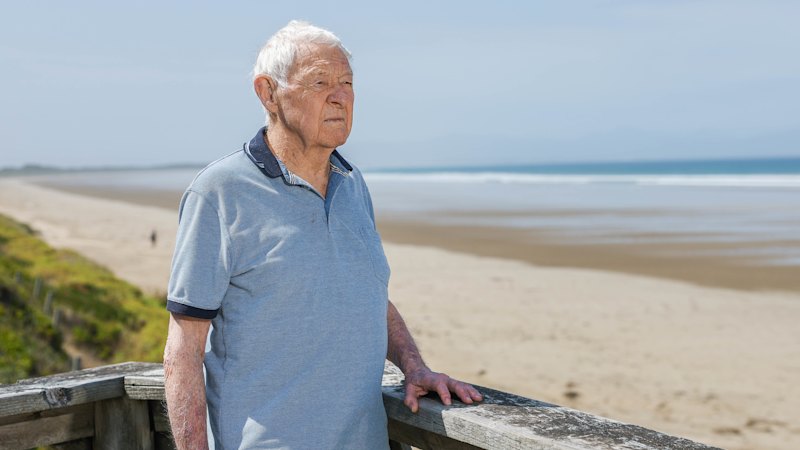
Jim Lowe, now 89, still resides in Foster, a short drive from Waratah Bay where William Crouch was last seen. A father of 13 grandchildren and grandfather to 19 great-grandchildren, Lowe admits he rarely ventures into the water these days, a sentiment underscored by the tragic events of Crouch’s death.
Looking out over the bay, Lowe reflects on the 32-year-old from Western Australia. Police believe Crouch departed from Walkerville South with the intention of windsurfing approximately 10 kilometres to Sandy Point. The exact distance he travelled and the location where his body was eventually discovered remain unclear.
“We assumed that he was blown off the surfboard and was actually swimming because his harness was separated from him,” Lowe recounted. “His autopsy showed massive, massive shark attack injuries. The size of the shark must have been huge. I can’t say any more than that.”
Sharks in Victorian Waters: A Persistent Reality
The summer has seen an increase in shark sightings along Victoria’s coastline, with over a dozen reported on the Dorsal shark alert app, many occurring on the southern edges of Port Phillip Bay. According to the fisheries authority, this surge is not uncommon during this period, as more people engage in water-based activities. The bay itself is home to tagged great white sharks, particularly around its heads, and boasts healthy populations of gummy and mako sharks.
Lowe’s recollection of his radio interview following Crouch’s death highlights a crucial point he stressed: the ocean is the domain of sharks. This message resonated with locals at the time, and it’s a sentiment Lowe upholds today. As long as humans venture into the natural habitat of these apex predators, there remains a small, albeit statistically low, risk of encountering them. “It’s a bit like walking into the wild in Africa,” Lowe mused.
While the specific details of Crouch’s case have faded with time, the year of his disappearance – 1986 – remains vivid for Lowe, particularly as he retired from the police force in 1987. He vividly recalls once flying over the entrance to Shallow Inlet, which opens onto Waratah Bay, and observing sharks in the shallow waters, their snouts pointed towards the bank, appearing “lined up like soldiers.” This visual memory serves as a stark reminder of the presence of these formidable creatures in Victoria’s coastal waters.