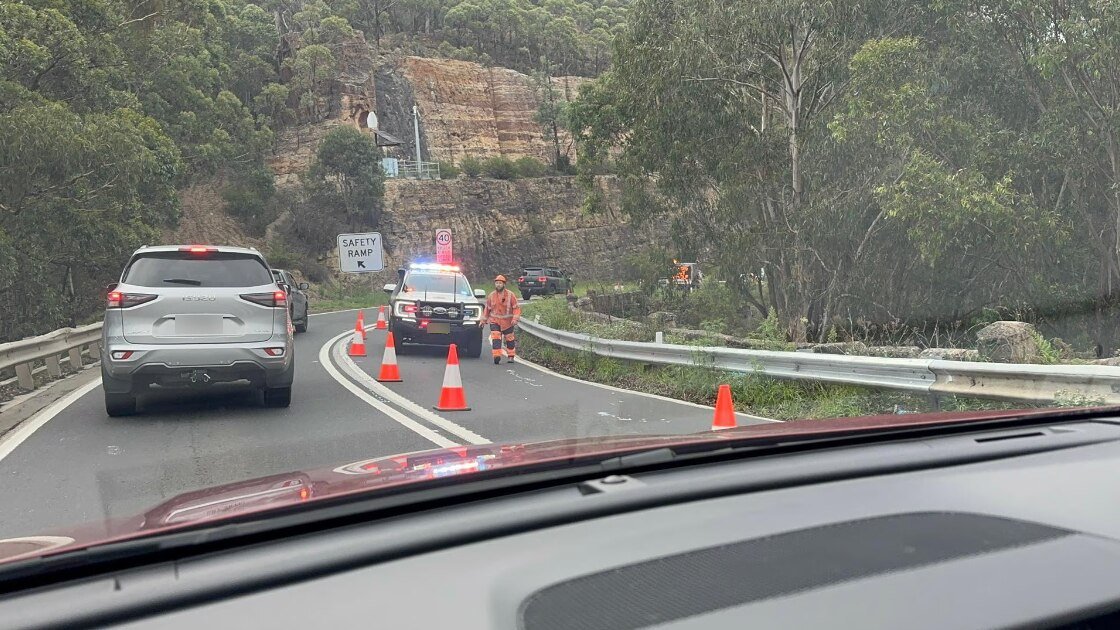
The primary road connecting Sydney with the western reaches of New South Wales has been abruptly shut down due to the discovery of cracks in a historic bridge constructed by convict labour. The Great Western Highway, a vital artery for thousands of daily commuters and heavy freight, is now closed in both directions, with no clear indication as to when it will be deemed safe for reopening. Initially, the disruption was anticipated to last for a mere four days.
Transport for NSW (TfNSW) has characterised the situation as “an evolving and complex scenario.” The initial closure on Thursday affected eastbound lanes at Victoria Pass, near Little Hartley, after damage was identified in the road surface of Mitchell’s Causeway, famously known as The Convict Bridge. However, the situation escalated significantly over the weekend. By Sunday night, westbound lanes were also closed following the identification of substantial structural issues by geotechnical assessment crews.
Bridge Under Threat: Safety First
Matt Fuller, the Deputy Secretary for Road Maintenance and Resilience, stated that assessment teams had been working tirelessly throughout the weekend to evaluate the potential risks. “We’ve identified further cracks in the pavement and our geotechnical information and monitoring has confirmed there’s movement in the road’s substructure,” he explained.
The heritage-listed structure, a testament to convict ingenuity from the 1830s, forms a crucial part of the steep and winding route. “Given those sensitivities and obviously with the overriding consideration of safety, we’ve taken the precaution to close both lanes,” Mr Fuller emphasised. He acknowledged the inevitable frustration this will cause motorists and expressed his appreciation for their patience and understanding during this challenging period.
Detours and Delays: The Ripple Effect
The closure has necessitated significant detours for motorists. Those travelling eastbound towards Sydney are being rerouted via Lithgow, utilising Chifley Road to connect with either the Bells Line of Road or the Darling Causeway. Similarly, westbound travellers are being directed along the Darling Causeway at Mount Victoria, subsequently joining the Bells Line of Road and Chifley Road.
Adding to the complexity and congestion, roadworks are currently underway on these diversion routes. This dual impact is significantly extending travel times. According to TfNSW data, the Great Western Highway between Little Hartley and Lithgow normally accommodates approximately 11,000 vehicles daily, with about 1,800 of those being heavy vehicles.
The implications for the freight industry are particularly severe. Truck drivers face considerable challenges, especially given existing restrictions on heavy vehicles passing through the main street of Lithgow.
Political Fallout and Infrastructure Debates
The repeated closures and the ongoing need to improve the road link to the state’s west have become a recurring political talking point, a long-standing issue for local communities. Paul Toole, the Shadow Minister for Regional Roads and Transport, highlighted the severe impact on commuters, reporting that journeys have been extended by one to two hours due to the diversions and ensuing congestion.
“It’s caused major confusion and chaos,” Mr Toole stated. “That impacts on productivity, it impacts on people having appointments and getting to Sydney, missing timelines they require.”
As the former State Member for Bathurst, Mr Toole has been a vocal critic of the current state government, accusing them of abandoning the NSW Nationals’ ambitious plans for an 11-kilometre Great Western Highway Tunnel. This proposed tunnel would have bypassed Victoria Pass, running beneath the land between Blackheath and Little Hartley.
“We saw the federal and state Labor governments rip $4.5 billion out of any of the upgrades or work that was required for the tunnel on that section of the road,” he asserted. While the tunnel project itself had not been formally funded or definitively costed under the previous NSW Coalition government, estimates at the time placed its potential price tag at a staggering $8 billion.
In 2023, the state Labor Party announced a pause on the project, citing that the cost had escalated dramatically to approximately $1 billion per kilometre for the tunnel. Mr Toole contends that the current government has failed to present a viable alternative, a decision he believes is proving to be a critical oversight.
“We’re not seeing any improvements. We’re continually seeing the road closed week after week,” he lamented. “We need to make sure that we have a road corridor that is fit for standard, but is also going to continue to meet the growing needs and demands of our communities.”
A New Vision for the Corridor
The state government’s recently unveiled White Paper for Sydney to the Central West outlines its strategic approach to the region’s road corridors. In this document, NSW Regional Roads and Transport Minister Jenny Aitchison described the former Coalition’s tunnel plans as a “fantasy.”
“They announced a megaproject they never properly funded, never finished planning and never intended to deliver,” she stated. “Then they walked away, leaving the Blue Mountains and Central West to deal with the consequences.”
Instead of the tunnel, the White Paper proposes a suite of alternative road upgrades, including adjustments to speed limits, initiatives to enhance road resilience, and improvements to rail services and freight efficiency. These measures aim to address the immediate and ongoing challenges faced by the communities reliant on this vital infrastructure.