
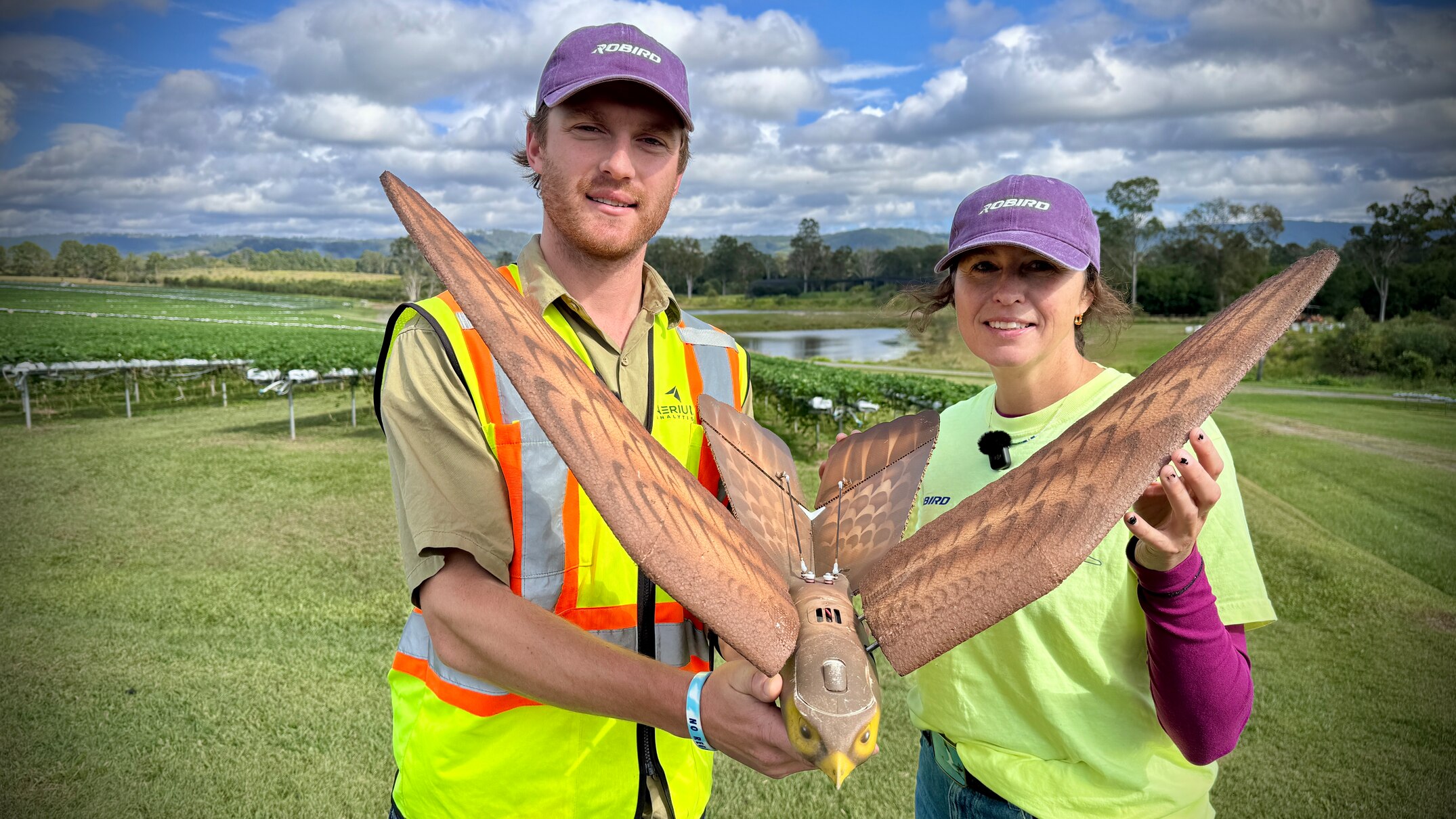
Australian strawberry farmers are pinning their hopes on a high-tech solution to combat a persistent and costly problem: ravenous rainbow lorikeets. The culprit, a drone meticulously designed to mimic the peregrine falcon, is offering a glimmer of relief to growers facing hundreds of thousands of dollars in crop losses.
This robotic raptor isn’t just any drone. It boasts the same imposing size, distinctive silhouette, and lifelike flight patterns of the world’s fastest bird. Equipped with flexible polyfoam wings, it engages in simulated hunting forays, operating in 15-minute bursts powered by rechargeable batteries. Launched with a simple overarm throw, the RoBird weighs less than a kilogram and has been engineered with a crucial objective: to protect valuable food crops without posing any threat to native wildlife.
A Targeted Approach to Pest Control
The technology operates on a principle of selective deterrence. “We’re only hazing or going after the birds that the farmers know eat the crops, in this case rainbow lorikeets and cockatoos,” explained drone pilot Harry Lagastes. He emphasised the commitment to biodiversity, adding, “All other birds … we’re not actively trying to remove them from the crop, for biodiversity.”
Queensland’s strawberry growers recently had the opportunity to witness this innovative technology firsthand. A gathering was held at TSL Family Farms, situated about an hour’s drive north-west of Brisbane. Here, farmers learned about a significant three-year joint trial involving the RoBird, a collaboration between Canadian-based AERIUM Analytics and funded by Hort Innovation’s Frontiers project.
AERIUM Analytics, a company at the forefront of this avian deterrence technology, has already seen success with both flying and fixed-wing versions of the RoBird. These robotic falcons have been deployed overseas to safeguard airports and mining sites from bird-related disruptions. The horticultural trials, which commenced last year, have been conducted in Victoria and South Australia, with an initial focus on protecting stone fruit, apples, and almonds.
Remarkable Reductions in Crop Damage
The results from these earlier trials have been nothing short of impressive. During an almond trial that spanned four and a half to five months, a direct comparison was made between a treated section of the orchard and an untreated one. “We saw an 89 per cent reduction in fruit damage, so we were obviously very excited about that,” stated Jill Viccars, Chief Growth Officer at AERIUM Analytics. Building on this success, the second year of almond operations will concentrate on scaling up the deployment of the technology.
The Devastating Impact of Lorikeets on Strawberry Farms
For TSL Family Farms co-owner Laura Wells, the prospect of hosting the RoBird’s inaugural Queensland trial was a welcome one. Her family had already made a significant shift in their farming practices, transitioning from traditional in-ground strawberry cultivation to tabletop production. This move was designed to alleviate strenuous labour, combat soil-borne diseases, reduce weed proliferation, and minimise the reliance on agricultural chemicals.
However, they could never have anticipated the new challenge that would arise: the elevation of their crops had inadvertently created an irresistible buffet for rainbow lorikeets. In the farm’s most challenging year, this avian menace resulted in staggering losses. Ms. Wells recounted the devastating impact, stating that in just a couple of weeks early in the season, they experienced “$200,000 in just a couple of weeks in early crop loss.”
The lorikeets, it seems, are not casual visitors. “They’re not a bird that just comes and has a snack, they actually annihilate entire rows of fruit,” Ms. Wells explained with evident frustration. “There’s not actually a berry left on a row where they’ve actually decided to go and eat.”
Ms. Wells further elaborated on the intensifying problem, noting that the influx of lorikeets escalates when natural nectar sources are diminished by rain. Conventional methods, such as bird scarers, gas guns, and even driving vehicles through the crops, have proven largely ineffective against these determined pests. The lorikeets have become remarkably adept at anticipating their feeding opportunities. “They actually come and settle in the night before, and then they’re here while that overcast weather is here so they know that they’re going to have a good food source.”
Over the next three years, the robotic falcon will become a familiar sight in the skies above south-east Queensland’s strawberry farms, undertaking multiple flights each day throughout the crucial growing season. “They’ve had a lot of success in other areas, and we’re hoping to see that here,” Ms. Wells expressed with cautious optimism.
The Future of Bird Deterrence: Human Operators and Scalability
For the time being, the sophisticated ornithopters require human operators to guide their missions. AERIUM Analytics has indicated that the three-year trial will be instrumental in determining the company’s future strategy, which could involve hiring out drone pilots and RoBirds or proceeding with direct unit sales to farmers.
When questioned about the economic viability of the technology, the company highlighted the urgent need expressed by the farmers they collaborate with. “They’ve all said that they’ve tried everything,” reiterated Mr. Lagastes. “So, the cost-benefit analysis certainly lies with the sometimes hundreds of thousands of dollars’ worth of crop that they’re losing.”
A National Challenge: Bird Damage to Horticulture
The economic toll of bird damage on Australia’s horticultural industry is substantial. The federal Department of Agriculture, Fisheries and Forestry has estimated that these losses amount to more than $300 million annually. This damage is not only significant but also unpredictable, varying considerably from one year to the next and from farm to farm. A wide array of over 60 bird species are identified as posing a threat to crops, including not only lorikeets and cockatoos but also ducks, corellas, and feral Indian mynas.
For Laura Wells and her fellow growers, the RoBird trial represents a beacon of hope in what has been a challenging battle. “Super excited to be honest, feeling really optimistic,” she shared. “We’re really, really hopeful that this is going to be the game changer.” The prospect of a sustainable and effective solution to a long-standing agricultural pest problem has injected a renewed sense of optimism into the Queensland strawberry farming community.


