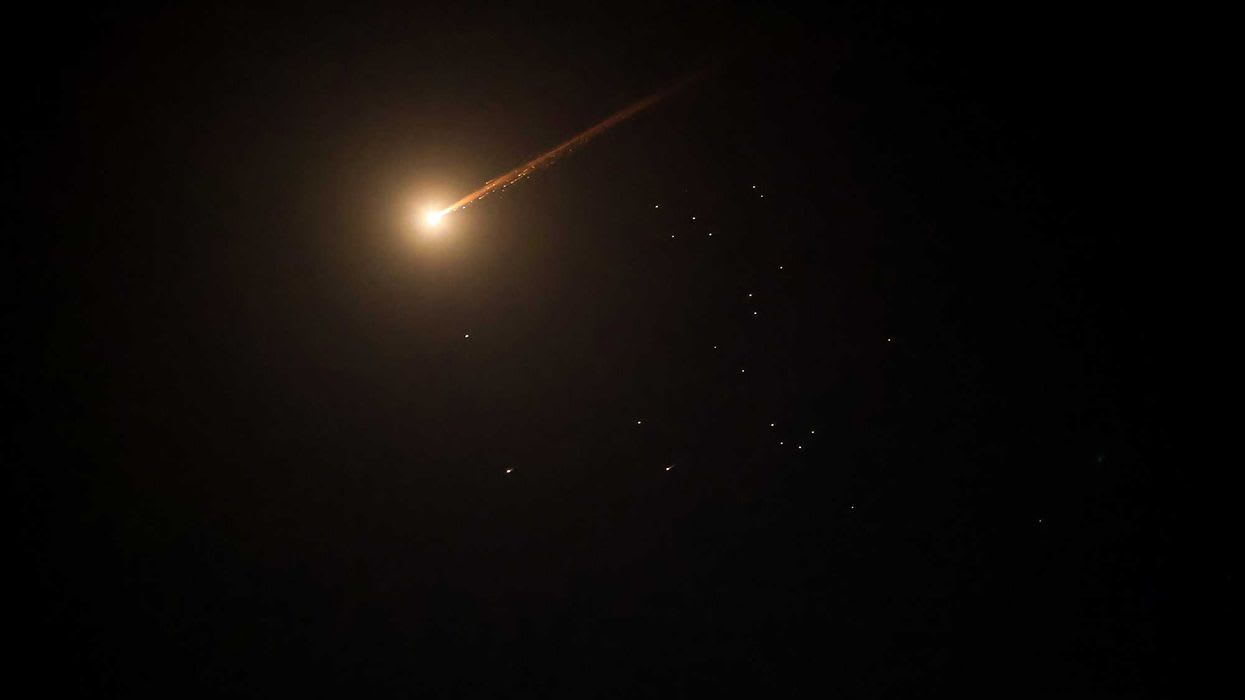
Iran launched two ballistic missiles toward Diego Garcia, a strategic U.S.-British military installation located in the Indian Ocean, marking a significant escalation that highlights the country’s missile capabilities extending far beyond what its foreign minister had previously stated. According to reports from the Wall Street Journal, the attack underscores the potential reach of Iran’s arsenal, which now appears to exceed the 2,000-kilometer limit claimed by Iranian Foreign Minister Abbas Araghchi just a month ago.
The remote island base, situated approximately 4,000 kilometers from Iran, is home to American bombers, nuclear submarines, and guided-missile destroyers. Despite the missile strikes, neither of the projectiles hit their intended target. One missile malfunctioned during its flight, while a U.S. warship launched an SM-3 interceptor at the second one. However, it remains unclear whether the interception was successful, as officials have not provided a definitive update on the outcome.
This incident has reignited discussions about Iran’s military capabilities and its strategic intentions. Iran Watch, an organization that monitors nuclear arms development, has long maintained that Iran possesses operational missiles capable of reaching distances of up to 4,000 kilometers. This suggests that the country’s missile technology may be more advanced than previously acknowledged, raising concerns among international observers.
In addition to the military implications, the attack also comes amid ongoing diplomatic tensions involving Diego Garcia. The base is part of the Chagos Archipelago, where the United Kingdom has been negotiating with Mauritius to transfer sovereignty over the wider territory while retaining control of the military installation through a long-term lease. Former U.S. President Donald Trump has expressed opposition to this arrangement, further complicating the geopolitical landscape surrounding the region.
The incident has also sparked renewed debate about the broader implications of Iran’s actions and the response from the international community. Analysts suggest that Iran may have tested the limits of U.S. and British military presence in the region, potentially signaling a shift in regional power dynamics. The situation has also drawn attention to the role of political figures such as Trump, who has faced criticism for his approach to foreign policy and national security.
Key points to consider:
- Missile Capabilities: The attack on Diego Garcia reveals that Iran’s missile range exceeds previous claims, indicating a more advanced arsenal.
- Military Response: The U.S. deployed an SM-3 interceptor, but the success of the interception remains uncertain.
- Diplomatic Tensions: The dispute over the Chagos Islands and the status of Diego Garcia continues to be a point of contention between the UK, Mauritius, and the U.S.
- Political Reactions: The incident has prompted discussions about the effectiveness of current foreign policies and the need for a coordinated international response.
As the situation unfolds, the international community will be closely monitoring how Iran’s actions influence regional stability and global security. The event serves as a reminder of the complex interplay between military strategy, diplomacy, and geopolitical interests in today’s world.