
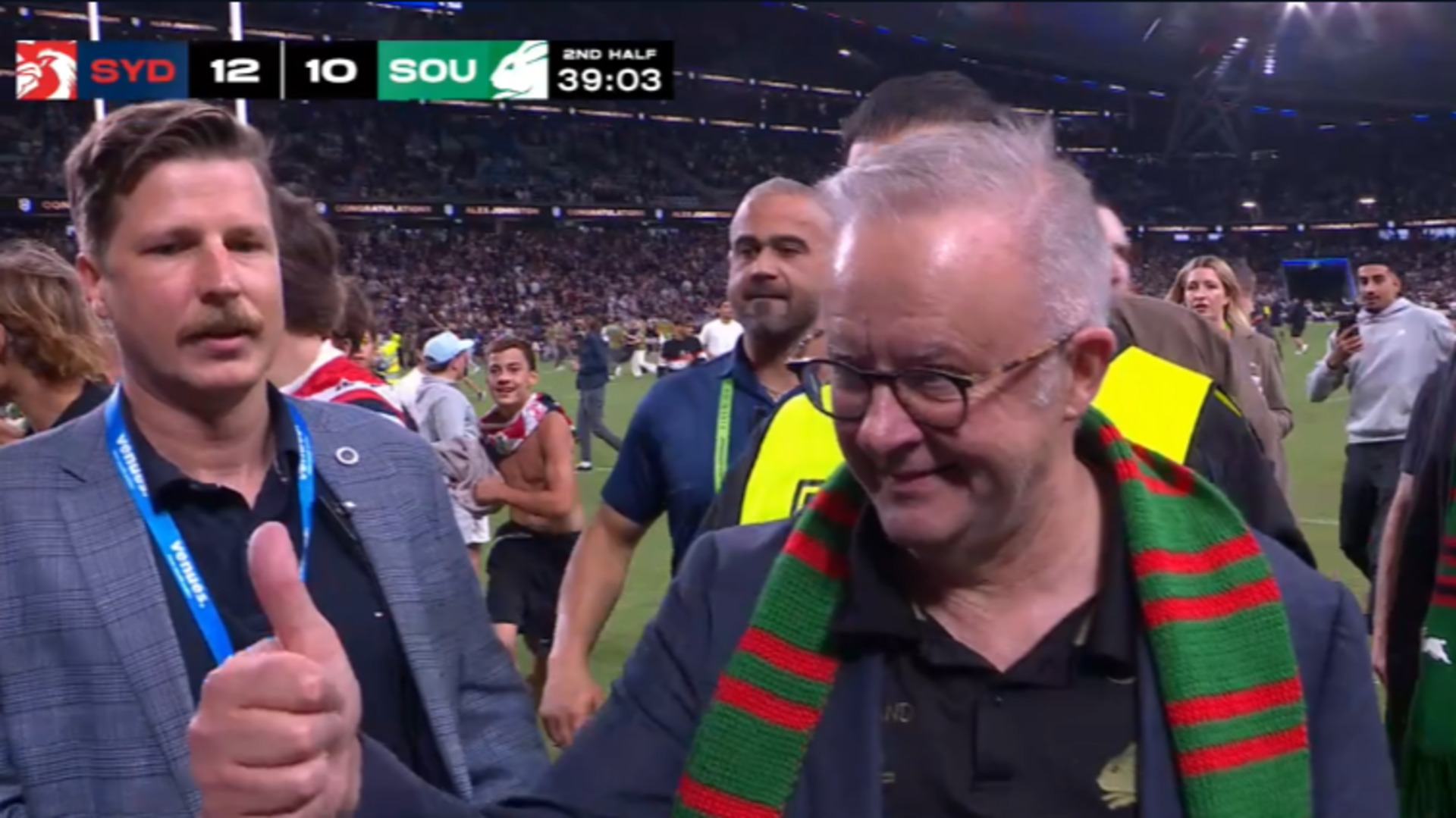
The recent spectacle of Prime Minister Anthony Albanese making an on-field appearance to celebrate Alex Johnston’s monumental try-scoring achievement in the NRL has ignited a fiery debate, with prominent media personalities weighing in on the appropriateness of the Prime Minister’s actions. Sky News host Rowan Dean was particularly vocal, expressing strong disapproval of the Prime Minister’s presence on the field, a move that also drew criticism from some NRL commentators.
Dean argued that the Prime Minister’s appearance was not merely an enthusiastic fan moment but a calculated attempt to garner public affection, a sentiment he believes the public has now recognised. “We are not being Karens,” Dean asserted, implying that the criticism was not about petty complaints but about a genuine concern regarding the Prime Minister’s priorities and actions. He linked Albanese’s presence on the field to broader economic concerns, suggesting that the Prime Minister’s focus on such displays was a distraction from pressing national issues.
“He’s desperate to be loved, this bloke. He has to be loved, and the public has figured him out,” Dean declared, characterising the Prime Minister as someone driven by a need for approval rather than by substantive policy achievements. This assessment suggests a perception that Albanese’s public persona is one of manufactured enthusiasm, a tactic that Dean believes is no longer resonating with the electorate.
The incident has highlighted a perennial tension in Australian politics: the line between a Prime Minister being a relatable figure and engaging in actions that are perceived as overly familiar or even inappropriate for the office. While some might see Albanese’s gesture as a display of genuine support for Australian sport and a popular athlete, others, like Dean, view it as a symptom of a government struggling to connect with voters on more fundamental issues like the economy, which Dean alluded to with his reference to “all the troubles that Bowen has caused us and all the troubles he has got with the economy.”
The Politics of On-Field Appearances
The act of a Prime Minister entering the sporting arena to celebrate a significant moment is not unprecedented. However, the intensity of the reaction in this instance suggests a particular political climate and a heightened level of scrutiny on the Albanese government. Critics argue that such actions can be perceived as:
- A distraction from serious issues: When the nation faces economic headwinds or other significant challenges, a Prime Minister’s presence on a football field can be seen as trivialising more pressing matters.
- A bid for popularity: As Dean suggested, these moments can be interpreted as attempts to leverage sporting achievements for political gain, an approach that can backfire if it appears inauthentic.
- Undermining the integrity of sporting events: Some believe that the field of play should remain a space for athletes and officials, and that political figures should maintain a respectful distance.
Conversely, supporters might argue that:
- It demonstrates relatability: A Prime Minister engaging with the public at popular sporting events can foster a sense of connection and show that they are in touch with the everyday lives of Australians.
- It honours achievement: Celebrating an athlete’s record-breaking performance is a way to acknowledge and promote national sporting success.
- It’s a harmless gesture: For many, the Prime Minister’s presence is simply a sign of support for a popular athlete and a beloved sport, and not a serious political manoeuvre.
Broader Economic Concerns and Public Perception
Dean’s linkage of the Prime Minister’s on-field appearance to economic troubles, specifically referencing “Bowen” (likely Treasurer Jim Chalmers or Minister for the National Disability Insurance Scheme and Government Services Bill Shorten, both prominent figures in the Albanese government often associated with economic portfolios or significant government spending), points to a deeper undercurrent of public sentiment. The Australian economy, like many globally, has been grappling with inflation, cost of living pressures, and ongoing debates about government spending and fiscal management.
When a government is perceived as struggling with these core economic responsibilities, any action that appears frivolous or like a diversion can be met with significant backlash. The accusation that Albanese is “desperate to be loved” and that “the public has figured him out” suggests a belief that voters are increasingly discerning and are looking for substance over spectacle. This sentiment could be interpreted as a warning sign for the government, indicating that its public relations efforts may be falling short of addressing genuine public anxieties.
The narrative being pushed by critics is that the Prime Minister is more concerned with projecting an image of popularity and success than with tackling the complex economic challenges facing the nation. This framing, whether entirely accurate or not, can gain traction if it resonates with a segment of the electorate feeling the pinch of economic difficulties. The incident at the NRL match, therefore, becomes a focal point for a broader critique of the government’s performance and its perceived priorities.
The Role of Media in Shaping Narratives
Commentary from figures like Rowan Dean plays a crucial role in shaping public perception. By framing the Prime Minister’s actions in a particular light – as a desperate plea for affection linked to economic mismanagement – media personalities can influence how the event is interpreted by their audience. The use of strong, evocative language like “desperate to be loved” and “figured him out” aims to create a memorable and impactful narrative.
This dynamic highlights the power of media in not only reporting events but also in constructing meaning around them. For the Albanese government, navigating such media scrutiny requires a careful balancing act: engaging with the public in relatable ways without appearing to neglect more serious responsibilities, and ensuring that symbolic gestures are not overshadowed by substantive policy concerns. The debate surrounding the Prime Minister’s field appearance is a microcosm of these broader challenges in contemporary Australian politics.


